Class 6 · Unit 1: AI and everyday life · Lesson 1.1 · 40 min
What is AI?
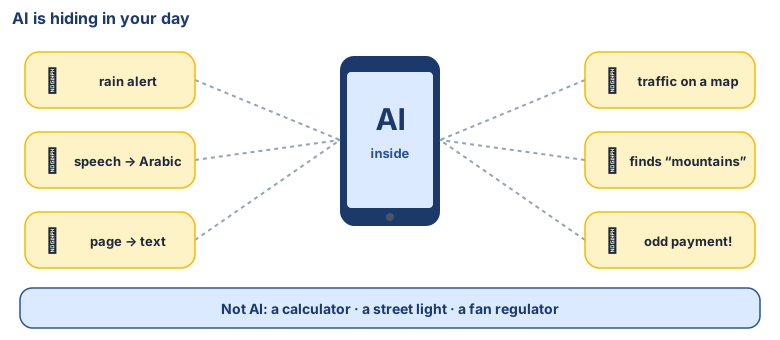
A rain alert. English turning into Arabic. A page turning into Urdu. How does the phone know all this? Someone taught it.
Today you will: Hunt for AI in things you use every day · Say what AI is in one sentence · Meet the man whose name became “algorithm”
Story
Hiba's phone buzzes. "Rain expected in Srinagar after 4 pm."
At dinner, her uncle in Dubai calls. He speaks English to his boss, and his phone turns it into Arabic. Later, Hiba's little brother Bilal holds a paper up to the phone camera, and the English words turn into Urdu.
Bilal: “How does the phone know all this?”
Hiba: “It isn't magic. Someone taught it. That is called AI.”
Today you will find out what AI is, and where it is hiding in your day.
Watch
What is AI? — — scan code 6.1.1 in the printed book.
Warm up your fingers
Skill: home row, J F and space (7 min)
- On typing.com, open Beginner → "Home Row: J, F, and Space".
- Rest your fingers on the home row. Feel the small bumps on F and J. They tell your pointing fingers where home is.
- Eyes on the screen, not your hands. Aim for accuracy first, and don't worry about speed.
On the laptop
Mission 1: The AI Hunt (pairs, 13 min)
- ☐1
Open LibreOffice Calc (it works offline). In row 1 type:
Where·What it does·AI? (Yes/No/Not sure). - ☐2
Your teacher shows eight things: a calculator, a phone keyboard suggesting the next word, a street light, a photo app finding "mountains", a fan regulator, a map showing traffic, a scanning app that turns a page into text, and a bank SMS warning about an odd payment.
- ☐3
Predict: how many of the eight are AI? Write your guess in cell E1.
- ☐4
Type one row for each. Decide together: AI or not?
- ☐5
Add three examples from your own home or school.
- ☐6
Click the
AI?column, Data → Sort. All the "Yes" rows sit together. Was your guess right? - ☐7
Save as
ai-hunt-<your roll number>.odsin your AI-work folder.
No laptop today?
Draw the three columns in your notebook. Fill in six of the examples and three of your own. Tick the ones your pair is sure about.
Now you know
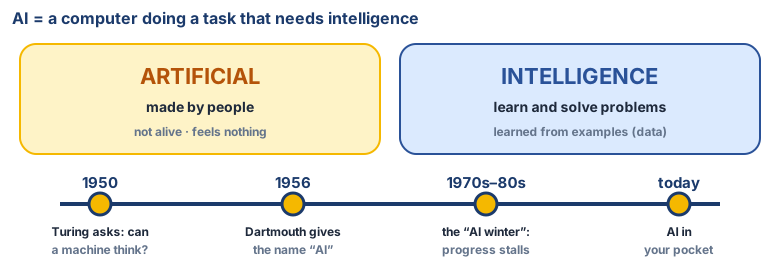
- Artificial Intelligence (AI) is a computer doing a task that usually needs human intelligence — recognising a face, understanding speech, making a choice.
- Examples teach it. AI learns from data; nobody writes it every rule.
- Algorithms are step-by-step instructions. Every computer runs on them, AI too.
- AI is everywhere: weather alerts, translation, maps, spam filters, search, scanning apps.
- AI is a tool made by people. It is not alive and feels nothing.
🕌 From our heritage
The word algorithm is somebody's name. Muḥammad ibn Mūsā al-Khwārizmī (c. 780–850 CE) came from Khwarazm and worked in Baghdad. His book on calculating with Indian numerals reached Europe in Latin as Algoritmi de numero Indorum — "Algoritmi" being his name — and the step-by-step method took his name with it. He did not invent algorithms; people had followed steps for centuries. But every time anyone says "algorithm" today, they are saying his name.
Source: al-Khwārizmī's arithmetic, surviving in Latin as Algoritmi de numero Indorum*. His other book,* al-Jabr wa'l-Muqābala*, gave us the word "algebra".*
Debate it
Bilal's phone translated his grandmother's Kashmiri voice message wrongly, and he laughed at what it said.
Whose fault is a wrong translation: the phone's, the people who built it, or Bilal's for trusting it? Talk to your partner and give one reason.
Check yourself — practice, not a test
1. AI stands for Artificial ______.
2. Which of these use AI? (choose all that apply)
- ○ A photo app that finds all your pictures of mountains
- ○ A calculator adding 25 + 17
- ○ A map that finds the fastest road around a traffic jam
- ○ A light switch
3. AI is a living thing that can feel happy or sad.
- ○ True
- ○ False
4. How does AI mostly learn?
- ○ By reading one rule book
- ○ From lots of examples (data)
- ○ It is born knowing everything
- ○ From electricity
5. The word "algorithm" comes from:
- ○ A Greek machine
- ○ The name of the scholar al-Khwārizmī
- ○ A computer company
- ○ The Latin word for "answer"
6. Put these in the order they happened:
- 1. The name "Artificial Intelligence" is given at Dartmouth (1956)
- 2. The "AI winter", when progress slowed
- 3. AI in everyone's pocket
- 4. Turing asks whether a machine can think (1950)
Remember
AI is a computer doing tasks that need intelligence, learned from examples.