Class 6 · Unit 1: AI and everyday life · Lesson 1.3 · 40 min
Human vs. machine intelligence
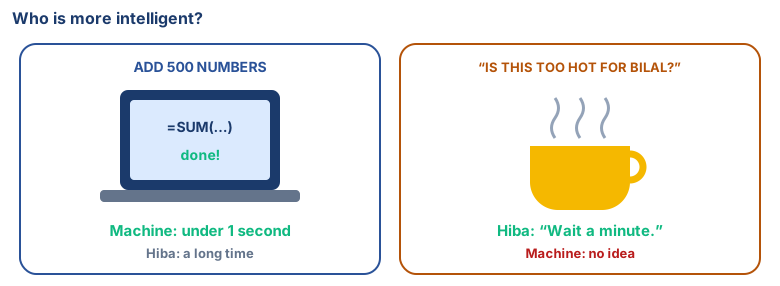
A computer adds 500 numbers in under a second. Then Grandmother asks: “Is this kahwa too hot for Bilal?” The computer has no idea.
Today you will: Race a spreadsheet — and lose · Find what a machine misses in a sentence · List what humans and machines each do best
Story
Hiba and a computer have a race: who can add 500 numbers fastest? The computer wins in less than a second.
Then Hiba's grandmother puts a cup of kahwa on the table and asks: "Is this too hot for Bilal?" Hiba looks at the steam, remembers Bilal burned his tongue last week, and says "Wait a minute." The computer has no idea what "too hot for Bilal" means.
So who is more intelligent: Hiba or the computer?
Watch
Human vs. machine intelligence — — scan code 6.1.3 in the printed book.
Warm up your fingers
Skill: home row, S and L (7 min)
- On typing.com, open Beginner → "Home Row: S and L".
- Ring fingers rest on S and L. Keep your wrists off the desk.
- Try the lesson twice. Compare your accuracy between the two tries. This is your own record, not a race with anyone else.
On the laptop
Mission 1: The Speed Test (pairs, 6 min)
- ☐1
Open
speed-test.odsfrom the class folder. Column A has 200 numbers. - ☐2
Human round: one partner adds the first 10 numbers in their head; the other times it on the laptop clock.
- ☐3
Predict: how long will the laptop take for all 200? Then click B1, type
=SUM(A1:A200), press Enter.
Mission 2: The Meaning Test (pairs, 7 min)
- ☐4
Open
meaning-test.ods: 6 sentences like "I'm fine," said Bilal, with tears in his eyes. - ☐5
Your teacher runs them through a word counter on the projector. It counts the words — but can it tell Bilal is not fine?
- ☐6
In a new sheet make two columns, Machines are better at and Humans are better at. Type at least 4 in each.
No laptop today?
Do the human round on paper with 10 numbers. Read the 6 sentences aloud: what would a machine miss? Make the two lists in your notebook.
Now you know
- Intelligence is the ability to learn, understand and solve problems.
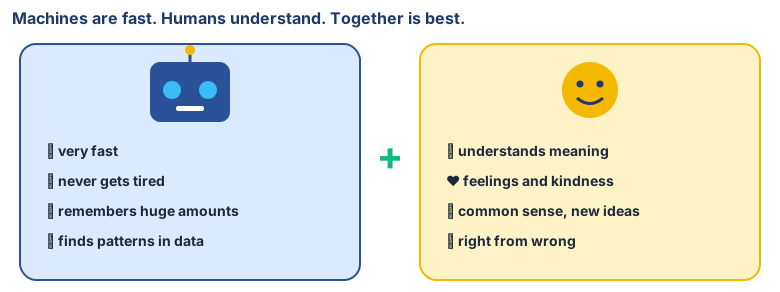
- Machines are fast, never tired, remember huge amounts, and find patterns in data.
- Humans understand meaning and feelings, use common sense, invent new ideas, and know right from wrong.
- AI doesn't understand the way we do. It finds patterns without knowing what they mean.
- Together is best with people making the important decisions.
- Many kinds of smart: understanding people (interpersonal), knowing yourself (intrapersonal), reading nature (naturalistic), numbers and reasoning (logical). Machines manage a narrow slice of the last one.
- The Turing Test (1950): Alan Turing said a machine "passes" if a person typing to it can't tell it from a human. Passing means sounding human — not understanding. Remember the kahwa.
Debate it
A hospital uses AI to look at X-ray pictures. It is very fast and usually correct.
Should the AI tell the patient the result, or should a doctor check it first? Why?
Check yourself — practice, not a test
1. Which task is a machine usually better at?
- ○ Comforting a sad friend
- ○ Adding thousands of numbers in a second
- ○ Knowing if a joke will hurt someone
- ○ Deciding what is fair
2. Which are human strengths? (choose all)
- ○ Common sense
- ○ Understanding feelings
- ○ Never getting tired
- ○ Knowing right from wrong
3. AI understands the meaning of words exactly as people do.
- ○ True
- ○ False
4. The best results come when humans and AI work ______.
5. Who suggested the test in which a person must guess whether they are typing to a human or a machine?
- ○ John McCarthy
- ○ Alan Turing
- ○ Al-Khwārizmī
- ○ Ada Lovelace
6. Intelligence is the ability to learn, understand and ______ problems.
7. A machine that passes the Turing Test has proved that it understands what it is saying.
- ○ True
- ○ False
Remember
Machines are fast. Humans understand. Together is best.