Class 6 · Unit 3: Patterns and decisions · Lesson 3.1 · 40 min
Patterns in my week
It's Sunday. Irfan knows the chai will be late — and he never looked at a clock. How?
Today you will: Put your own week into a spreadsheet · Colour the things that repeat · Guess what next Monday looks like
Story
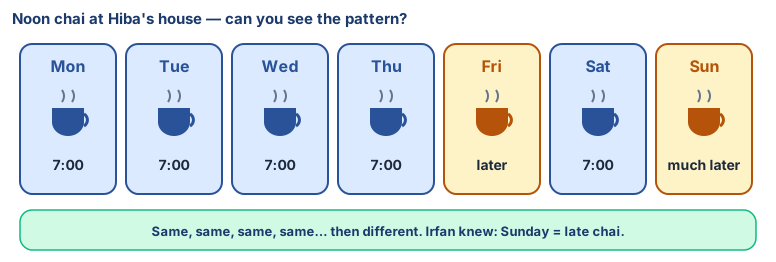
Every morning, Hiba's mother puts the noon chai on the stove at 7 o'clock. On Friday it is a little later. On Sunday, much later.
One day Hiba's little brother Irfan wakes up and says, "It's Sunday. No school. Chai will be late." He is right, and he did not look at a clock.
How did Irfan know? He noticed a pattern: something that happens again and again in the same way. Machines that learn do the same thing, only with far more data.
Watch
Patterns hiding in your week — — scan code 6.3.1 in the printed book.
Warm up your fingers
Today's lesson has a lot of typing into cells, so warm up the home row.
- On typing.com: Beginner → Home Row lessons (J, F, space).
- Goal: fingers stay on A S D F and J K L ;. Feel the bumps on F and J.
- Try to be accurate, not fast. Speed comes later.
On the laptop
Tools: LibreOffice Calc (free, offline, no account)
Mission 1: Build your week (alone or pairs, 8 min)
- ☐1
Open LibreOffice Calc. Save the file as
my-week.odsin your AI-work folder. No name on it. - ☐2
In row 1, type one heading per cell:
Day·Woke up·Left for school·Subject I liked most·Played outside? (Y/N)·Slept at - ☐3
Type
Mondayin A2, then drag the small square at the cell's corner down. Calc fills in the rest of the week by itself. That's a pattern the computer knows! - ☐4
Fill in each row for last week, as well as you remember. Use times like
7:00. Make row 1 bold (Ctrl + B).
Mission 2: Be a pattern detective (pairs, 8 min)
- ☐5
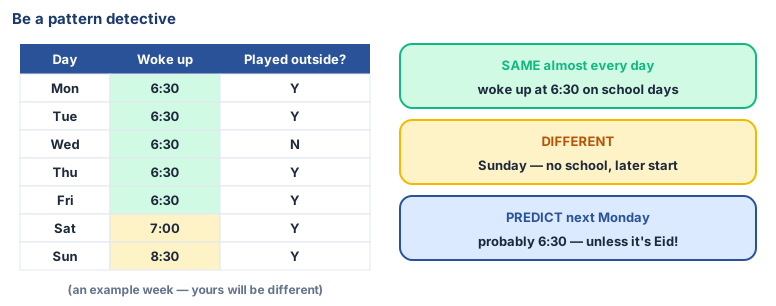
Predict: which thing will be the same almost every day? Write your guess next to the table.
- ☐6
Now look. Beside your table, answer: Which day is different? What is the same almost every day? What will you probably do next Monday?
- ☐7
Colour the pattern: select the cells that repeat and give them one fill colour.
- ☐8
Swap laptops with a partner. Can they spot a pattern you missed?
No laptop today?
Draw the same table in your notebook with a ruler. Colour the repeating cells with a pencil. Swap notebooks and find your partner's patterns.
Now you know
- A pattern is something that repeats in a way we can notice.
- Patterns help us predict: "It's Sunday, so school is closed."
- A spreadsheet keeps data in rows and columns, so patterns are easier to see.
- AI finds patterns in data like your table, but with thousands of rows.
- A pattern is a good guess, not a promise. A holiday can break your Monday pattern.
Debate it
Your phone could learn your week the way you just did: when you wake, when you leave home, where you go.
Is that helpful, or is it too much? Who should decide what the phone learns about you?
Check yourself — practice, not a test
1. What is a pattern?
- ○ A single thing that happened once
- ○ Something that repeats in a way we can notice
- ○ A kind of drawing
- ○ A mistake in data
2. A pattern always tells us exactly what will happen next.
- ○ True
- ○ False
3. In a spreadsheet, data is kept in rows and ______.
4. Which of these are patterns? (choose all that fit)
- ○ School starts at the same time every weekday
- ○ The Friday market opens every week
- ○ A cat crossed the road once on Tuesday
- ○ Snow falls in winter
Remember
A pattern repeats, and a pattern helps us guess what comes next.