Class 6 · Unit 3: Patterns and decisions · Lesson 3.3 · 40 min
Making predictions
Hiba guesses the mid-day meal right, two days running. "Are you magic?" No — she noticed the menu repeats.
Today you will: Predict next year's weather from the pattern · Check how far off you were · Watch a machine guess your drawing
Story
Hiba's class has a game. Every morning, one child guesses what the lunch will be in the school mid-day meal.
On Monday, Hiba guesses rice and rajma. She is right. On Tuesday, she guesses rice and dal. Right again.
Friend: “Are you magic?”
Hiba: “No. I noticed the menu repeats every week.”
That is a prediction: a guess that uses a pattern.
Watch
How a computer guesses your drawing — — scan code 6.3.3 in the printed book.
Warm up your fingers
- On typing.com: continue Beginner → Home Row, or the next lesson your teacher gives you.
- Today's goal: accuracy above 90%. If you make a mistake, slow down.
On the laptop
Tools: LibreOffice Calc · your srinagar-weather.ods · Quick, Draw! in the browser (no account)
Mission 1: Predict and check (alone or pairs, 12 min)
- ☐1
Open
srinagar-weather.odsfrom last lesson. - ☐2
Predict: in a new column
My guess for next year (High), type a guess for every month. Use the pattern, not luck. - ☐3
Your teacher reads out the real highs from a recent year. Type them in a new column
Real (High). - ☐4
Next column
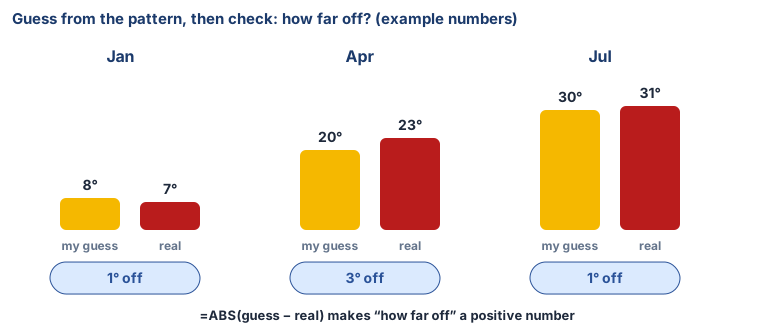
Difference: type=ABS(D2-E2)and drag it down.ABSshows how far off you were. - ☐5
Which months did you predict best? Which were hardest?
Mission 2: A machine that predicts (pairs, 8 min)
- ☐6
Go to quickdraw.withgoogle.com and click Let's Draw! While you draw, the computer says its guesses out loud.
- ☐7
After the game, click one drawing to see what other people drew — the data the machine learned from.
- ☐8
Write down one drawing it guessed quickly and one it got wrong. Why was it wrong?
Finished early?
Predict like al-Kindī. In a new sheet, type a sentence your teacher gives you, one
letter per cell down column A. In C1 type e, and beside it =COUNTIF(A:A;C1). Try a and t too.
Which letter is commonest? In English it's usually e — enough to start breaking a secret message.
No laptop today?
Part 1: make your guesses in your notebook; your teacher writes the real numbers on the board. Part 2: play Guess my drawing in pairs — one draws slowly, the other guesses after every line. Notice how you guess from the first few lines. That's prediction from a pattern.
Now you know
- A prediction is a guess that uses a pattern from earlier data.
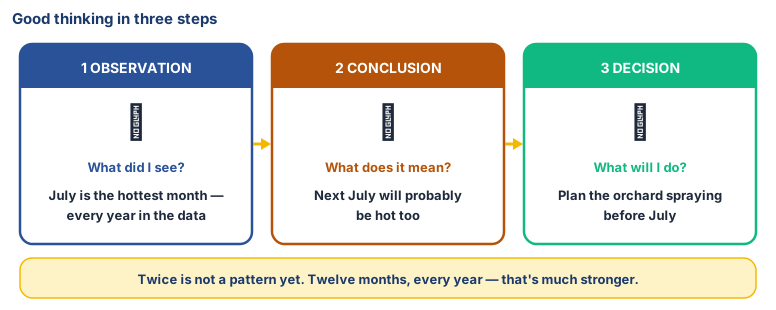
- Three steps of good thinking: observation (what did I see?) → conclusion (what does it mean?) → decision (what will I do?).
- Know the limits. "Rice on Monday, twice" isn't a pattern yet; twelve months of temperatures is much stronger.
- A good prediction is close , but rarely exact. We check it against what really happened.
- Quick, Draw! predicts because it learned from millions of drawings by people around the world.
🕌 From our heritage
Around 850 CE, the scholar al-Kindī, working in Baghdad, wrote down how to read a secret message without the key: count how often each letter appears. The commonest letter in the code is probably the commonest letter in the language. This is the oldest surviving description of the method, and it is prediction from a pattern in data — the same idea behind the machine guessing your drawing.
Al-Kindī, Risāla fī Istikhrāj al-Muʿammā (On Decrypting Encrypted Messages), c. 850 CE.
Debate it
Quick, Draw! learned from drawings from all over the world. Suppose most people who drew "house" drew a sloping roof, like homes in Kashmir, and nobody drew a flat roof.
Would the machine recognise a flat-roofed house? What does that tell you about the data a machine learns from?
Check yourself — practice, not a test
1. What makes a guess a prediction?
- ○ It is always right
- ○ It uses a pattern from earlier data
- ○ It is made by a computer
- ○ It is made very quickly
2. Quick, Draw! can guess drawings because it learned from many drawings made by people.
- ○ True
- ○ False
3. How do we find out whether a prediction was good?
- ○ Ask a friend if they like it
- ○ Make it again, louder
- ○ Compare it with what really happened
- ○ Delete it
4. Which of these usually make a machine's predictions better? (choose all that fit)
- ○ More data
- ○ Data from many different kinds of examples
- ○ A bigger screen
- ○ Asking it to guess faster
5. "Every day this week, the bus came late." → "The bus is usually late." → "I will leave home ten minutes earlier." Match each part to its name:
What I saw · What it means · What I will do
Match with: conclusion · decision · observation
Remember
A prediction is a guess from a pattern. We check it against what really happens.