Class 6 · Unit 3: Patterns and decisions · Lesson 3.5 · 40 min
When patterns mislead
Irfan wore his green cap and his team won. Twice! "It's my lucky cap." Then week three happened.
Today you will: Flip a coin 100 times in one second · Hunt for streaks in random data · Catch three ways a pattern can fool you
Story
Irfan wore his green cap on the day his cricket team won. The next week he wore it again, and they won again!
Irfan: “It's my lucky cap. Every time I wear it, we win.” (to everyone.)
The third week he wears the cap, and his team loses badly.
Was the cap ever lucky? Irfan saw a pattern that wasn't real. People do this, and so do machines.
Watch
Patterns that fool us — — scan code 6.3.5 in the printed book.
Warm up your fingers
- On typing.com: your current Beginner lesson.
- Mini-challenge: type
heads tails heads tailsfive times with no mistakes.
On the laptop
Tools: LibreOffice Calc (offline) — or Scratch Desktop, see the Finished early? box
Mission 1: 100 coin flips (alone or pairs, 8 min)
- ☐1
Open a new Calc file. Save it as
coin-flips.ods. In A1 typeFlip, in B1Result. - ☐2
Type
1in A2 and drag down to A101 — flips 1 to 100. - ☐3
In B2 type exactly
=IF(RAND()<0.5;"Heads";"Tails"), press Enter, and drag it down to B101. (If your Calc uses commas, type,instead of;.) - ☐4
You just flipped a coin 100 times! Press F9 — all 100 flips change.
Mission 2: Test the patterns (pairs, 8 min)
- ☐5
Predict: out of 100 flips, how many heads? Write your guess.
- ☐6
In D1 type
Heads count, and in E1=COUNTIF(B2:B101;"Heads"). Press F9 ten times and write down each count. Is it always exactly 50? - ☐7
Hunt for streaks: find 4 or 5 of the same in a row. After a streak of Heads, is the next flip more likely to be Tails? Check a few.
- ☐8
Too little data: look only at flips 1–4. What "pattern" would you have guessed? Now look at all 100.
Finished early?
Scratch version: use pick random 1 to 2, say "Heads" if 1 and "Tails" if 2,
and repeat 20 times with a tally variable.
No laptop today?
Everyone flips a real coin (or a stone with a chalk mark) 20 times and writes down H or T. Put the whole class's results on the board. Look for streaks, and for how close the total is to half.
Now you know
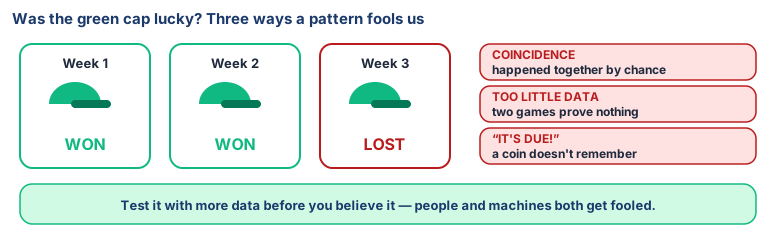
- Coincidence: two things can happen together by chance. The cap didn't cause the win.
- Too little data: a pattern from 2 or 3 examples is often wrong. More data shows the truth.
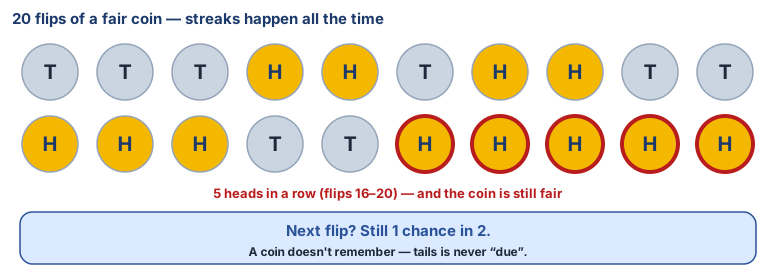
- "It's due" is a mistake: a fair coin doesn't remember. After 5 heads, tails is still 1 chance in 2.
- Streaks are normal in random events. They don't mean something special is happening.
- Humans must check: AI learns false patterns too, if its data is small, one-sided or accidental.
🕌 From our heritage
Ibn al-Haytham (965–1040) refused to believe a claim simply because a famous scholar had made it. He tested light and vision by experiment, and showed that the old Greek explanation of how we see was wrong. He wrote that a seeker after truth should become a hostile critic of everything they study, and follow the proof. That is what you did today: you did not trust "the cap is lucky", you tested it.
Ibn al-Haytham, Kitāb al-Manāẓir (The Book of Optics), c. 1021 CE.
Debate it
An app notices that children who use it at night get lower marks, and says, "Using the app at night makes you do worse."
Could there be another reason? What would you want to know before believing the app?
Check yourself — practice, not a test
1. Irfan's team won twice when he wore his cap. What is the best explanation?
- ○ The cap is lucky
- ○ It was a coincidence, and two games is too little data
- ○ The cap makes players stronger
- ○ The other team was scared of green
2. After a coin lands on Heads 5 times in a row, Tails is more likely on the next flip.
- ○ True
- ○ False
3. Which of these can make a pattern misleading? (choose all that fit)
- ○ Too little data
- ○ Coincidence
- ○ Data about only one kind of example
- ○ Checking the pattern against new data
4. What should people do when an AI finds a surprising pattern?
- ○ Trust it, because computers are never wrong
- ○ Ignore all AI
- ○ Check it with more data and ask whether something else could explain it
- ○ Share it quickly with everyone
Remember
Not every pattern is real. Check with more data before you believe it.