Class 6 · Unit 4: Ethics and digital responsibility · Lesson 4.2 · 40 min
Privacy — my data, my choice
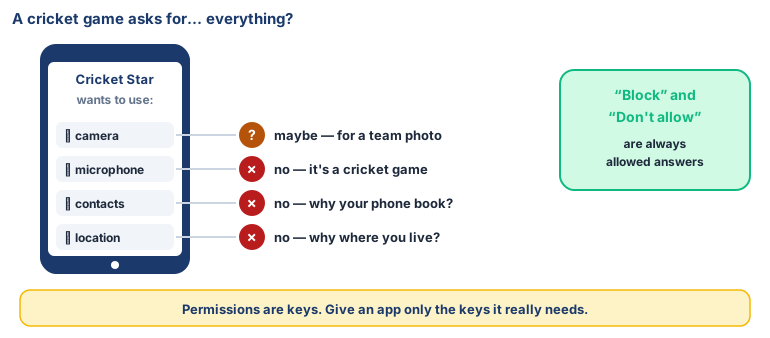
"Allow this cricket game to use your camera, microphone, contacts and location?" "Just press yes." Wait — why does a cricket game need your phone book?
Today you will: Spot personal data — even when it hides · Check what a site is allowed to use · Say no to permissions an app doesn't need
Story
A new game arrives on Hiba's cousin's phone. Before it opens, a box pops up:
Hiba: “Allow this game to use your camera, microphone, contacts and location?”
Cousin: “Just press yes. It won't work otherwise.”
Hiba frowns. "Why does a cricket game need to know who is in your phone book? And where you live?"
Her cousin stops, with a finger over the button.
Today you will learn what personal data is, and why you get to decide who has it.
Watch
Your data belongs to you — — scan code 6.4.2 in the printed book.
Warm up your fingers
Skill: top row, R and U (7 min)
- On typing.com, open Beginner → "Top Row: R and U".
- Your pointing fingers do the work: left finger to R, right finger to U.
- Try the whole lesson without looking down once.
On the laptop
Tools: a web browser · the laptop's Settings · a new text document
Mission 1: Is this personal? (pairs, 4 min)
- ☐1
New document, title "Is this personal data?"
- ☐2
Mark each P (personal) or N (not): my name · the colour blue · my photo · the capital of India · my voice recording · my school + class + roll number · today's weather · my home address. Predict first: which one will surprise you?
Mission 2: The permission inspector (pairs, 11 min)
- ☐3
Visit a map website. When it asks "Allow this site to know your location?", press Block (or Don't allow).
- ☐4
Click the padlock or settings icon. What are Location, Camera and Microphone set to?
- ☐5
Open Settings → Privacy (Windows: Privacy & security). Which apps may use the Camera and Location? Write down two. Look — don't change anything.
- ☐6
Scroll to the bottom of the website and open Privacy Policy — where a site must say what it collects and why. Copy one line. Was it easy to understand?
- ☐7
Finish: "This app needs my ___ because ___" or "This app does NOT need my ___."
Rule for today: we look and switch things off — never on for a site we don't know.
No laptop today?
Draw a phone screen with a permission pop-up for a pretend Apple Orchard Game asking for six things. Cross out the ones a farming game doesn't need, with a reason beside each.
Now you know
- Personal data tells someone who you are — name, photo, voice, address, location, school.
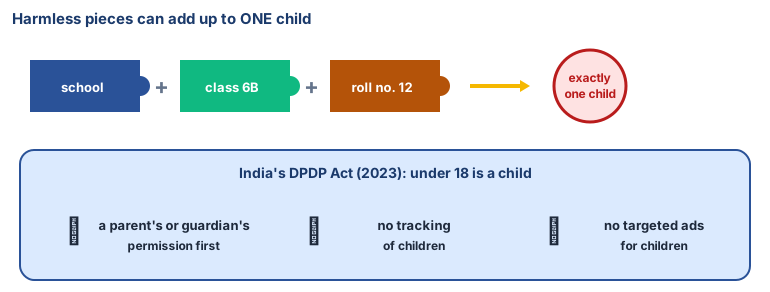
- Combined data can be personal even when each piece isn't: school + class + roll number points to one child.
- India's DPDP Act (2023): under 18 is a child. Apps need a parent's or guardian's permission and must not track children or show them targeted ads.
- A privacy policy says what a site collects and why — usually linked at the bottom.
- Permissions are keys. Give an app only what it needs.
- "Block" and "Don't allow" are always allowed answers.
🕌 From our heritage
The Qur'ān teaches that you do not walk into someone's home without asking: "O believers! Do not enter any house other than your own until you have asked for permission and greeted its occupants" (An-Nur 24:27). A phone is a house too, and so is an account. Reading someone's messages, or passing on their photo without asking, is walking in without knocking. Permission first — that is what the DPDP Act asks of companies, and what good manners ask of us.
Source: Qur'ān 24:27–28, translation by Dr. Mustafa Khattab, The Clear Quran.
Debate it
A school wants to use an AI camera at the gate that recognises every student's face, so that attendance happens by itself.
What is good about this idea? What could go wrong? Who should be asked first?
Check yourself — practice, not a test
1. Which of these are personal data? (choose all that apply)
- ○ Your photo
- ○ The number of days in a week
- ○ Your home address
- ○ Your voice recording
2. Under India's DPDP Act, an app must get a parent's or guardian's permission before using the personal data of a 12-year-old.
- ○ True
- ○ False
3. A torch (flashlight) app asks for your contacts. What should you do?
- ○ Allow it, because all apps need contacts
- ○ Say no, because a torch doesn't need your contacts
- ○ Give it your password instead
- ○ Share it with friends first
4. Under the DPDP Act, anyone under the age of ______ is a child.
5. The page where a website says what it collects about you and why is called its ______ policy.
Remember
Your data is part of you. Give an app only the keys it really needs.