Class 6 · Unit 4: Ethics and digital responsibility · Lesson 4.6 · 40 min
Copying, cheating and creators' rights
Monday: a copied project. Wednesday: a "free" program full of malware. Friday: Hiba's own kani drawing on someone else's page, marked "My design".
Today you will: Write a credit line for a source · Tell honest quoting from plagiarism · Match copyright, trademark, patent and GI
Story
Three things happen in one week.
Monday. Bilal hands in a beautiful project on the chinar tree. His teacher reads it, then turns the page round. "This is very good English, Bilal. Where is it from?" Bilal had copied it, word for word, from a website.
Wednesday. His cousin downloads a "free full version" of an expensive drawing program from a site he found. By Thursday the laptop is crawling, and strange windows keep opening.
Friday. Hiba finds her own drawing of a kani border on someone else's page. Underneath it says: "My design."
Hiba: “Three different things. Or is it one thing three times?”
Today you will learn how to use other people's work honestly — and what is yours.
Watch
Whose work is it? — — scan code 6.4.6 in the printed book.
Warm up your fingers
Skill: punctuation — quotation marks, comma and full stop (6 min)
- On typing.com, open the punctuation lesson for quotation marks and the comma .
- The quotation mark needs Shift and the right little finger. Practise opening and
closing a quote:
"like this". - You will use these keys in today's activity. Quoting honestly is partly a typing skill.
On the laptop
Tools: LibreOffice Writer · chinar-facts.odt (class folder) · the teacher's image folder, or
Wikimedia Commons
Mission 1: Say where it came from (alone, 12 min)
- ☐1
Open
chinar-facts.odtand read it twice. - ☐2
Close the file. This matters — you can't copy what you can't see.
- ☐3
In a new document, write three sentences in your own words about the chinar.
- ☐4
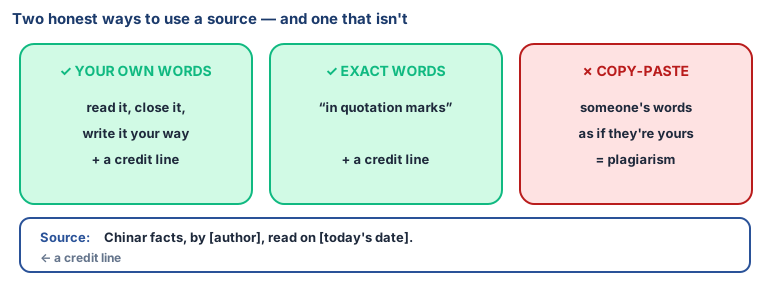
Add a credit line: Source: Chinar facts, by [author], read on [today's date].
- ☐5
The other honest way: open the file again, copy one sentence exactly, put it in "quotation marks", and add the same credit.
- ☐6
Compare with a partner. Both are honest. What would make them dishonest? One sentence.
Mission 2: Whose picture is it? (pairs, 6 min)
- ☐7
Predict: will most pictures online be free to use, or not?
- ☐8
Pick one picture of Kashmir from the folder or Wikimedia Commons. Find its licence — what the owner allows and the credit you must give — and copy the credit under it.
- ☐9
"All rights reserved", or no licence at all? You may not use it. Find another.
Teacher demo (projector): the spam folder. The teacher opens their spam folder. The filter learned from thousands of messages people marked as spam — the supervised learning from Unit 1, Lesson 5.
No laptop today?
Read a printed fact sheet, turn it over, write three sentences in your own words and a credit line. Swap: underline any phrase copied straight from the sheet. Then match copyright · trademark · patent · GI mark to a song · a shop's logo · a new apple-picking tool · Kashmir Pashmina.
Now you know
- Plagiarism is using someone's words, pictures or ideas and letting people think they're yours. Changing a few words doesn't fix it.
- Two honest ways: your own words + a credit, or exact words in "quotation marks" + a credit.
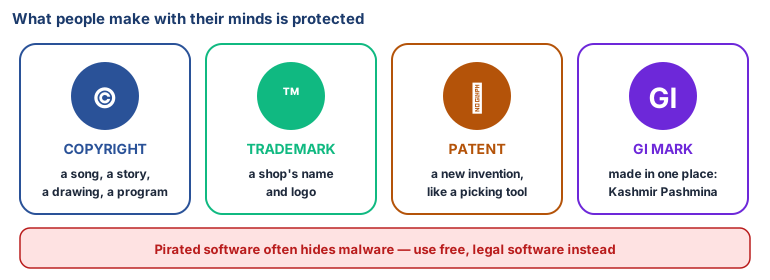
- Intellectual property is what people make with their minds: copyright for writing, music, drawings, photos and programs; trademark for a business's name and logo; patent for a new invention; GI mark for a product truly from one place, like Kashmir Pashmina.
- Software piracy is copying paid software without paying. Pirated files often carry malware — use free, legal software like LibreOffice.
- Spam and hacking both take what isn't yours: spam takes attention, hacking takes access.
🕌 From our heritage
Our scholars built an entire science out of saying where something came from. A report was not accepted because it sounded right: the isnād — the chain of who heard it from whom — had to be named, and each narrator's memory and honesty examined. You met this in Unit 2, Lesson 5, as the question every data scientist asks: where did this come from, and can I trust the chain? Scholars carried the chain with the sentence, for centuries, rather than passing words off as their own. The credit line at the end of your paragraph is that same habit, in a school notebook.
Sources: the method of the great hadith collectors, among them Imam al-Bukhārī (d. 870 CE) and Imam Muslim (d. 875 CE).
Debate it
A shop near the Dal sells shawls labelled "Pure Kashmiri Pashmina". They are machine-made, from artificial wool, in another state.
Who is harmed by that label — the buyer, the Kashmiri artisan, or both? Would you call it stealing? What exactly is being stolen?
Check yourself — practice, not a test
1. What is plagiarism?
- ○ Reading a website for your project
- ○ Using someone's words or ideas and letting people think they are yours
- ○ Writing a project in your own words
- ○ Quoting a sentence and saying where it came from
2. If you change a few words, copying someone's paragraph is no longer plagiarism.
- ○ True
- ○ False
3. Match each protection to what it covers:
Copyright · Trademark · Patent · GI mark
Match with: A product that genuinely comes from one place, like Kashmir Pashmina · A business's name and logo · A new invention · A song, a drawing or a computer program4. Why is downloading a "free full version" of paid software a bad idea? (choose all that apply)
- ○ The people who made it are not paid
- ○ The file often carries malware
- ○ It makes the laptop screen bigger
- ○ It is against the law
5. Unwanted messages sent in bulk to many people are called ______.
Remember
Somebody made this. Say who.