Class 6 · Unit 5: Computational thinking · Lesson 5.1 · 40 min
Big jobs, small tasks
Plantation Day! "Easy — we just plant the trees." Then: who brings the saplings? Who digs? Who fetches water? What if it rains?
Today you will: Break a big job into small tasks · Find which tasks must wait for others · Build a checklist that turns green
Story
Our school is holding a Plantation Day next month. Every class will plant a chinar sapling near the playground.
Principal sahib asks Class 6 to plan it. Umar says, "Easy! We just plant the trees."
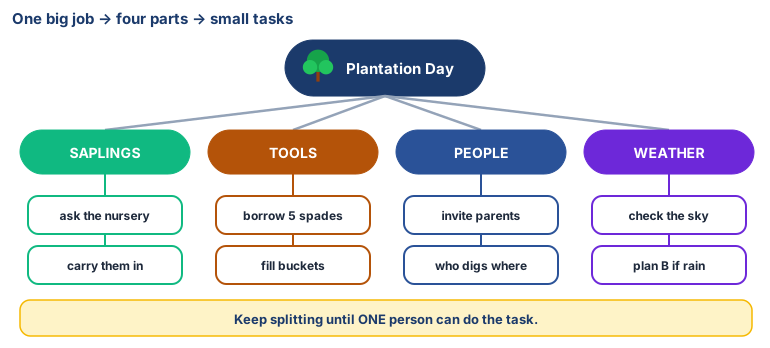
Mehak shakes her head. "Who brings the saplings? Where do we dig? Who gets the water? Who invites the parents? What if it rains?"
Suddenly the easy job looks enormous. How do we plan something this big without forgetting anything?
Watch
Decomposition: eating an elephant one bite at a time — scan code 6.5.1 in the printed book.
Warm up your fingers
Practise the home row and the number row. Today you will type dates and quantities.
- typing.com: Beginner → Number row lessons
- Goal for today: type the numbers 1 to 10 with no mistakes and without looking.
On the laptop
You need: LibreOffice Calc (free, offline)
Mission 1: List the tasks (groups of 3–4, 8 min)
- ☐1
Open Calc. In row 1 type:
Task·Part·Who·Needs first·Done? - ☐2
Predict: how many small tasks will your group find? Write your guess on paper.
- ☐3
List at least 12 small tasks, one per row — ask the nursery for 10 saplings, borrow 5 spades, mark the digging spots…
Mission 2: Group and order them (groups, 7 min)
- ☐4
In Part, write
Saplings,Tools,PeopleorWeather. - ☐5
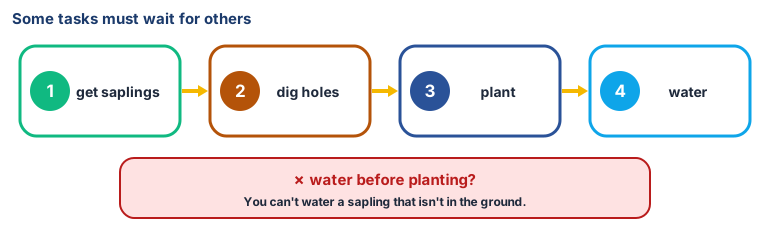
In Needs first, write the task that must happen before this one — or
-if none. - ☐6
Select the table, Data → Sort by
Part. Now your tasks sit in groups. TypeNoin every Done? cell and save asplantation-plan.ods.
Finished early?
Make Done? cells that say Yes turn green: select the column, Format → Conditional →
Condition. Mark three tasks Yes and watch them change. Then find a task that's still too big — invite
parents is really three — and split it.
No laptop today?
Draw the table in your notebook. Write each task on a slip of paper and sort the slips into four piles: Saplings, Tools, People, Weather.
Now you know
- Decomposition means breaking a big problem into small parts you can manage.
- Keep splitting until one person can do each task.
- Some tasks depend on others. Find what must happen first.
- Grouping tasks helps you spot what's missing.
- AI is built this way too: many small steps, each doing one job.
Debate it
Your group forgot one task, and on the day there is no water for the saplings. Whose job was it to notice? How could your checklist help a team check its own plan before the day?
Check yourself — practice, not a test
1. What does decomposition mean?
- ○ Making a problem harder
- ○ Breaking a big problem into smaller parts
- ○ Solving a problem using a computer only
- ○ Throwing away the difficult parts
2. Put these Plantation Day tasks in a sensible order:
- 1. Get saplings from the nursery
- 2. Water the saplings
- 3. Plant the saplings
- 4. Dig the holes
3. A task like "Organise Plantation Day" is small enough for one person to do in one step.
- ○ True
- ○ False
4. When one task must happen before another, we say the second task ______ on the first.
Remember
A big problem is just many small problems standing together.