Class 6 · Unit 5: Computational thinking · Lesson 5.3 · 40 min
Abstraction: what to leave out
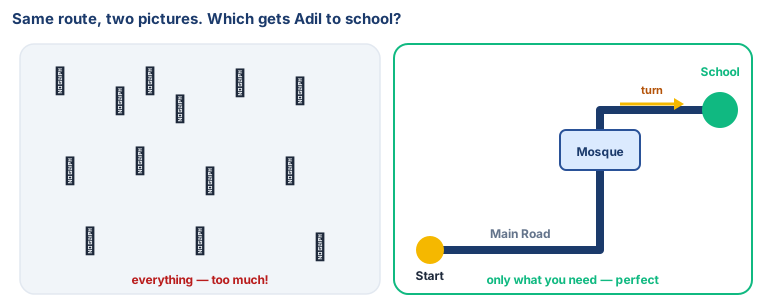
"You pass the baker — best girda — then a blue gate, then my aunt's three cats…" Adil is lost. A map with four shapes gets him there in five seconds.
Today you will: List everything on your way to school · Keep only what someone needs · Draw a map a stranger could follow
Story
A new student, Adil, joins the class. He has just moved to your mohalla and asks Zoya how to walk to school.
Zoya starts talking: "You pass the baker's shop — he makes the best girda — then there's a blue gate, then my aunt's house, she has three cats, then a chinar tree, then the mosque, then…"
Adil looks lost. His elder brother draws him a quick map instead: a line for the road, a box for the mosque, a circle for the school, and an arrow for "turn left". Adil gets it in five seconds.
The map left out the cats, the colour of the gate and the taste of the girda. Leaving things out made it better.
Watch
Abstraction: the art of leaving things out — scan code 6.5.3 in the printed book.
Warm up your fingers
Practise Shift + letter (capitals) and short words, because you will label your map.
- typing.com: Beginner → Shift key lessons
- Then type these labels quickly:
School,Mosque,Bridge,Main Road,Turn Left.
On the laptop
You need: paper and pencil, then LibreOffice Draw (free, offline)
Mission 1: Everything, then only what matters (alone, 5 min)
- ☐1
On paper, list everything you pass on the way to school — shops, trees, animals, the bridge, the bus stop. Try for 15.
- ☐2
Predict: how many of your 15 will a stranger really need? Write the number.
- ☐3
Circle only what someone needs: turns, big landmarks, crossings. Cross out the rest.
Mission 2: Draw the map (alone, 12 min)
- ☐4
In Draw, use the Line tool for roads (hold Shift for straight lines), a Rectangle for big buildings, a Circle for Start and the school.
- ☐5
Double-click a shape to type its label. Add arrows for the way to walk. Label your house just Start — no house number, no family name.
- ☐6
Save as
route-to-school.odg. Swap with a partner: could a stranger reach school with only your map? They write one missing detail and one that could go.
Finished early?
Copy your map for a different purpose — where to buy stationery on the way. What do you add, and what do you take away?
No laptop today?
Draw the map in your notebook using only lines, boxes, circles and arrows, with no more than 6 labels.
Now you know
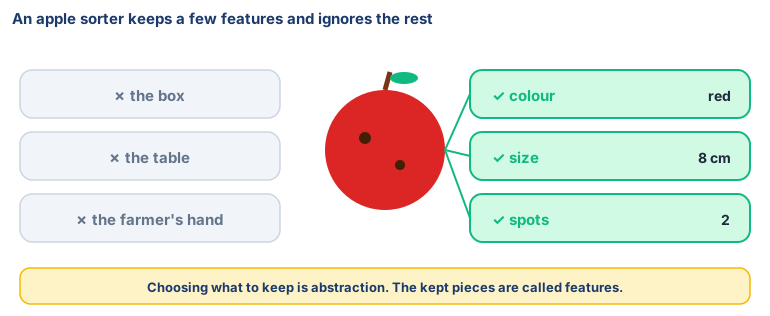
- Abstraction means keeping the details that matter for a purpose and hiding the rest.
- Different purposes, different maps: the same place can be drawn many ways.
- Too much detail confuses. Too little is useless.
- Features are the few pieces of information an AI model looks at — like colour, size and spots on an apple. Choosing them is abstraction.
- Leaving things out is a decision and decisions can be good or bad.
Debate it
A map app for drivers shows the main roads but leaves out the narrow lanes where many families live. Who could be harmed by what a map leaves out? When you leave things out, how do you make sure you are not leaving people out?
Check yourself — practice, not a test
1. What is abstraction?
- ○ Adding as much detail as possible
- ○ Keeping the details that matter and hiding the rest
- ○ Drawing a picture with colours
- ○ Copying a map exactly
2. Which details belong on a walking map to school? (choose all correct)
- ○ Where to turn left
- ○ How many cats live in a house
- ○ A big landmark like the mosque or the bridge
- ○ The colour of the baker's shirt
3. Every map of the same place must show exactly the same details.
- ○ True
- ○ False
4. The few pieces of information an AI model looks at are called ______.
Remember
Good abstraction keeps what matters for the job and leaves out the rest.