Class 7 · Unit 1: Three techniques · Lesson 1.5 · 40 min
Which technique fits?
Milk tomorrow, a saffron flower ready to pick, villages grouped by crop. Three great ideas — and three different techniques.
Today you will: Sort 12 real problems into three techniques · Give a reason using label, number or similar · Build a flowchart that chooses for you
Story
The school is holding an "AI for Our Valley" idea fair. Bilal's list of ideas is long:
- "An app that says how many litres of milk our cow will give tomorrow."
- "A camera that tells if a saffron flower is ready to pick."
- "Something that groups all our village's families by what crops they grow."
Teacher: “Great ideas. But which technique would each one need?” (Ms. Shafi.)
Bilal blinks. "There's more than one?"
How do we choose between classification, regression and clustering?
Watch
Choosing the right technique — scan code 7.1.5 in the printed book.
Warm up your fingers
Skill: typing whole words and sentences (7 min)
- On typing.com, do a sentence practice lesson.
- Then type these three words ten times each, without looking at the keys:
classification·regression·clustering
On the laptop
You need: LibreOffice Calc · which-technique.ods (12 problem cards in column A) · LibreOffice Draw (optional)
Mission 1: Sort the 12 problems (pairs, 9 min)
- ☐1
Open
which-technique.ods. Column A has 12 problems — snow in Gulmarg tomorrow, a leaf with scab, saffron's price next season, songs that sound alike… - ☐2
Predict: which technique will get the most problems? Write it in F1.
- ☐3
Column B: the kind of answer —
group,numberornew groups. Column C: the technique. Column D: one reason, using label, number or similar.
Mission 2: Count and check (pairs, 5 min)
- ☐4
In F2 type
=COUNTIF(C2:C13;"Classification"); the same for the other two in F3 and F4. Was your prediction right? - ☐5
Swap with another pair. Where column C differs, read each other's reasons. Who has the better one?
Finished early?
Part 3: A decision flowchart. In LibreOffice Draw, start at "What kind of answer do we
want?" and branch to the three techniques. Add "Do we have labelled examples?" Save as
technique-flowchart.odg.
No laptop today?
The 12 problems go on slips. The board has three columns: Classification · Regression · Clustering. Pairs stick each slip up with a reason aloud; the class may challenge — only with a better reason.
Now you know
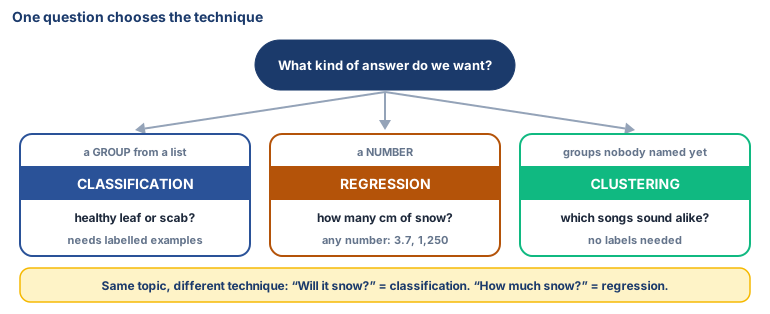
- Ask one question: what kind of answer do we want? A group → classification. A number → regression. Groups nobody knows yet → clustering.
- Labels: classification needs labelled examples. Clustering does not.
- Any number: regression can answer 3.7 or 1,250, not just a few choices.
- The same topic can need different techniques will it snow? vs how much snow?
- Choose first: the technique is the builder's first decision, before any data is collected.
Debate it
Bilal wants an app that sorts his classmates into groups by "how clever they are" using their marks.
Which technique is that? Should anyone build it? Who could be hurt by it? (Remember our rule: no rankings of children.)
Check yourself — practice, not a test
1. "Predict how many tourists will visit Dal Lake in May" needs:
- ○ Classification
- ○ Regression
- ○ Clustering
2. "Decide if a saffron flower is ready or not ready to pick" needs:
- ○ Classification
- ○ Regression
- ○ Clustering
3. Match each problem to its technique:
Group customers who buy similar things, with no groups given · Will it snow tomorrow: yes or no? · How many cm of snow will fall?
Match with: Regression · Classification · Clustering4. The best first question for choosing a technique is: "What kind of answer do we want?"
- ○ True
- ○ False
5. Which problems need labelled examples to train? (choose all)
- ○ Is this leaf healthy or scabbed?
- ○ Group the valley's weather days into types we haven't named
- ○ Is this message spam or not spam?
Remember
Group from a list → classification. Number → regression. New groups → clustering.