Class 7 · Unit 3: AI at work · Lesson 3.1 · 40 min
AI in healthcare
Snow has closed the road from Kupwara. Grandmother still sees a specialist in Srinagar — through a screen, with a computer helping the doctor.
Today you will: Read real cases of AI in health · Weigh one benefit and one risk for each · Say who makes the final decision
Story
Bilal's grandmother lives in a village in Kupwara. In winter, snow blocks the road, and the nearest specialist doctor is hours away in Srinagar.
Last month she had a bad cough. The health worker at the village health centre opened a laptop, connected to a doctor in Srinagar on a video call, and the doctor spoke to her and wrote a prescription. The health centre is called an Ayushman Arogya Mandir.
Hiba: “Was the doctor a robot?”
Bilal: “No. It was a real doctor. But the computer helped. It suggested questions to ask and things to check.”
AI in hospitals does not replace doctors. It helps them reach more people and notice more.
Watch
AI in healthcare — — scan code 7.3.1 in the printed book.
Warm up your fingers
Skill: typing whole sentences, Term 2 (7 min)
- On typing.com, continue your Intermediate sentence lessons.
- Then type this sentence three times, without looking at the keys:
The doctor decides. The AI suggests. - Watch your accuracy, not your speed. Your target this term is 92%.
On the laptop
You need: health-cards.pdf (4 cards, offline) · LibreOffice Calc · benefit-risk.ods
Mission 1: Read (pairs, 5 min)
- ☐1
Open
health-cards.pdf: telemedicine · AI reading eye scans · AI reading X-rays · AI suggestions for doctors. Your teacher gives your pair two cards. - ☐2
Predict: for your cards, will the benefit or the risk be bigger? Note your guess.
Mission 2: Weigh it (pairs, 10 min)
- ☐3
Open
benefit-risk.ods. One row per card: Tool · What the AI does · Who it helps · One benefit · One risk · Who decides? Type full sentences — typing practice too. - ☐4
For One benefit, use one of CBSE's five advantages: saves time · saves cost · improves quality · better decisions · more safety.
- ☐5
For Who decides? — it's never "the AI". Share one row on the projector.
No laptop today?
The teacher reads the four cards aloud. Pairs draw the six-column table in their notebooks and fill two rows.
Now you know
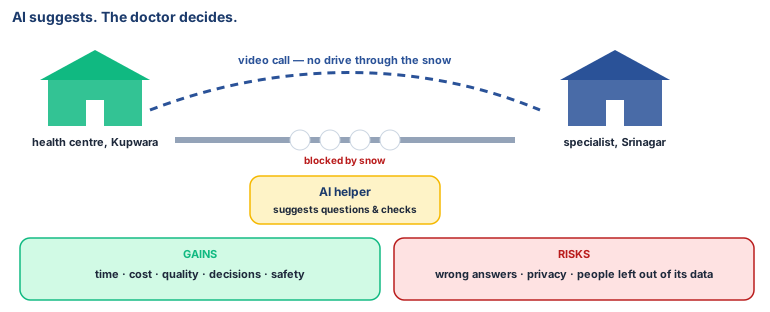
- Telemedicine lets a faraway doctor see a patient through a screen — most useful where roads close and specialists are few.
- Medical images eye scans, X-rays — are where AI spots patterns quickly and at scale.
- AI suggests; the doctor decides. The doctor knows the whole patient; the AI knows only its data.
- Gains: time, cost, quality, better decisions, safety. Risks: wrong answers, privacy, unfairness if its data left people out.
Debate it
An AI eye-scan tool was trained mostly on photos from big city hospitals. Now it is used in a village in Gurez.
Could it make more mistakes there? Why? What should the health workers do about it?
Check yourself — practice, not a test
1. What is eSanjeevani?
- ○ A new medicine for coughs
- ○ India's national telemedicine service
- ○ A robot that replaces doctors
- ○ A hospital in Srinagar
2. If an AI tool says a patient is healthy, the doctor does not need to check.
- ○ True
- ○ False
3. Which are advantages of AI in healthcare? (choose all)
- ○ Saves time
- ○ Helps reach patients in remote areas
- ○ It never makes mistakes
- ○ Can spot patterns in scans quickly
4. In healthcare, the AI suggests, and the ______ decides.
Remember
**In healthcare, AI helps the doctor see more and reach further, and the doctor still decides.**