Class 7 · Unit 3: AI at work · Lesson 3.2 · 40 min
AI in agriculture: orchards and saffron
Uncle lost part of his crop to scab last year. Now an AI claims it can spot scab before he can. What if it calls a healthy leaf sick?
Today you will: Train a scab spotter on real leaf photos · Test it on leaves it has never seen · Hunt down its mistakes — and say why
Story
In Class 6, Hiba's uncle in Shopian lost part of his crop to apple scab, a disease that spots the leaves dark olive and black.
This year he shows Hiba a photo on his phone. "The scientists say an AI can look at a leaf like this and tell if it has scab, before I can even see it clearly."
Hiba grins. "We can build one of those in class. We did something like it last year with chinar and willow leaves."
Bilal is not so sure. "But what if your AI says a healthy leaf is sick? Your uncle might spray medicine he doesn't need."
Today you train a leaf-disease spotter, and then you try to catch it making mistakes.
Watch
AI in orchards and saffron fields — — scan code 7.3.2 in the printed book.
Warm up your fingers
Skill: sentences with this unit's AI vocabulary, Term 2 (7 min)
- On typing.com, open the custom lesson your teacher has made with this unit's words .
- Words to master:
classificationtrainingtestingscabsensorhumidity - Then type:
The model learns from labelled photos of healthy and scab leaves.
On the laptop
You need: Teachable Machine in the browser (no account) · leaf-photos/train/healthy/, leaf-photos/train/scab/, leaf-photos/test/ · LibreOffice Calc · scab-score.ods
Mission 1: Train (groups of 3, 7 min)
- ☐1
Teachable Machine → Image Project → Standard image model.
- ☐2
Rename the classes
HealthyandScab. - ☐3
Upload the
train/healthyphotos into Healthy andtrain/scabinto Scab. - ☐4
Click Train Model. Keep the tab open.
Mission 2: Test (groups, 8 min)
- ☐5
Predict: how many test leaves will it get right? Then, in Preview, switch Input to File and drag in each
leaf-photos/test/photo. - ☐6
In
scab-score.ods, one row each: Photo · Model says · Confidence % · Real answer (teacher's sheet) · Right? - ☐7
Accuracy:
=COUNTIF(E2:E13;"Yes")/COUNTA(E2:E13).
Mission 3: Mistake hunt (groups, 3 min)
- ☐8
Find one photo it got wrong. Look closely. Why was it fooled? Write your idea in the last column.
⚠️ Don't save or upload the model. When you close the tab it's gone — that's fine.
No laptop today?
Human classifier. The teacher shows 10 printed leaf photos. Study 5 labelled training photos, then label the 5 test photos alone. Compare with the key and count the class's accuracy on the board.
Now you know
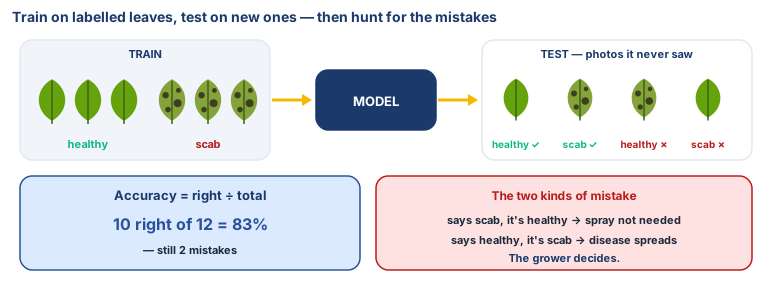
- Disease spotting is classification healthy or scab, learned from training data.
- Test on photos it never saw. Testing on training photos is marking an exam with the answers written in.
- Accuracy = right ÷ total. High accuracy still means some mistakes.
- Sensors in orchards and saffron fields collect temperature, moisture and humidity — AI can learn from them to warn growers early.
- The grower decides. AI helps spot problems early; it doesn't replace a farmer's eyes.
Debate it
Your model marks a healthy leaf as scab. The farmer sprays chemicals he did not need. Another time it marks a scab leaf as healthy, and the disease spreads.
Which mistake is worse for the farmer? Why? Should the model be built to avoid one kind more than the other?
Check yourself — practice, not a test
1. Telling healthy leaves from scab-spotted leaves is an example of…
- ○ Regression
- ○ Clustering
- ○ Classification
- ○ Sorting by size
2. To check a model fairly, you should test it on the same photos you trained it with.
- ○ True
- ○ False
3. A model got 18 out of 20 test photos right. Its accuracy is ______%.
4. Put the steps in order:
- 1. Collect labelled photos
- 2. Test on new photos
- 3. Train the model
- 4. Check the mistakes and improve
5. What can sensors in a saffron field measure? (choose all)
- ○ Temperature
- ○ Soil moisture
- ○ The price of saffron in Delhi
- ○ Humidity
Remember
**An AI can spot disease from a leaf photo, if it is trained on good examples, tested on new ones, and checked by the grower.**