Class 7 · Unit 3: AI at work · Lesson 3.3 · 40 min
AI in education: help or cheating?
Winter break. Bilal's cousin types the essay question and the AI writes the essay: full marks. Hiba's app gives her a new question every time she's wrong. Only one of them learned.
Today you will: Sort 12 real ways students use AI · Use one test: does it help me think? · Turn a "depends" into honest help
Story
It is December. Snow has closed the school for the winter break, and the class is learning from home.
Bilal's cousin in Class 10 shows him an app. "Look, I type my English essay question, and the AI writes the whole essay."
Hiba: “So you learned nothing?”
Bilal: “I got full marks.”
Hiba: “But the exam hall has no app.”
Later, Hiba uses a different tool. It gives her a new practice question each time she gets one wrong, and it explains why.
Both of them used AI for school. Only one of them learned something.
Watch
AI in education — — scan code 7.3.3 in the printed book.
Warm up your fingers
Skill: short typed answers, Term 2 (7 min)
- On typing.com, continue your Intermediate lessons.
- Then type this answer in one go, fixing mistakes with Backspace:
I will use AI to check my thinking, not to do my thinking.
On the laptop
You need: LibreOffice Calc · help-or-cheat.ods (12 scenarios — a translator for one word, a copied essay, a practice app, all 20 maths problems solved, speech-to-text…)
Mission 1: Decide (pairs, 9 min)
- ☐1
Open
help-or-cheat.ods. Predict: how many of the 12 will you call Harmful? Note it. - ☐2
In Helpful / Harmful / Depends, type your pair's choice for each row.
- ☐3
In Why?, one sentence using the test: does it help me think, or think for me?
Mission 2: Fix a "depends" (pairs, 6 min)
- ☐4
Sort by your first column (Data → Sort) so the Depends rows sit together.
- ☐5
For one Depends row, write what would make it Helpful — e.g. "Ask the AI to explain step 1, then solve the rest yourself." Be ready to share it.
No laptop today?
The teacher reads out the 12 scenarios. Stand on one side for Helpful, the other for Harmful, the middle for Depends. After each, one child from each group gives a reason.
Now you know
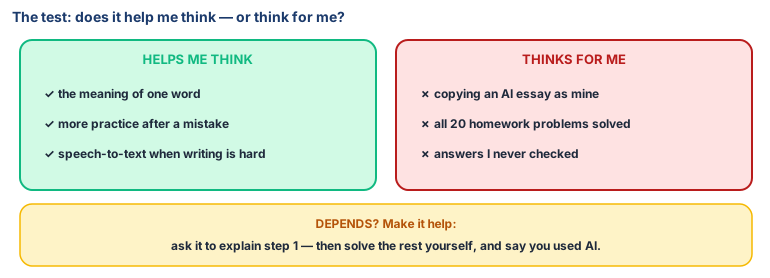
- AI can help learning personal practice, translation, access for children who find writing hard, and help for teachers.
- The test: does it help me think, or think for me?
- Plagiarism is handing in someone else's work — an AI's included — as your own. It's dishonest, and you didn't learn.
- Using AI? Say so, and check it. It can be confidently wrong.
- Learning is a trust (amanah). Honest work builds knowledge you keep for life.
Debate it
A practice app gives each student different questions depending on their mistakes. It also keeps a record of every mistake every child has ever made.
Is that record helpful, harmful, or both? Who should be allowed to see it?
Check yourself — practice, not a test
1. Which use of AI helps you learn?
- ○ Copying an AI essay and handing it in
- ○ Asking AI to finish all your homework
- ○ Using a practice tool that explains why your answer was wrong
- ○ Using AI to write your exam answers
2. Handing in AI-written work as your own is plagiarism.
- ○ True
- ○ False
3. Match the tool to how it helps:
Translation · Speech-to-text · Personalised practice
Match with: Gives more questions on what you got wrong · Explains a word in a language you know better · Helps a student who finds writing difficult4. A good test: does the tool help me ______, or think for me?
Remember
Use AI to help you think, never to do your thinking for you, and say when you used it.