Class 7 · Unit 3: AI at work · Lesson 3.5 · 40 min
Advantages, and what it costs
"AI will take everyone's jobs." "No machine knots a carpet like my hands." "AI brought us bookings." "The app costs money." All four are right.
Today you will: Weigh AI's gains against its costs · Make one clear slide about real work · Say what AI should never replace
Story
Hiba's aunt weaves carpets in Srinagar. Bilal's father runs a houseboat on Dal Lake. Hiba's uncle grows apples in Shopian.
At a family gathering, someone says, "AI will take everyone's jobs."
The aunt shakes her head. "No machine can knot a carpet like my hands."
Bilal: “But an AI helped a tourist find our houseboat. Bookings are up.” ('s father.)
Uncle: “And an AI helped me spot scab early. But the app costs money, and my neighbour has no smartphone.”
All three are right, in different ways. AI brings gains, and it has costs. Today you weigh both.
Watch
AI's advantages, and what they cost — — scan code 7.3.5 in the printed book.
Warm up your fingers
Skill: typing a short paragraph, Term 2 (7 min)
- On typing.com, do one paragraph practice.
- Then type your slide title, carefully:
AI in my family's work: gains and costs
On the laptop
You need: LibreOffice Impress · ai-at-work.odp (one slide, four boxes)
Mission 1: One slide, "AI in the work I know" (alone or pairs, 18 min)
- ☐1
Open
ai-at-work.odp. Title: the work — apple growing, houseboats and tourism, carpet weaving, shopkeeping, driving a taxi. Your family's work or any local work. No names. - ☐2
Predict: will your slide end up with more gains or more costs?
- ☐3
Box 1 — Where AI could help: one or two sentences.
- ☐4
Box 2 — Advantages: at least two of time, cost, quality, decisions, safety, each explained in a few words.
- ☐5
Box 3 — Costs: at least two of jobs, privacy, errors, access.
- ☐6
Box 4 — What AI should never replace: one sentence.
- ☐7
Easy to read: 24-point text or bigger, about 40 words in all. Save as
unit3-slide-<roll number>.odp. Three volunteers show theirs.
No laptop today?
Fold an A4 sheet into four boxes and fill the same headings by hand. Pin the sheets up and walk around the gallery.
Now you know
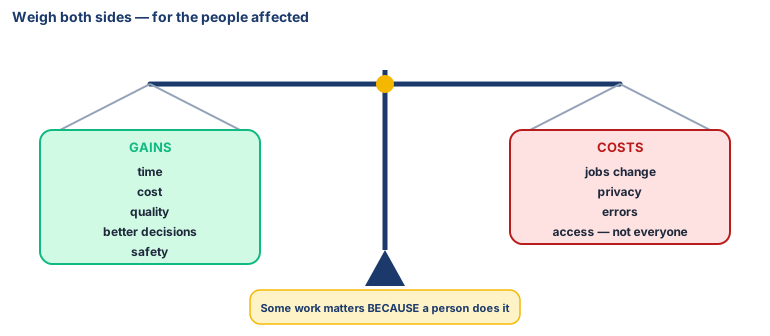
- Five advantages (CBSE): time, cost, quality, better decisions, safety.
- Costs too: jobs change, privacy can be lost, errors happen, not everyone gets access.
- Weigh both sides for the people affected not only for the business.
- Some work is valuable because a person does it like a hand-woven shawl. AI can help around it — selling, designing, bookkeeping.
- New jobs appear people who build, check and repair AI systems.
Debate it
A company offers an AI that designs new carpet patterns in seconds. It learned from thousands of photos of Kashmiri carpets, without asking the weavers.
Is that fair to the weavers whose designs it learned from? What would make it fair?
Check yourself — practice, not a test
1. Which are advantages of AI named by CBSE? (choose all)
- ○ Saves time
- ○ Improves quality
- ○ Makes everyone rich
- ○ Improves safety
2. Which are possible costs of AI? (choose all)
- ○ Some jobs change or disappear
- ○ Personal data may be collected
- ○ The AI can make mistakes
- ○ Nobody ever needs to learn anything
3. An AI tool is fair as long as it helps the business that uses it.
- ○ True
- ○ False
4. Match the Kashmiri work to one way AI could help:
Apple growing · Tourism and houseboats · Handicrafts
Match with: Helping visitors find and book stays · Selling online to buyers far away · Spotting leaf disease early
Remember
**Weigh both sides: AI can save time, money and lives, and it can cost jobs, privacy and fairness. People decide the balance.**