Class 7 · Unit 5: Bias and citizenship · Lesson 5.2 · 40 min
Three kinds of bias
"Set an alarm for fajr." "Sorry, I didn't catch that." Hiba's cousin from Delhi says the same words — the phone answers at once. Which kind of bias is it?
Today you will: Crack six real bias cases · Name the kind: missing, historical or measurement · Match each kind to its fix
Story
Hiba's aunt tries the new voice assistant on her phone.
Aunt: “Set an alarm for fajr.” (in Kashmiri-accented English.)
The phone answers: "Sorry, I didn't catch that."
She says it again, slowly. The phone answers again: "Sorry, I didn't catch that."
Hiba's cousin from Delhi says the same words, and the phone answers at once.
Hiba: “It's not you, Masi. It's the data. I bet it never heard enough people who sound like us.”
Bilal thinks. "But what if it's something else? What if the microphone is bad? Or what if it learned from old recordings?"
They are both asking a good question: which kind of bias is it?
Watch
Missing, historical, measurement: three kinds of bias — — scan code 7.5.2 in the printed book.
Warm up your fingers
Skill: editing a paragraph with Ctrl+Z (Term 3 focus, 7 min)
- On typing.com, do one Intermediate paragraph lesson.
- In Writer, type: "Missing-group bias leaves people out. Historical bias repeats the past. Measurement bias comes from faulty measuring."
- Delete a whole word by mistake, on purpose, then press Ctrl+Z to bring it back.
On the laptop
You need: LibreOffice Calc · unit-5/bias-cases.ods (6 sheets, one case each, with a small table)
Mission 1: Bias detectives (pairs, 20 min)
- ☐1
Open
bias-cases.odsand save a copy asbias-cases-<group code>.ods— no names. - ☐2
Read Case 1 and its table — e.g. the same assistant understood 92 of 100 words through a new headset and 61 through an old laptop mic.
- ☐3
Predict the kind of bias before you look closely. Then in the yellow cells choose Missing-group / Historical / Measurement (more than one is allowed).
- ☐4
Next cell: one sentence of evidence — which number or fact shows it?
- ☐5
Green cell: one fix — e.g. "Record voices on the same kind of microphone."
- ☐6
Do all six: the microphones · face unlock tested on 900 adults and 100 children · a "best students" AI trained on 20 years of prize lists · a thermometer on a sunny wall · 1 million Hindi examples and 5,000 Kashmiri · a hiring AI that learned from years of mostly hiring men.
- ☐7
Compare with another pair. Where you disagree, each explains its evidence.
No laptop today?
The teacher reads each case aloud. Stand in the corner labelled Missing, Historical or Measurement. One student from each corner gives evidence — anyone may change corners after.
Now you know
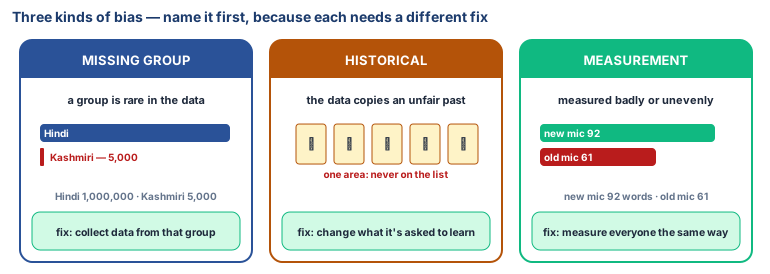
- Missing-group bias: a group is left out or rare in the data. Fix: collect data from that group.
- Historical bias: the data truthfully shows an unfair past, and the AI repeats it. Fix: question the past; change what the AI learns.
- Measurement bias: data measured badly or unevenly. Fix: measure everyone the same careful way.
- More than one kind can be at work at once.
- Name the bias first each kind needs a different fix.
Debate it
Case 6: the hiring AI learned from a company's real history. The data was accurate.
Can data be true and still be unfair? Should an AI copy the past, or help us do better than the past?
Check yourself — practice, not a test
1. Match each kind of bias to its example:
Missing-group bias · Historical bias · Measurement bias
Match with: A thermometer hung on a sunny wall · An AI trained on years of unfair past decisions · A translation app with very few Kashmiri examples2. A face-unlock system was tested on 900 adults and 100 children, and it fails more often for children. Which kind of bias is this?
- ○ Historical bias
- ○ Missing-group bias
- ○ Measurement bias
- ○ No bias
3. If the data about the past is accurate, an AI trained on it cannot be biased.
- ○ True
- ○ False
4. What is a good fix for measurement bias?
- ○ Delete the AI
- ○ Measure everyone in the same, careful way
- ○ Add more data measured the same faulty way
- ○ Ask the AI to try harder
Remember
Missing people, an unfair past, or bad measuring: name the bias, then fix it.