Class 7 · Unit 5: Bias and citizenship · Lesson 5.3 · 40 min
Human in the loop
The program puts Bilal on the extra-coaching list. His teacher knows something the program doesn't: the road was shut by snow for two weeks.
Today you will: Run a decision desk with eight AI suggestions · Sort low stakes from high stakes · Write your rule for when a person must decide
Story
The school has a new computer program that suggests which students need extra coaching before the exams. It looks at marks and attendance.
The list comes out. Bilal's name is on it. His attendance was low in January.
His teacher, Mr. Wani, reads the list, then calls Bilal over.
Teacher: “The program says you need help. But I know you missed school because the road was closed by snow for two weeks, and your marks since then are good. Do you think you need extra coaching?”
Bilal shakes his head. Mr. Wani crosses his name off, and adds another student whom the program had missed, one who comes every day but has been struggling quietly.
The program made a suggestion. A person who knew the students made the decision.
Watch
AI suggests, a human decides — — scan code 7.5.3 in the printed book.
Warm up your fingers
Skill: typing short answers with punctuation (Term 3 focus, 7 min)
- On typing.com, do one Intermediate lesson with punctuation.
- In Writer, type the loop as one line, using the arrow sign
->(hyphen, then Shift +.):Data -> AI suggests -> Human checks -> Decision -> Feedback
On the laptop
You need: LibreOffice Calc · unit-5/decision-desk.ods (8 cases, each with an AI suggestion and a fact the AI didn't know)
Mission 1: The decision desk (groups of 3, 20 min)
- ☐1
Roles rotate every 3 cases: AI Reader (reads the suggestion) · Checker (reads the extra fact) · Decider (decides and types). Save a copy as
decision-desk-<group code>.ods. - ☐2
Predict: how many of the 8 will need a person to decide? Note it.
- ☐3
For each case fill: AI suggests · What the AI didn't know · Stakes (Low/High) · Human needed? (Y/N) · Final decision · Why. Cases include a next-song pick, an email sent to Junk, repeat a class for a student who was ill, a loan refused after a hailstorm, a three-week cough called "nothing serious", the Mughal Road on a snow-warning day, "Ambri" spell-checked to "Amber", and an exam camera flagging a sideways glance as cheating.
- ☐4
Count your Y's:
=COUNTIF(E2:E9;"Y"). Was your prediction right? - ☐5
At the bottom, one sentence: your group's rule for when a human must decide.
No laptop today?
The teacher reads each AI suggestion; a volunteer Checker reads the extra fact from a card. The class sits for "AI can decide" or stands for "Human must decide", and one student explains.
Now you know
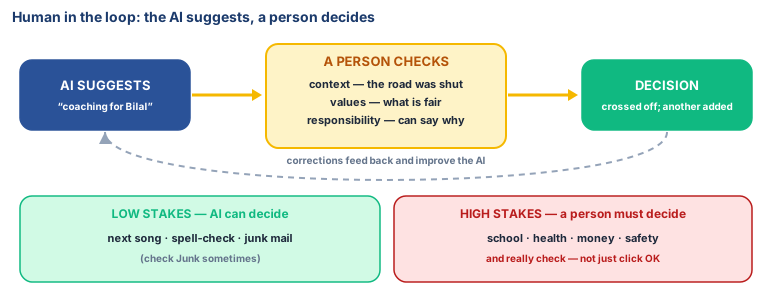
- Human in the loop: a person checks — and can change — an AI's suggestion before it becomes a decision.
- High stakes need a person: education, health, money, safety, freedom.
- People bring what the AI lacks: context (the snow road), values (what's fair), responsibility (someone who can be asked why).
- Automation bias is trusting the computer too much. Really check — don't just click OK.
- The loop feeds back: human corrections can improve the AI.
Debate it
The coaching program was right about most students. Checking every name takes Mr. Wani an hour.
Is it worth that hour? What could go wrong if schools stopped checking because "the program is usually right"?
Check yourself — practice, not a test
1. What does human-in-the-loop mean?
- ○ A human is replaced by an AI
- ○ A person checks, and can change, what the AI suggests before it becomes a decision
- ○ A human builds the computer
- ○ The AI watches what humans do
2. Which decisions most need a human in the loop? (choose all that apply)
- ○ Which song plays next
- ○ Whether a student must repeat a class
- ○ Whether a patient's illness is serious
- ○ Whether someone gets a loan
3. If an AI is usually right, a human no longer needs to check its high-stakes decisions.
- ○ True
- ○ False
4. Put the human-in-the-loop steps in order:
- 1. Data goes in
- 2. Feedback improves the AI
- 3. A decision is made
- 4. AI makes a suggestion
- 5. A human checks the suggestion
5. Trusting a computer too much without really checking is called automation ______.
Remember
AI can advise. People must decide, especially about people.