Class 7 · Unit 5: Bias and citizenship · Lesson 5.4 · 40 min
Consent, privacy, transparency
Free tablets for a month! Page 4, tiny print: "voice recordings and camera images may be… shared with partners". If you can't understand it, did you really agree?
Today you will: Check which apps can use the camera and mic · Rewrite a consent form a child can read · Say when AI is being used on you
Story
A company visits the school with free tablets. The children can keep them for a month.
There is a form to sign. Hiba reads it on the bus home. Page 4, in tiny letters:
Hiba: “The user agrees that usage data, voice recordings and camera images may be collected, processed by automated systems, and shared with partners for improving services.”
Bilal: “What does 'partners' mean? And what 'automated systems'? Is an AI looking at our photos?”
Hiba's mother reads it twice. "If I can't understand what I'm agreeing to," she says, "then I haven't really agreed to anything."
In Class 6 you learned that your data belongs to you. Today: what does it take to truly say yes, and how do we know when an AI is being used on us?
Watch
Saying yes the right way — — scan code 7.5.4 in the printed book.
Warm up your fingers
Skill: typing a paragraph and moving through it quickly (Term 3 focus, 7 min)
- On typing.com, do one Intermediate paragraph lesson.
- In Writer, type two sentences, then use Ctrl + ← / → to jump a word at a time, and Home / End to jump to the start or end of a line. Fix mistakes without the mouse.
On the laptop
You need: Settings on the school laptop · LibreOffice Calc and Writer · unit-5/sample-terms.odt (a made-up, hard-to-read terms page)
Mission 1: Who can use what? (pairs, 8 min)
- ☐1
Predict: how many apps on this laptop can use the microphone? Note it.
- ☐2
Open Settings → Privacy & security → App permissions. Click Camera, Microphone, Location.
- ☐3
In Calc, list up to five apps: App · Camera · Microphone · Location · Does it need it? · Why?
- ☐4
Don't change anything on the school laptop — just record. The teacher decides on changes.
Mission 2: A consent note anyone can read (pairs, 12 min)
- ☐5
Open
sample-terms.odt. Highlight every sentence about data in yellow. - ☐6
In a new Writer file,
consent-note.odt, write a consent note for your Predict it project survey (or the Unit 4 one) that answers, in words a Class 3 child understands: what we collect (and don't — no names) · why · who sees it · how long we keep it · how to say no or change your mind · is an AI or program used on it, and what does it do? - ☐7
Under 100 words, short sentences. Swap with another pair: they tick each question it answers clearly.
No laptop today?
Pairs underline the data sentences in the printed terms and write the six-question consent note in their notebooks. The class votes on the hardest sentence in the original and rewrites it together on the board.
Now you know
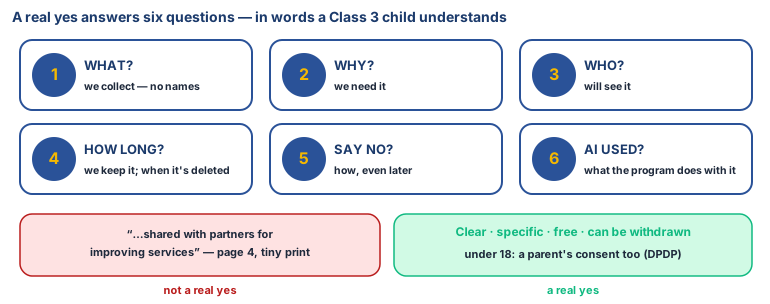
- Informed consent means agreeing while knowing what's taken, why, who gets it, for how long, and how to say no — whenever data is collected, used, shared, kept or deleted.
- Real consent is clear, specific, free, and can be withdrawn. A yes hidden on page 4 isn't one.
- Children's data in India needs a parent's verifiable consent (DPDP Act).
- Transparency: people are told when AI is used on them, and how it decides, simply.
- App permissions: no need for your camera, mic or location? It shouldn't have them.
Debate it
The tablet company says: "We told you everything. It's all on page 4."
Is something "transparent" if it is written down but nobody can understand it? What should the company have done instead?
Check yourself — practice, not a test
1. Which make consent "informed"? (choose all that apply)
- ○ Knowing what data is collected
- ○ Knowing who it will be shared with
- ○ Knowing how to change your mind later
- ○ Signing quickly because everyone else did
2. Under India's DPDP Act, a 12-year-old can give consent for their own data without a parent.
- ○ True
- ○ False
3. What does transparency in AI mean?
- ○ The AI is invisible
- ○ The computer screen is clear
- ○ People are told when AI is used, and how it decides, in words they can understand
- ○ The AI never makes mistakes
4. CBSE lists the moments when consent matters. Put them in the order data goes through:
- 1. Archived
- 2. Used
- 3. Collected
- 4. Shared
- 5. Deleted
5. Good consent can be ______, which means you can take your yes back later.
Remember
If you can't understand it, you haven't agreed to it.