Class 8 · Unit 1: The AI project lifecycle · Lesson 1.1 · 40 min
What problem are we solving?
Bilal wants a face-recognition camera at the gate. Hiba points at the bin behind the science block. “That's a problem. Yours was a machine.”
Today you will: Fill a 4Ws canvas for a real problem · Write a problem statement someone could check · Decide whether it even needs AI
Story
The Class 8 noticeboard has a new poster: SCHOOL AI CLUB — FIRST MEETING FRIDAY.
Bilal arrives with a plan already made. "We'll build an AI for the school. A camera at the gate that knows every student's face."
Hiba: “For what?”
Bilal: “For… attendance. Or safety. Something.”
Hiba picks up a marker. "Bilal, walk to the back gate and look at the ground."
He does, and comes back quieter. Behind the science block, the bin is surrounded by a week's worth of wrappers, peels and plastic bottles, all mixed together. The sweeper empties the bin every morning. By lunchtime it looks the same again.
Hiba: “That's a problem. Yours was a machine.”
This year you will build things. But every build starts in the same place: naming the problem so precisely that you could tell someone else exactly what to fix.
Watch
The AI project lifecycle, and the 4Ws — — scan code 8.1.1 in the printed book.
Warm up your fingers
Skill: punctuation at speed — the full stop, comma and question mark (6 min)
- On typing.com, open the Intermediate lessons on punctuation.
- A problem statement is one long sentence with commas in it. Type this one three times,
looking at the screen and not at your hands:
Students mix wet and dry waste in one bin, so nothing can be composted. - Goal for this term: 28–32 words per minute at 93% accuracy. Accuracy first; speed follows.
On the laptop
You need: LibreOffice Calc · problem-canvas.ods
Mission 1: Three canvases (12 min, in pairs)
- ☐1
Columns: Who · What · Where · Why · Who else is affected? Row 1 is started — waste behind the science block. Finish it.
- ☐2
Fill row 2 for the bus that gets students to school late, row 3 for apple trees with spotted leaves near your home.
- ☐3
Write the Who as real people — the sweeper, Class 6 students, the orchard owner. "Everyone" means you haven't looked hard enough.
Mission 2: One sentence (8 min, alone)
- ☐4
Sheet Statements: When [who] are [where and when], [what happens], which means [why it matters]. Under 40 words.
- ☐5
Predict: will your partner be able to tell when it's fixed? Swap. They answer: Can I picture it? Could I tell it was fixed? Is it small enough for us? Fix yours and save.
Finished early?
For your three problems, write AI or automation beside each — and why.
No laptop today?
Rule the columns across a double page and do the same in pairs. Read three sentences aloud; the class votes on one question: could you tell whether this was fixed?
Now you know
- Problem scoping comes first: exactly what you are solving, and for whom.
- The 4Ws — Who · What · Where · Why force you to be precise. "Everyone" is not a who.
- A good problem statement lets someone else tell whether it's been fixed.
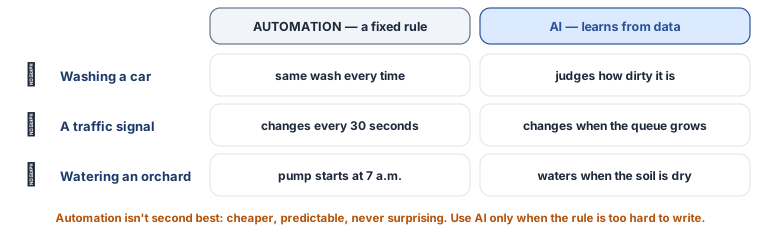
- Ask whether it needs AI at all. If a rule, a timer or a person can do it, use those.
- Start with the problem, not the tool and pick one this class can finish this year.
🕌 From our heritage
When al-Khwārizmī (c. 780–850) opened his book on algebra, he did not begin with the mathematics. He began by naming who needed it and why: what people "constantly require" in cases of inheritance, legacies, partition, lawsuits and trade, and in measuring land, digging canals and other everyday work. He scoped the problem before he built the method — which is exactly the order you are being asked to work in today.
Source: al-Khwārizmī, al-Kitāb al-Mukhtaṣar fī Ḥisāb al-Jabr wa-l-Muqābala (c. 820), preface.
Debate it
A member of the AI club proposes Bilal's idea again: a camera at the gate that recognises every student's face and marks them present.
Before anyone discusses whether it would work, answer these:
- Who is affected who was never asked?
- What could go wrong for a student the camera fails to recognise?
- Is there a way to solve the same problem — knowing who is present — that collects less information about children?
Check yourself — practice, not a test
1. Put the four short names of the AI project lifecycle in order:
- 1. Define the problem
- 2. Test AI tools
- 3. Collect data
- 4. Reflect and improve
2. Which is a properly scoped problem statement?
- ○ We should use AI in our school
- ○ Class 6 students mix wet and dry waste in the bin behind the science block at lunch, so nothing can be composted
- ○ Waste is a big problem in India
- ○ Let's train a model on some photos
3. Which questions does the 4Ws canvas ask? (choose all that apply)
- ○ Who is affected
- ○ What is the problem
- ○ Which tool is the newest
- ○ Why it matters
4. Choosing the AI tool first and then looking for a problem it could solve is good practice.
- ○ True
- ○ False
5. Deciding exactly what you are solving, and for whom, is called problem ______.
6. Which is automation and which is AI?
A pump that starts at 7 a.m. every day · A pump that starts when the soil is dry · A traffic signal that changes every 30 seconds · A traffic signal that changes when the queue grows
Match with: AI · Automation
Remember
Name the problem before you name the tool.