Class 8 · Unit 1: The AI project lifecycle · Lesson 1.2 · 40 min
Collecting the right data
“More data is better, right?” says Bilal, pointing the phone at everyone at the bin. Hiba covers the lens.
Today you will: Write a data plan · Cut every piece of data you don't need · Name three steps of preparing data
Story
The AI club has chosen its problem: waste behind the science block.
Bilal is already holding his father's phone. "Easy. I'll stand by the bin at lunch and photograph everyone throwing something in. Faces, bags, everything. More data is better, right?"
Hiba puts her hand over the lens.
Hiba: “Two questions. First — does the model need faces to tell a banana peel from a plastic bottle? Second — did you ask any of those students?”
Bilal lowers the phone. "…No."
Hiba: “Then we plan it first, and we photograph only what we actually need.”
Today you write the plan that decides what data your project will — and will not — collect.
Watch
Making a data plan — — scan code 8.1.2 in the printed book.
Warm up your fingers
Skill: the apostrophe, brackets and the hyphen (6 min)
- On typing.com, continue the Intermediate punctuation lessons.
- Then type these column headings into Calc without looking down:
Feature · Why it matters · Source · How often · Consent needed? · Risk if missing - Aim: 28–32 WPM at 93% accuracy. If accuracy drops below 90%, slow down.
On the laptop
You need: LibreOffice Calc · data-plan.ods · your problem statement from Lesson 1.1
Mission 1: Build the plan (12 min, in pairs)
- ☐1
Copy your problem statement into A1.
- ☐2
One row per feature: Feature · Why it matters · Source · How often · Consent needed? · Risk if missing. The first two rows (the photo, and its wet/dry/hazardous label) are done for you.
- ☐3
Add rows for time of day, how full the bin is, and who empties it. In Consent needed?, name who must be asked.
Mission 2: Cut it down (8 min)
- ☐4
Predict: how many rows will survive? Add a column, Do we really need it?, and answer yes or no for every row, with a reason.
- ☐5
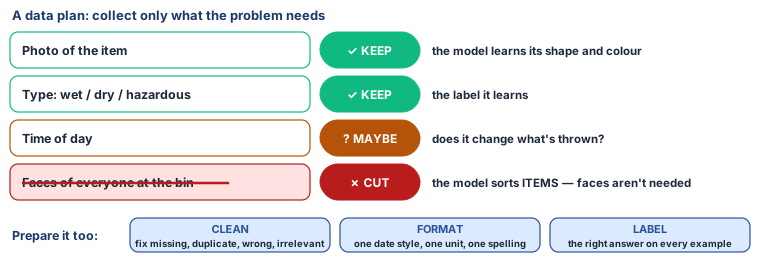
Delete every no. Bilal's "faces of everyone at the bin" is the test: the model sorts items, so faces aren't needed.
- ☐6
Count what's left:
=COUNTA(A3:A20)-1. One sentence: the smallest set of data that still solves it. Save for Lesson 1.3.
No laptop today?
Rule the six columns across a double page. Do the cutting round aloud: a pair reads a row, the class votes need it or don't, and the pair gives the reason either way.
Now you know
- Stage 2, collect data, begins with a data plan: feature · why · source · how often · whose permission · risk if missing.
- Sources CBSE names four: sensors · surveys · websites · historical records. Always write the source down.
- Prepare it in three steps: cleaning (missing values, duplicates, wrong or irrelevant data) · formatting (one style, one unit, one spelling) · labelling (the right answer on every example).
- Garbage In, Garbage Out. Careless data, careless answers.
- Ask before you collect, and collect only what the problem needs.
🕌 From our heritage
Ḥunayn ibn Isḥāq (809–873) was the most exacting translator of his age in Baghdad. He would not work from a single copy of a text: he described hunting down several Greek manuscripts of the same book and comparing them against one another to settle what the author had actually written, before translating a word. One copy could carry a scribe's mistake; several, compared, revealed it. Checking a source against other sources is the same habit you used in Class 6 with the chains of ḥadīth narrators — and the same habit a data plan asks of you now.
Source: Ḥunayn's own account of his translations of Galen, described in his Risāla (letter) on the Syriac and Arabic translations.
Debate it
Another group wants to train a model that predicts which students will be absent tomorrow, using the attendance register.
- Which features would it need?
- Who would have to consent?
- Suppose it works. A student is predicted absent, and a teacher treats them differently because of it. Who is harmed, and who is responsible?
Write three sentences. There is no single right answer, but "it would be interesting" is not a reason to collect data about children.
Check yourself — practice, not a test
1. What is the first thing you do at the "collect data" stage?
- ○ Start taking photographs
- ○ Write a data plan
- ○ Download a dataset from the internet
- ○ Train a model
2. A good data plan records which of these for each feature? (choose all that apply)
- ○ Where the data comes from
- ○ Whose permission is needed
- ○ How expensive the laptop was
- ○ How often it is collected
3. Collecting extra data you do not need is harmless, because more data is always better.
- ○ True
- ○ False
4. Match each source to its type:
A class survey about lunch boxes · A camera above the bin · The school attendance register · A photo set downloaded from a website
Match with: Records · People · Instrument · Someone else's dataset5. Collecting only the data the problem actually needs is called data ______.
6. Data cleaning fixes which of these faults? (choose all that apply)
- ○ Missing values
- ○ Duplicate entries
- ○ A slow laptop
- ○ Incorrect information
7. The saying that poor data produces poor results is "Garbage In, ______ Out".
Remember
Plan the data before you collect it. Collect only what the problem needs.