Class 8 · Unit 1: The AI project lifecycle · Lesson 1.5 · 40 min
Putting it to work, and keeping it working
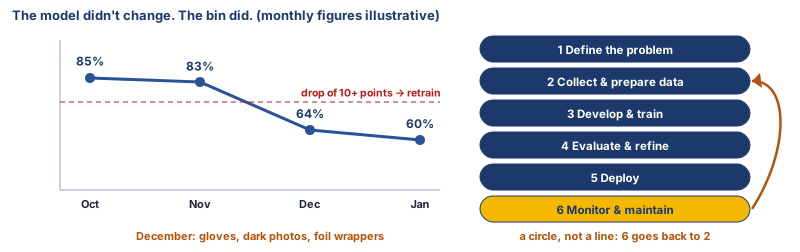
85% in October. Then December: gloves, dark photos, foil wrappers. “It's broken!” “No — the bin changed, and nobody told the model.”
Today you will: Write a deployment plan · Build a sheet to watch accuracy month by month · Name all six stages — and the four short ones
Story
By October the waste model is good. Eighty-five per cent on photos it has never seen. The club sets up an old laptop on a stool beside the bin, with a printed sign: hold it up to the camera before you throw it.
For three weeks it works. Class 6 queue up to try it.
Then December comes. The photos are darker. Half the school is in gloves. The canteen changes supplier and the wrappers are suddenly foil-lined instead of plastic. A boy holds up a foil wrapper and the screen says wet, 91%.
Bilal: “It's broken.”
Hiba: “It isn't. It's exactly as good as it was in October. The bin changed, and nobody told the model.”
Watch
Deployment, and why models go stale — — scan code 8.1.5 in the printed book.
Warm up your fingers
Skill: steady typing of a whole paragraph (6 min)
- On typing.com, open a short paragraph practice lesson. One continuous run, no restarts — stop at the end and read your accuracy, not your speed.
- Term 1 goal: 28–32 WPM at 93% accuracy. From Term 2 the target rises to 30–35 WPM.
On the laptop
You need: LibreOffice Calc · deploy-plan.ods (sheets Deployment, Monitoring) · lifecycle-map.ods
Mission 1: The deployment plan (10 min, in pairs)
- ☐1
Sheet Deployment: answer six questions for the waste sorter — Where does it run? · Who uses it? · What does it do when unsure? · What happens when it's wrong? · Who does a user tell? · Who can switch it off?
- ☐2
Argue about the third. "Not sure — ask a person" often beats always answering.
Mission 2: The monitoring sheet (10 min)
- ☐3
Sheet Monitoring: Month · 10 fresh photos tested · Number correct · Accuracy · What changed? Fill today's row; type
=C2/10*100once and fill down twelve months. - ☐4
Insert a line chart of accuracy. Under it, the rule: a drop of more than 10 points → collect new photos and retrain.
- ☐5
Predict: what will have changed by December? Write it in December's row.
Mission 3: Two names for one cycle (5 min)
- ☐6
In
lifecycle-map.ods, match CBSE's six stages to the four short names. Learn both.
No laptop today?
Draw the six stages as a circle on the board, with stage 6 pointing back to stage 2. Run the deployment questions for the school bell or a face-unlock phone, then list three things that could change here by December.
Now you know
- Stage 5, deployment: the model goes into real use — spam filters, recommendations, voice assistants, face unlock.
- A deployment plan answers: where · who uses it · what it does when unsure · what happens when it's wrong · who to tell · who can switch it off.
- Stage 6, monitoring: the world changes and the model doesn't. Accuracy falls with no warning.
- The lifecycle is a circle. When accuracy drops: new data → retrain → evaluate → deploy.
- Four short names: Define Problem · Collect Data · Test AI Tools · Reflect and Improve.
🕌 From our heritage
Mosques with astronomical timekeeping did not set an instrument once and walk away. They employed a muwaqqit — a timekeeper chosen for his skill in astronomy, unlike the muezzin, who was chosen for piety and voice — whose job was to keep the times right as the seasons turned. Ibn al-Shāṭir (1304–1375) held that post at the Umayyad Mosque in Damascus, and built a new sundial for its minaret in 1371. A system that people depend on needs someone whose job is to keep it accurate. That is stage six.
Source: on the office of the muwaqqit and Ibn al-Shāṭir's post and sundial at the Umayyad Mosque, Damascus.
Debate it
A hospital deploys a model that reads chest X-rays and flags the ones a doctor should look at first. It was trained on images from one large city hospital two years ago.
- Name two things that could change in two years and make it less accurate.
- What should the hospital measure every month to notice?
- If nobody is given the job of watching it, whose fault is it when it quietly stops working?
Check yourself — practice, not a test
1. Put CBSE's six stages of the AI project lifecycle in order:
- 1. Model evaluation and refinement
- 2. Model deployment
- 3. Model development and training
- 4. Define the problem
- 5. Data collection and preparation
- 6. Monitoring and maintenance
2. A model works well in October and badly in December. The most likely reason is:
- ○ The laptop is old
- ○ The world changed and the model did not
- ○ The accuracy formula is wrong
- ○ Somebody deleted the training data
3. Which of these are deployed AI models you might meet in a normal day? (choose all that apply)
- ○ Spam detection in email
- ○ Recommendations on a video app
- ○ A printed bus timetable
- ○ Face unlock on a phone
4. Watching a deployed model to see whether it is still accurate is called ______ and maintenance.
5. Once a model is deployed, the project is finished.
- ○ True
- ○ False
Remember
Deploying is not finishing. The world keeps changing, so somebody keeps watching.