Class 8 · Unit 2: Building with no-code AI · Lesson 2.2 · 40 min
AI in healthcare and education
“The computer said the doctor should see me,” says Nani. “So it decided you're ill?” “No. It said look at this one. The doctor decides.”
Today you will: Weigh benefit against the cost of a mistake · Tell a false alarm from a miss · Name the person who decides
Story
Hiba's grandmother came back from the eye camp at the health centre with a slip of paper and an appointment in Srinagar.
Nani: “They photographed the inside of my eye. The computer looked at the picture straightaway and said the doctor should see me.” (amazed.)
Bilal frowns. "So the computer decided you are ill?"
Nani: “No. It said look at this one. The doctor decides.”
Hiba writes that down, because it sounds like the most important sentence she has heard all week.
Today: what AI can do for health and learning, and where the human must stay.
Watch
The machine advises, the person decides — — scan code 8.2.2 in the printed book.
Warm up your fingers
Skill: punctuation under control, Term 1 (5 min)
- On typing.com, open the punctuation lesson for this term.
- Type this line three times, without looking down:
The model screens; the doctor decides, and the patient is told why. - Target: 28–32 WPM at 93%+. Semicolons and commas slow everybody down at first.
On the laptop
You need: health-education-cards.pdf (offline) · LibreOffice Calc · benefit-risk-8.ods
Mission 1: Your mission
- ☐1
Six cards, six real uses: telemedicine support · AI eye screening · reading text aloud for a blind student · speech-to-text in class · translating a school notice · practice that adapts to a child's level.
- ☐2
One row per card: Use · Who it helps · Benefit · What if it's wrong? · Who decides in the end?
- ☐3
In What if it's wrong?, name which wrong: a false alarm (worry, a wasted trip) or a miss (the problem slips through).
- ☐4
In the last column, name a person — the doctor, the teacher, the parent — never a system.
- ☐5
Predict: which use has the worst mistake? Then sort by column four, most serious at the top.
- ☐6
One sentence: the rule our class would give any school buying an AI tool.
No laptop today?
Each pair takes one printed card and reads out only its last two columns. The class lines the six cards up on the board from "least harm if wrong" to "most", and argues about the order.
Now you know
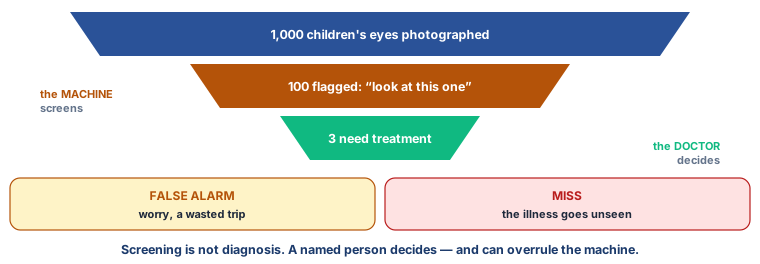
- Screening is not diagnosis. It sorts many cases fast so a person can look closely at the few that matter.
- Assistive AI helps someone do what they couldn't easily do: read aloud, write down speech, translate, practise at the right level.
- Human in the loop: a named person decides and can overrule the machine.
- Two kinds of wrong and somebody must choose which to guard against.
- A model trained on other people's data may work badly on ours: other accents, handwriting, faces, light.
In Indian health services today — a person still decides every time:
| Where | What the machine does | Who decides |
|---|---|---|
| TB screening | Reads a chest X-ray and flags likely TB (tools tested by the ICMR) | The doctor |
| SUMAN SAKHI, Madhya Pradesh | Answers women's health questions on WhatsApp, in Hindi | The woman and her health worker |
| Eye screening | Photographs the retina and flags eyes to look at | The doctor |
A teacher notices a child has stopped eating lunch. No model does that.
🕌 From our heritage
A thousand years ago Abū Bakr al-Rāzī (c. 865–925) did something no physician had done before: he separated smallpox from measles. Both bring fever and a rash, so they had been treated as one illness. Al-Rāzī watched many patients, wrote down the signs of each case, and showed that the two diseases differ in how they begin and how the rash appears. That is classification from carefully recorded features — exactly what a screening model does now, except that he did it with notes, patience and his own eyes.
Source: al-Rāzī, Kitāb fī al-Judarī wa-l-Ḥaṣba (The Book of Smallpox and Measles).
Debate it
A screening tool checks 1,000 children's eyes at a school camp. It flags 100 of them for a closer look. When the doctor examines all 100, only 3 turn out to need treatment.
Was the tool a failure? Would you rather it had flagged 4 children and found 2? Give your reason. There is no single right answer — but say what you are willing to accept, and for whom.
Check yourself — practice, not a test
1. An AI screening tool's proper job is to:
- ○ Diagnose the illness and name the treatment
- ○ Find the cases a person should look at closely
- ○ Replace the doctor at small health centres
- ○ Decide who cannot afford treatment
2. "Human in the loop" means a named person can overrule the model's output.
- ○ True
- ○ False
3. Match each tool to the person who stays in charge:
Eye-screening model at a camp · Practice questions that adapt to a child · Text read aloud for a blind student · Decision support inside telemedicine
Match with: The teacher · The student · The doctor4. A model misses a real illness. This kind of mistake is worse than a false alarm because:
- ○ It makes the model look bad
- ○ The person goes untreated and does not know
- ○ It costs the hospital money
- ○ It is harder to count
5. A tool trained on other people's handwriting may fail on ours, because the ______ it learned from did not look like us.
6. A platform that lets you train a model without writing any code is called a ______ platform.
7. Before AI chest X-ray tools were used in India's TB programme, they were:
- ○ Bought because they were cheapest
- ○ Tested and recommended by the ICMR
- ○ Trusted because the company said they worked
- ○ Used without anyone checking
Remember
The machine advises. A named person decides — and can say no.