Class 8 · Unit 3: Generative AI · Lesson 3.3 · 40 min
Images that were never photographed
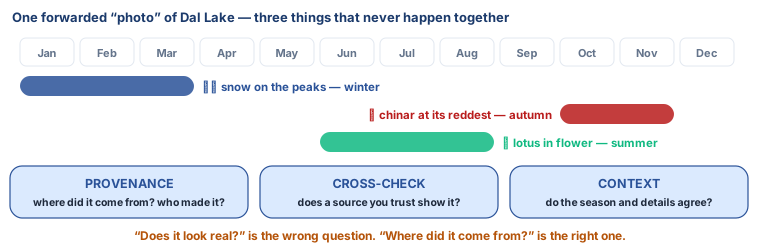
Snow on the peaks, the chinar at its reddest, lotus on the water — three different months in one “photograph”.
Today you will: Check where an image came from · Cross-check it against a trusted source · Use the details to test it
Story
The picture in the family group is beautiful: Dal Lake at sunrise, a shikara on still water, snow on the mountains behind — and the chinar on the bank in full autumn red.
Bilal: “Send it to everyone. Look at our Kashmir.” ('s uncle.)
Hiba looks longer. Snow on the peaks and chinar leaves at their reddest and lotus in flower on the water. Three different months, in one photograph.
Hiba: “Where did it come from?”
Nobody in the group knows. It was forwarded from another group, which got it from another.
Bilal: “Does it look real? Where did it come from?” (is the wrong question. is the right one.)
Watch
Where did this picture come from? — — scan code 8.3.3 in the printed book.
Warm up your fingers
Skill: symbols in web addresses, Term 2 (5 min)
- On typing.com, open the symbols practice your teacher has set.
- Today's keys are the ones a link needs:
/:.-_and the capital letters in a file name. - Type these three lines without looking down:
image-01.jpg·sources/school-calendar.png·https://www.cybercrime.gov.in
On the laptop
You need: images/ (eight numbered images, each with a teacher's note) · LibreOffice Calc · image-check.ods
Mission 1: Your mission
- ☐1
Columns: Image · Where did it come from? · Does another source show it? · Label or credential? · Trust: yes / no / can't tell · Why.
- ☐2
Predict: look at each image and write your gut feeling in brackets in the last column.
- ☐3
Now read each image's note file and fill Where did it come from? — who took it and when, or that it was generated, or that it arrived as a forward with no history.
- ☐4
For the two starred images, cross-check: does a source you trust show the same? Your teacher searches on the projector.
- ☐5
Fill Trust. An image nobody can trace is can't tell, however real it looks.
- ☐6
Count how many times you changed your mind from your gut feeling.
No laptop today?
The eight images and notes are printed and pinned up. Fill the table from the images alone, then again after each note is read out — and count the changes.
Now you know
- A generated image is made by prediction, like generated text. It records nothing that happened.
- Don't judge by looking. Tells like odd hands get fixed with every new version of the tools.
- Three checks that last: provenance, cross-check, context.
- Content credentials are a signed record of how a file was made. Present, they help; missing, they prove nothing.
- In India, realistic AI-generated content must be labelled under the IT Rules as amended in 2026, and removing the label isn't allowed.
🕌 From our heritage
In Class 6 you met the isnād — the chain of narrators that had to be unbroken before a report was accepted. Scholars did not ask whether a report sounded convincing; a beautiful, moving report with no chain was set aside, while a plain one with a sound chain was kept. A forwarded picture arrives with no chain at all: no one can say who made it or when. Content credentials are a modern attempt to attach a chain to a file. The question is a thousand years old — who told you this, and how do they know?
Source: ʿilm al-ḥadīth; see Class 6, Unit 2, Lesson 5, where isnād is taught as data provenance.
Debate it
A true photograph of a real flood, taken by a neighbour, is shared with no name, no date and no location. A generated picture of a flood that never happened is shared with a clear label saying which tool made it.
Which one would mislead more people? What does that tell you about labels, and about chains?
Check yourself — practice, not a test
1. The most reliable question to ask about an image is:
- ○ Does it look realistic?
- ○ Where did it come from, and who made it?
- ○ Do the hands look correct?
- ○ How many people forwarded it?
2. Advice like "count the fingers" is a permanent way to spot AI images.
- ○ True
- ○ False
3. Which of these strengthen trust in an image? (choose all)
- ○ A named photographer and a date
- ○ The same scene reported by a source you already trust
- ○ A content credential saying how the file was made
- ○ A caption in capital letters saying "100% REAL"
4. A signed record attached to a file saying how it was made is called a content ______.
5. Nobody in the group can say where a striking photo came from. You should record it as:
- ○ True, because it looks real
- ○ False, because nobody knows
- ○ Can't tell, and not forward it
- ○ True, because many people shared it
Remember
Don't ask "does it look real?" Ask "where did it come from?"