Class 8 · Unit 3: Generative AI · Lesson 3.4 · 40 min
Deepfakes and misinformation
It's the head teacher's voice: “School will remain closed tomorrow.” He never recorded it.
Today you will: Say what a deepfake is and how little it needs · Run Stop – Check – Share with a new question · Correct a rumour without shaming anyone
Story
The voice note is forty seconds long, and it is the head teacher's voice. Everyone in the class group knows that voice.
Teacher: “Due to the weather, school will remain closed tomorrow. Please inform all parents.”
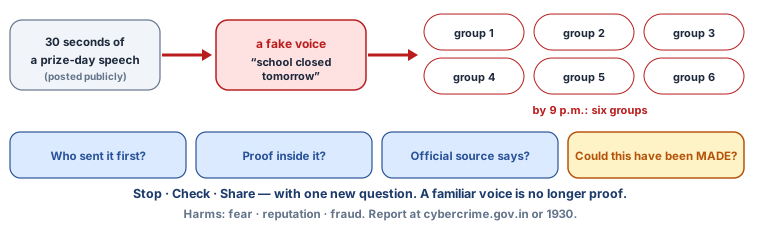
By nine at night it has reached six groups. By ten, a parent has rung the school office. The head teacher never recorded anything.
Somebody took a clip of him speaking at last year's prize day — thirty seconds, posted publicly — and used it to make a voice that says whatever they type.
In Class 6 you learned to check a message. Now the message can sound like someone you know.
Watch
When the voice is not the person — — scan code 8.3.4 in the printed book.
Warm up your fingers
Skill: punctuation for quoting, Term 2 (5 min)
- On typing.com, open the punctuation practice your teacher has set.
- Today's keys:
" "?!and the comma. You need them to quote a message exactly when you report it. - Type this line three times, exactly:
He said, "School is closed tomorrow." Is that true?
On the laptop
You need: forward-01.txt to forward-03.txt · official-sources.txt · LibreOffice Calc · stop-check-share.ods
Mission 1: Your mission
- ☐1
Columns: Message · Who sent it first? · Proof inside it? · Official source says? · Could this have been made? · Share / Don't share · What I'd do instead.
- ☐2
Fill a row for each forward — from the message itself first.
- ☐3
Check each against
official-sources.txt. Your teacher opens one official page on the projector. - ☐4
The new question: if someone wanted to fake this, could they? A known person's voice note: yes. A signed notice on an official site: much harder. Predict your answer before you decide.
- ☐5
Write the one calm line you'd actually send to the group — how to check, not a lecture. If it would embarrass whoever forwarded it, rewrite it.
No laptop today?
Your teacher reads each forward aloud twice. Fill the table in notebooks; three volunteers read their "what I'd send instead" lines, and the class picks the calmest.
Now you know
- A deepfake is generated video, audio or an image of a real person doing or saying what they never did.
- It needs very little a short public clip. A familiar voice is no longer proof.
- Three harms: fear, reputation, fraud (a known voice asking for money, an OTP or a password).
- If it targets you or someone you know: don't forward it, screenshot it, tell a trusted adult, report at cybercrime.gov.in or 1930.
- Send the check, not the shame.
Debate it
Someone can copy a voice from a few seconds of audio — and most of us have sent hundreds of voice notes.
Agree one rule your family could use to know that a call or voice note is really from you. Why would a code word work better than "I would recognise their voice"?
Check yourself — practice, not a test
1. A deepfake is:
- ○ Any photograph that has been edited
- ○ Generated video, audio or images of a real person, showing something they did not do
- ○ A message forwarded many times
- ○ A password that has been stolen
2. If a voice note sounds exactly like someone you know, it must be from them.
- ○ True
- ○ False
3. Put the steps in order when a worrying forward arrives:
- 1. Share only what you have checked
- 2. Ask whether it could have been made
- 3. Compare it with an official source
- 4. Check who sent it first and what proof is inside
- 5. Stop — do not forward it yet
4. India's national cybercrime helpline number is ______.
5. A relative's voice note asks you to send money urgently. Good responses include: (choose all)
- ○ Call them back on the number you already have
- ○ Ask something only they would know
- ○ Send the money because the voice is right
- ○ Tell an adult in the family before doing anything
Remember
A familiar voice is not proof. Check before you forward — and correct kindly.