Class 8 · Unit 3: Generative AI · Lesson 3.5 · 40 min
Hallucination: confident and wrong
The king is right. The architect never existed. The arches belong to someone else's bridge. Not one “perhaps”.
Today you will: Rate how sure a claim sounds — then check it · Mark claims true, false or can't tell · Rewrite one false claim with its source
Story
Bilal has to write half a page on a bridge in his own city. He asks an AI tool — through his teacher, on the class projector — and gets a beautiful paragraph: the bridge's age, the king who built it, the number of arches, the name of the architect.
His grandfather reads it and laughs, then stops laughing.
Teacher: “The king is right. The architect never existed. And that number of arches is somebody else's bridge.”
Bilal looks at the paragraph again. Nothing in it looks uncertain. There is no probably, no perhaps, no I am not sure.
A model that has never heard of your bridge will still write you a paragraph about it.
Watch
Fluent and wrong — — scan code 8.3.5 in the printed book.
Warm up your fingers
Skill: typing notes while you think, Term 2 (5 min)
- On typing.com, open the timed paragraph your teacher has set.
- Target: 30–35 WPM at 93%+, without looking at the keys.
- Then type these three, which you will use in the activity:
True·False·Can't tell — no source
On the laptop
You need: local-claims.txt (eight AI statements about your district) · sources/ · LibreOffice Calc · claim-check.ods — you're marking what an AI already said, not asking it anything
Mission 1: Your mission
- ☐1
Columns: Claim · How confident does it sound? (1–5) · Source I checked · True / False / Can't tell · What the source actually says.
- ☐2
Predict: fill the confidence column before checking anything. Most will be a 5.
- ☐3
Check each claim against
sources/. If nothing settles it: Can't tell — no source. Don't mark it false just because you couldn't find it. - ☐4
Count the true, false and can't tell.
- ☐5
Look at confidence beside the verdicts. One sentence: what do you notice?
- ☐6
Rewrite one false claim as it should read, with the source beside it.
No laptop today?
The claims go on the board. Each group gets one source document and reports on the claims it can settle. The class fills the table together — the can't tell column is usually longest.
Now you know
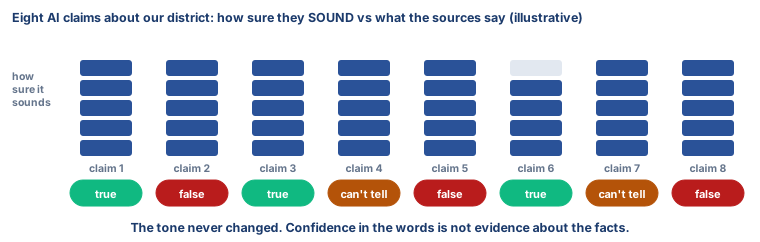
- A hallucination is a confident, fluent statement that is simply false. It comes from how the model works; it can't be switched off.
- The model predicts likely words. It doesn't look anything up or compare with the world.
- It sounds sure of everything because it learned the shape of factual writing.
- It's worse on local questions little is written about our villages and shrines.
- Use only checked facts. Named source, or leave it out. Can't tell is a real answer.
🕌 From our heritage
Saying I do not know was treated as a mark of a serious scholar, not a weak one. Imam Mālik ibn Anas (d. 795) is remembered for answering question after question with "lā adrī" — I do not know — rather than filling the gap. The Qur'ān states the principle directly: "Do not follow what you have no ˹sure˺ knowledge of" (Al-Isra 17:36). A language model has no lā adrī setting. You have to supply it.
Sources: Qur'ān 17:36, translation by Dr. Mustafa Khattab, The Clear Quran*; the "lā adrī" reports about Imam Mālik are widely transmitted in biographical literature.*
Debate it
A tool that answered "I do not know" to every question it was unsure about would be far less impressive to use, and far more useful.
Why do you think tools are not built that way? Who benefits from an answer that always sounds certain?
Check yourself — practice, not a test
1. A hallucination in a generative model means:
- ○ The model has stopped working
- ○ It states something false as if it were fact
- ○ It refuses to answer
- ○ It repeats the question back
2. The more confident the wording sounds, the more likely the fact is correct.
- ○ True
- ○ False
3. Hallucinations are more likely when you ask about:
- ○ Very common world facts
- ○ Local people, places and events that little has been written about
- ○ Simple arithmetic
- ○ The spelling of an English word
4. If no source can settle a claim, the honest verdict is ______ tell.
5. Which of these make a generated fact safe to use? (choose all)
- ○ A source you have read that says the same
- ○ It was written fluently
- ○ A second, independent source
- ○ The model repeated it when asked twice
Remember
Fluent is not the same as true. No source, no sentence.