Class 8 · Unit 4: Data and fairness · Lesson 4.4 · 40 min
Inclusivity: who is left out?
She draws a kangri. “Bucket? Basket? Purse? Lantern?” It never gets there. It has never seen one.
Today you will: Test a tool on your own world · Find who it leaves out · Say why that's about data, not people
Story
Hiba's cousin in Class 5 is playing a drawing game on the school laptop. The computer has to guess what she is drawing.
She draws a cat. "I see a cat!" She draws a bicycle. "Bicycle!" She draws a kangri, carefully, with the wicker and the handle.
The computer guesses: bucket · basket · purse · lantern. It never gets there.
Hiba: “It's broken.”
Hiba: “It isn't broken. Nobody ever showed it a kangri. It has seen a million buckets and not one of ours.”
Watch
The things it has never seen — — scan code 8.4.4 in the printed book.
Warm up your fingers
Skill: typing while you think (Term 2 focus, 6 min)
- On typing.com, do one paragraph lesson.
- Then type this sentence five times, correcting mistakes as you go:
A tool that has never heard my language cannot serve me well.
On the laptop
You need: Quick, Draw! (quickdraw.withgoogle.com, no account) · inclusion-log.ods · handwriting-cards.pdf · objects-list.txt
Test 1: Objects it has never seen (8 min, in pairs)
Mission 1: Your mission
- ☐1
Play one round of Quick, Draw! as it comes; note how fast it guesses.
- ☐2
Predict: which local object will it never guess? Then draw from
objects-list.txt: kangri, samovar, pheran, tumbaknari, a chinar leaf, a shikara. Record every guess. - ☐3
Objects only — never a person or a name. Your drawings go into a public collection.
Test 2: Handwriting (6 min)
- ☐4
Read the same six words in four handwriting styles (
handwriting-cards.pdf). Which would a computer find hardest, and why? (If your lab has offline handwriting recognition, try it.) Test 3: Voice — teacher-operated (5 min)
- ☐5
The teacher runs a speech tool. Several of you say the same English sentence, then one with Anantnag, Pampore, Baramulla, Ganderbal. Record where it failed. Nobody's voice is saved.
Finish (3 min)
- ☐6
For each test: who would this fail? — a shopkeeper, a grandmother, a Class 2 child, a farmer describing a disease in Kashmiri.
No laptop today?
The teacher runs Tests 1 and 3 at the front; Test 2 needs only the printed cards. Everyone fills the last column — who would this fail? — and that's the part that's assessed.
Now you know
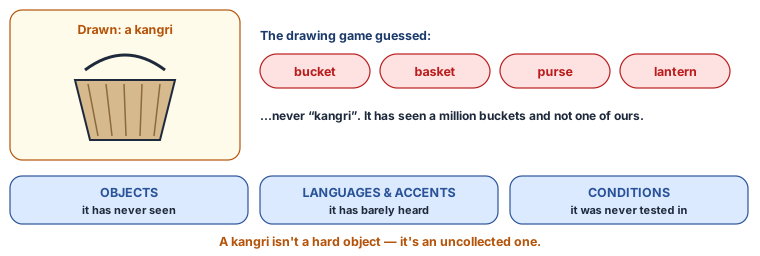
- A model recognises what it was trained on, and nothing else. A kangri isn't hard — it's uncollected.
- Left out in three ways: objects it never saw, languages and accents it barely heard, conditions it was never tested in.
- The people left out are usually furthest from the people collecting: other languages, regions, ages, cameras.
- Testing a tool on your own world needs no permission, account or code — and it's real evidence.
🕌 From our heritage
The Qur'ān says God made people "peoples and tribes that you may know one another" (Al-Ḥujurāt 49:13). Knowing one another is the point of the difference — not flattening it. A tool that has never heard your language, or seen the things in your house, cannot know you yet. Building so that it can is work worth doing, and it starts with noticing who is missing. Qur'ān 49:13, Sūrat al-Ḥujurāt.
Debate it
A company says: "We will add Kashmiri when there is enough demand. Right now it isn't worth the cost."
Is a language worth supporting only when it is profitable? If not, who should pay — the company, the government, or the people who speak it?
Check yourself — practice, not a test
1. The drawing tool cannot recognise a kangri. The best explanation is:
- ○ A kangri is too complicated to draw
- ○ Almost nobody put kangris in its training data
- ○ The tool is broken
- ○ The drawing was not good enough
2. A language with little recorded or written data available for training AI is called a ______ language.
3. If a speech tool struggles with a Kashmiri accent, it means the speaker is pronouncing the words wrongly.
- ○ True
- ○ False
4. Match each failure to what is missing:
Cannot recognise a samovar · Types the wrong word for Pampore · Fails on a photo taken in a dim winter classroom · Suggests far fewer videos in Kashmiri than in English
Match with: accents and names it never heard · a language with little data collected · objects it was never shown · conditions it was never tested in5. Which of these are fair ways to test a tool for inclusion? (choose all that apply)
- ○ Try it with objects that are ordinary here and rare elsewhere
- ○ Try it in the light your classroom actually has
- ○ Test it only on the examples the company chose
- ○ Ask whether it works as well in the languages your family speaks
Remember
A tool is not "accurate". It is accurate for the people it was trained on. Test it on yours.