Class 8 · Unit 4: Data and fairness · Lesson 4.5 · 40 min
Accountability: who answers for it?
The app said healthy — in green, with a tick. It wasn't. The company, the shop and the officer all have an answer ready.
Today you will: Play four roles around one AI failure · Check for bias, supervision and transparency · Write a rule before the tool is switched on
Story
The leaf app tells Bilal's uncle his Ambri tree is healthy. It is not. By the time anyone notices, the crop from that corner of the orchard is worth a fraction of what it should be.
Everybody has an answer ready.
The company says: "The app is a guide. The terms say so." The shopkeeper who installed it says: "I only sold the phone." The agriculture officer says: "He should have called us." His uncle says: "It said healthy. In green. With a tick."
Bilal: “Somebody has to answer for this.”
Hiba: “Yes. The hard part is deciding who, before it happens — not after.”
Watch
Who answers for it? — — scan code 8.4.5 in the printed book.
Warm up your fingers
Skill: writing a short statement, fast (Term 2 focus, 6 min)
- On typing.com, do one paragraph or punctuation lesson.
- Then type this in Writer in under two minutes, punctuation included:
If this tool is wrong, the person who answers is: ____. They will do the following: ____.
On the laptop
You need: case-cards.pdf (four cases) · LibreOffice Calc · accountability-log.ods · your logs from Lessons 4.3 and 4.4
Four roles (in groups of four): Builder (chose the data) · School or employer (chose to use it) · User (had no say) · Regulator (writes one rule).
Four cases: the leaf app calls a diseased Ambri tree healthy · a hiring tool learns to prefer men · an attendance camera fails in December light · a homework checker marks local English wrong.
Mission 1: Your mission
- ☐1
Read your case aloud. Each person states their position in one sentence, in role.
- ☐2
Fill the log: bias check (what should have been measured before release?) · human supervision (which decision must a person review?) · transparency (what should it have told the user?).
- ☐3
Predict: who will your group decide answers for it? Then decide, in one sentence — and what each party must do: apologise, repay, fix, withdraw, publish.
- ☐4
The regulator writes: "Before an AI tool is used on people in a school, it must ___."
- ☐5
Swap with another group: would your rule have prevented their case?
No laptop today?
The roles work the same round a desk, with the log on one sheet. Read the rules aloud; the class votes on the two clearest.
Now you know
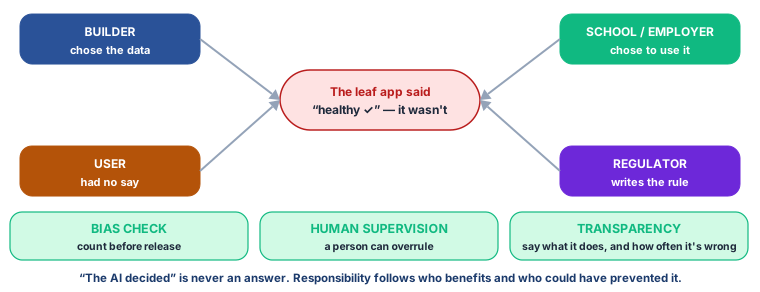
- Accountability means a named person or organisation can be asked to explain and put it right. If everyone can point elsewhere, there is none.
- CBSE's three measures: a bias check before release · human supervision with the power to overrule · transparency about what it does and how often it's wrong.
- "The AI decided" is never an answer. People chose the data, the threshold and where to install it.
- Write the rule before switching it on. Arguing after the harm is much harder.
🕌 From our heritage
Muslim jurists worked from a maxim taken from a ḥadīth: al-kharāj bi'l-ḍamān — the yield belongs to the one who bears the liability. Whoever takes the benefit of a thing carries the loss if it causes harm. A company that profits from a tool it built, on data it chose, cannot hand the loss to a farmer and keep the gain. Sunan Abī Dāwūd, Book of Sales, and Jāmiʿ al-Tirmidhī, Book of Sales (exact numbering varies by edition).
Debate it
The company adds one line to its app: "This is a guide only. Always consult an agriculture officer." Nothing else changes.
Has it become more transparent, or just better protected? What would real transparency have looked like here?
Check yourself — practice, not a test
1. Which are CBSE's three measures for a fairer AI system? (choose all that apply)
- ○ A bias check before release
- ○ Human supervision of important decisions
- ○ A higher confidence score
- ○ Transparency about what the tool does and how often it is wrong
2. A hiring tool learned to prefer men. The root cause was:
- ○ The tool disliked women
- ○ It learned from past hiring that had favoured men
- ○ There was not enough computing power
- ○ The applicants wrote poor applications
3. "The algorithm decided" is an acceptable answer when an AI system causes harm.
- ○ True
- ○ False
4. Measuring the gaps in a dataset before a tool is released is called a ______ check.
5. Put a responsible release in order:
- 1. Define the problem and decide whether AI is needed
- 2. Run a bias check on the training data
- 3. Decide who supervises the decisions, and how they overrule
- 4. Release it, then monitor and fix
- 5. Tell users plainly what it does and how often it is wrong
Remember
Whoever takes the benefit answers for the harm. Decide who that is before you switch it on.