Class 8 · Unit 5: Responsible AI · Lesson 5.1 · 40 min
Privacy in an AI world
Danish pasted his whole essay into a free app — name, birthday, village and all. "It even remembered it from last week." Remembered it where?
Today you will: Find what a tool keeps, in its own words · Ask the three questions of any AI tool · Write a data note people read before they type
Story
Bilal's cousin Danish is applying to college. He has pasted his whole application essay into a free AI writing app to "fix the English" — and with it his full name, his date of birth, his father's job, and the name of the village where the family land is.
Danish: “It's free. It even remembered my essay from last week.”
Hiba looks up from her book. "It remembered it. Where?"
Danish shrugs. "On their computer, I suppose."
Hiba: “For how long? Who else can read it? And if it's free, what are they getting out of you?”
In Class 6 you learned that your data is yours. This year: once you type it into an AI tool, where does it go, and how would you find out?
Watch
Where your words go — — scan code 8.5.1 in the printed book.
Warm up your fingers
Skill: typing your own words at speed (Term 3 focus, 7 min)
- On typing.com, do one Advanced paragraph lesson.
- Then close it and type this from memory, in Writer, as fast as you can while staying accurate: "What does it keep? For how long? Who can see it?"
- Your Term 3 goal is 32–38 WPM at 94% accuracy — against your own last score.
On the laptop
You need: a browser (reading only — nobody signs up, nobody types into the tool) · policy-hunt.ods · data-note-template.odt
Mission 1: Read the policy, not the advert (pairs, 9 min)
- ☐1
Open
policy-hunt.odsand save a copy aspolicy-<your group code>.ods. Your teacher opens one AI tool's policy page on every laptop. - ☐2
Predict: will the page say how long it keeps what you type? Write yes or no at the top.
- ☐3
Press Ctrl + F and search for train, retain (or keep), delete, share, child. Copy each sentence you find into What it says.
- ☐4
In What that means for me, rewrite it in under fifteen words. "Could not understand it" is a real finding.
- ☐5
Answer the three questions at the bottom: What does it keep? For how long? Who sees it? If the page doesn't say, write not stated. Don't guess. Was your prediction right?
Mission 2: The class data note (whole class, 6 min)
- ☐6
Each pair gives the projector one plain sentence beginning "If you type something into this tool…".
- ☐7
The class agrees six. The teacher prints the note for the lab wall — short enough to read before you type.
No laptop today?
The teacher reads four sentences from a printed policy. In pairs, rewrite each in under fifteen words and mark it 🟢 clear · 🟡 hard · 🔴 impossible. Then discuss: if nobody can read a page, whom does that protect?
Now you know
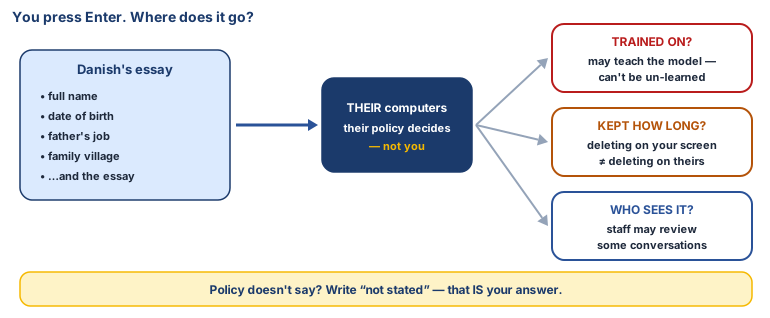
- An AI tool runs on someone else's computers. What happens to your words there is decided by their policy, not by you.
- Training data is what a model learns from. Many tools may learn from your chats unless you switch it off — and what's learned can't be pulled back out.
- Retention is how long they keep it. Deleting from your screen ≠ deleting from theirs.
- Three questions, any tool: what does it keep? for how long? who sees it? Not stated is an answer.
- Free still has a price. And other people's details are never yours to paste in.
🕌 From our heritage
The Qur'ān says: "Indeed, Allah commands you to return trusts to their rightful owners" (An-Nisa 4:58). In Class 6 you learned that a password you hold is a trust. This works the other way too: when a company holds your data, it is holding something that belongs to you — and a trust can be betrayed by the powerful just as easily as by the weak. Asking a company what it keeps is not rudeness. It is asking after your own.
Source: Qur'ān 4:58, translation by Dr. Mustafa Khattab, The Clear Quran.
Debate it
A free AI app offers to check your homework. Its policy says your work may be used to train the model, and that you can turn this off in the settings.
Is it wrong of the company to offer this? What would make the offer fair? And does "you can turn it off" mean much, if nobody reads far enough to find the switch?
Check yourself — practice, not a test
1. Deleting a conversation from your screen always deletes it from the company's computers too.
- ○ True
- ○ False
2. The best way to find out what an AI tool keeps is to:
- ○ Ask a friend who uses it
- ○ Read the tool's own policy page and search it for "train", "keep" and "delete"
- ○ Look at the app's advertisement
- ○ Assume it keeps nothing, because it is free
3. Which of these should you not paste into an AI tool? (choose all that apply)
- ○ A classmate's phone number
- ○ A maths question from the textbook
- ○ Your father's bank details
- ○ A photo of a friend, without asking them
4. The examples a model learns from are called its ______ data.
5. How long a company keeps your data after you delete it is called ______.
Remember
You cannot unsay what you have typed. Ask three questions first: what is kept, for how long, and who sees it.