Class 8 · Unit 5: Responsible AI · Lesson 5.2 · 40 min
Check before you share
Five messages in the family group before breakfast. A ₹10,000 scholarship, a collapsed bridge, a miracle cure, a school notice, a teacher's voice. Uncle has forwarded four.
Today you will: Run four checks on five real-looking messages · Say "cannot tell" — and mean it · Know the four things you never share
Story
Five messages reached Bilal's family group before breakfast.
One says the government is giving ₹10,000 to every student, and asks for a bank account number and the OTP that arrives after. One has a photograph of a collapsed bridge, "in Srinagar, today". One says saffron cures every illness and that doctors are hiding it. One is a school notice about a parents' meeting. One is a voice note that sounds like Bilal's own maths teacher, saying tomorrow's homework is cancelled.
His uncle has already forwarded four of them.
Bilal: “Which one is true?”
Hiba is not sure either. "That is the point," she says. "None of us knows. But everyone has already shared them."
Before you forward something, what would you have to do to know?
Watch
Four questions before you forward — — scan code 8.5.2 in the printed book.
Warm up your fingers
Skill: typing accurately under time pressure (Term 3 focus, 6 min)
- On typing.com, do one Advanced accuracy drill.
- Then type the four steps from memory in Writer, on four lines: Check the source · Verify on a trusted site · Read beyond the headline · Think critically.
- Term 3 goal: 32–38 WPM at 94% accuracy, measured against your own last score.
On the laptop
You need: messages-5.ods · a browser, only for the sites listed in the sheet · fact-check-template.odt
Mission 1: Run the routine on five messages (pairs, 14 min)
- ☐1
Open
messages-5.odsand save a copy asmessages-<your group code>.ods. The five messages from the story are in column A. - ☐2
Predict: which ones are true? Mark your guess in the grey column before you check anything.
- ☐3
For each message fill four columns: Who sent it first? · What date? · On a trusted site? · Does the detail match the headline? Where it doesn't say, type not stated — that is evidence.
- ☐4
Check only on the listed sites: the J&K government site, two newspapers, the school's notice board photo.
- ☐5
Give a verdict — True, False or Cannot tell — and what you'd do: forward, don't, or ask first. A message you can't check is a message you don't forward.
Mission 2: The class fact-check sheet (whole class, 6 min)
- ☐6
On the projector, the class writes the four checks in its own words, plus one line: Never share: OTP · bank details · password · PIN.
- ☐7
Print it. Everyone takes one home — the people forwarding these are usually not children.
No laptop today?
The five messages are printed on cards. Pairs sort them into True, False and Cannot tell, and write the reason on the back of each — the reason matters more than the pile. Draft the fact-check sheet on the board and copy it into notebooks.
Now you know
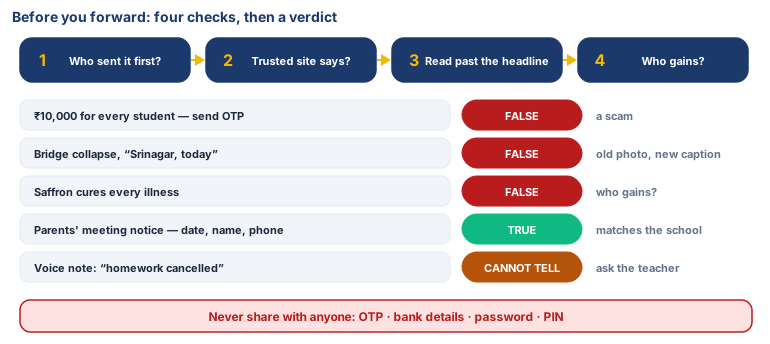
- Misinformation is false information that spreads. Most people forwarding it aren't lying — they just never checked.
- Four checks, in order: the source · a trusted site · past the headline · who gains?
- "Cannot tell" is an honest verdict. You don't need proof it's false to not forward it.
- AI can now make a photo, a story and a voice. Judge the source, not the polish.
- Never share with anyone: an OTP, bank details, a password, a PIN. No real office asks in a message.
🕌 From our heritage
The Prophet ﷺ said: "It is enough of a lie for a man to narrate everything he hears." Not that he lied deliberately — only that he passed on whatever reached him. Forwarding is narrating. In Class 6 you learned how the ḥadīth scholars checked a chain before accepting a report; this is the same discipline pointed at your own thumb.
Source: Ṣaḥīḥ Muslim, Introduction, ḥadīth 5, chapter on the prohibition of narrating everything one hears.
Debate it
Bilal's uncle forwards the scholarship message because he wants to help students. He gains nothing, and he means well.
Is he responsible for the harm if a family loses money? Does meaning well make a difference — and what should he do now that he has already sent it?
Check yourself — practice, not a test
1. Put the four verification steps in the order you would use them:
- 1. Think critically about who gains
- 2. Verify on a trusted site
- 3. Check the source
- 4. Read beyond the headline
2. A message has no name, no date and no link. The best verdict is:
- ○ It is false
- ○ It is true, since nobody would make it up
- ○ Cannot tell — so do not forward it
- ○ Forward it and ask people to check
3. Which of these do you share with nobody? (choose all that apply)
- ○ An OTP
- ○ The name of your school
- ○ Your bank account PIN
- ○ Your password
4. A photograph that looks completely real proves the event happened.
- ○ True
- ○ False
5. False information that spreads, whether or not the sender knows it is false, is called ______.
Remember
If you cannot say where it came from, you cannot say it is true — so do not pass it on.