Class 8 · Unit 5: Responsible AI · Lesson 5.3 · 40 min
AI and work
Four months to embroider one shawl. In the bazaar: one that looks the same, at a fifth of the price, labelled "Kashmiri handmade". So the machine wins?
Today you will: Split a job into tasks, not a yes/no · Say why some tasks are hard to automate · Make one honest slide about work you know
Story
Hiba's neighbour Rafiqa weaves sozni embroidery. It takes her four months to finish a shawl. In the bazaar last week she saw a shawl that looked almost the same, priced at a fifth of hers, machine-made in another state and labelled "Kashmiri handmade".
Bilal: “So the machine wins.”
Rafiqa: “Look closer.” (She turns her shawl over. The back is as neat as the front. Then she shows them the label sewn into the corner: a GI tag with a QR code. Scan it, and it says where this shawl was made, and by whom.)
Rafiqa: “The machine can copy my pattern. It cannot copy where it came from.”
Which parts of somebody's work can a machine take over — and which parts cannot?
Watch
What machines take, and what they leave — — scan code 8.5.3 in the printed book.
Warm up your fingers
Skill: typing from your own notes (Term 3 focus, 6 min)
- On typing.com, one Advanced paragraph lesson.
- Then, in Writer, type the names of five kinds of work done in your area — no names of people — as fast as you can, correctly spelled.
- Term 3 goal: 32–38 WPM at 94% accuracy, against your own last score.
On the laptop
You need: LibreOffice Calc · work-cards.ods (twelve tasks) · LibreOffice Impress · work-slide-template.odp
Mission 1: Which tasks, not which jobs (pairs, 12 min)
- ☐1
Open
work-cards.odsand save a copy aswork-<your group code>.ods. It lists twelve tasks, not jobs — sorting apples by size, embroidering a shawl, telling a visitor which road is open… - ☐2
Predict: how many of the twelve will you mark Easy? Write the number in the grey cell.
- ☐3
In column B mark each Easy, Partly or Hard to automate. In column C, why — under ten words. The why is the lesson.
- ☐4
Sort by column B (Data → Sort). What do the easy ones share? The hard ones?
- ☐5
Finish the green cell: "Tasks are easiest to automate when they are ______."
Mission 2: One honest slide (alone, 8 min)
- ☐6
In the template, make one slide, "AI and the work I know": the kind of work · one task a machine could do today · one that needs a person · what that person should learn next.
- ☐7
No names, no photos of people, no family income. Write about the work. Would rather not use your family? Pick one of the six job cards in the template.
- ☐8
Save as
work-slide-<your roll number>.odp. Three volunteers present.
No laptop today?
Sort the twelve printed task cards into three columns on a desk, with the reason on the back of each. Draw the slide on paper, in the same four parts.
Now you know
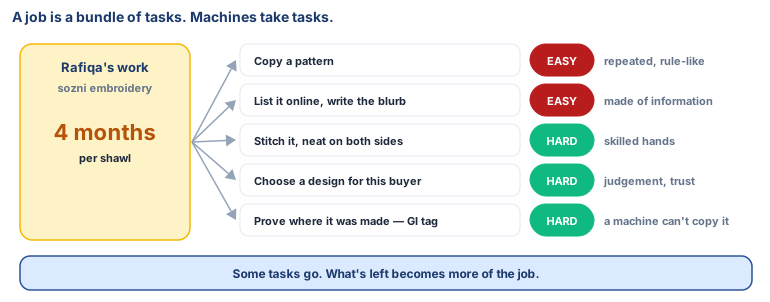
- A job is a bundle of tasks. AI takes tasks; the job changes shape — it rarely vanishes overnight.
- Automated first: tasks that are repeated, rule-like, made of information.
- Last longest: skilled hands, judgement in an unclear case, trust, knowledge of one place.
- New work appears labelling data, checking a model's output, keeping machines running.
- Provenance can be worth more than the product. A GI tag proves where it came from; a copy can't.
🕌 From our heritage
The Prophet ﷺ said: "Nobody has ever eaten a better meal than that which one has earned by working with one's own hands," and noted that the Prophet Dāwūd ate from the work of his own hand. Skilled work has never been treated in our tradition as something to escape from. When a machine takes over a task, the question is not whether work matters, but which work is now ours to do well.
Source: Ṣaḥīḥ al-Bukhārī 2072, Book of Sales and Trade, chapter on a person's earnings and manual labour.
Debate it
A machine-made shawl costs a fifth of a hand-embroidered one and looks similar to most buyers.
Is it wrong to sell the machine-made shawl? What exactly makes it wrong to label it "handmade"? And who is harmed — the buyer, the weaver, or both?
Check yourself — practice, not a test
1. Which task is easiest to automate?
- ○ Deciding whether a family can be trusted to repay a loan
- ○ Sorting apples into three sizes on a moving belt
- ○ Guiding visitors along a mountain path after heavy snow
- ○ Embroidering a sozni shawl by hand
2. Which features make a task easy to automate? (choose all that apply)
- ○ It is repeated many times
- ○ It follows clear rules
- ○ It needs trust between two people
- ○ It is done on information rather than materials
3. When AI enters an industry, the number of different kinds of work always falls.
- ○ True
- ○ False
4. A ______ tag, now carrying a QR label on Kashmiri crafts, proves where a product was really made.
5. Match each change to the work it affected:
Controlled-atmosphere stores · Translation apps · Machine-copied patterns
Match with: part of a tourist guide's day · the price of imitation shawls · when apples can be sold
Remember
AI takes tasks, not whole jobs. Ask which tasks go, and what is left for a person to do well.