Class 8 · Unit 5: Responsible AI · Lesson 5.4 · 40 min
The environment costs something
The lab's power is off again. "At least the AI still works — it doesn't use our electricity." Then whose does it use?
Today you will: Work out what our class's questions cost · Give a range — with its source and year · Name the habits worth changing
Story
The lab has lost power again. Bilal sighs and shuts the laptop lid.
Boy: “At least the AI still works. It's on the internet. It doesn't use our electricity.” (at the next desk.)
Hiba thinks about this. "It doesn't use ours," she says slowly. "So whose does it use?"
Nobody in the room knows. The model Bilal used this morning runs in a building he has never seen, in a country he has never visited, and that building is drawing power and cooling itself while he sits in the dark.
Every answer arrives from somewhere. What does it cost to produce, and who pays that?
Watch
Where the answer is made — — scan code 8.5.4 in the printed book.
Warm up your fingers
Skill: numbers and units at speed (Term 3 focus, 6 min)
- On typing.com, one number row accuracy drill.
- Then type these in Writer, exactly, including units:
415 TWh,945 TWh,5,400,000 L,500 ml,1.5%. - Term 3 goal: 32–38 WPM at 94% accuracy, against your own last score.
On the laptop
You need: LibreOffice Calc · energy-cards.ods (each published figure with its source and year)
Mission 1: Work it out for our class (pairs, 12 min)
- ☐1
Open
energy-cards.odsand save a copy asenergy-<your group code>.ods. - ☐2
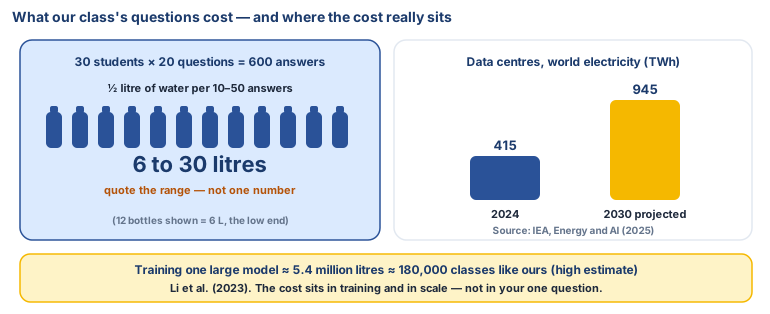
Predict: 30 students ask 20 questions each. How much water is that — a cup, a bucket, a tank? Write your guess.
- ☐3
That's 600 answers. At one 500 ml bottle per 10–50 answers, type
=600/50*0.5and=600/10*0.5. Write the range as a sentence. How close was your guess? - ☐4
In column D: why do the two answers differ five times — and which would you quote? (The range. That's the honest answer.)
- ☐5
In the yellow block, divide the training figure (5,400,000 litres) by your high estimate. How many classes like ours make one training run? What does that say about where the cost sits?
- ☐6
Chart data-centre electricity in 2024 and the projection for 2030 (Insert → Chart). Title it with the source and year — a chart without its source isn't evidence.
Mission 2: Deliberate use (whole class, 6 min)
- ☐7
On the board: three habits that cost a lot for little gain — forty images to pick one, a training run repeated with nothing changed, asking a model what a textbook says in a line.
- ☐8
Beside each, the deliberate version. Keep the list — Lesson 5 turns it into a rule.
No laptop today?
Do the sums in notebooks from figures on the board — the arithmetic is the lesson, not the spreadsheet. Draw the two-bar chart by hand, with its source underneath.
Now you know
- Answers are made in data centres, which use electricity and, for cooling, water. The cost is real, and it's paid somewhere else.
- Training is a huge one-off cost. Answering is tiny — repeated billions of times.
- Estimates vary and go stale. Always give the source and year, and quote a range.
- Responsible isn't refusing AI. It's using it deliberately — not forty images to choose one.
🕌 From our heritage
The Qur'ān says: "…eat and drink, but do not waste. Surely He does not like the wasteful" (Al-A'raf 7:31). Isrāf — excess — is not about having little. It is about using more than the purpose needs. A computer in another country is still using water that someone, somewhere, needs.
Source: Qur'ān 7:31, translation by Dr. Mustafa Khattab, The Clear Quran.
Debate it
A hospital uses an AI system that consumes a great deal of electricity, and it finds illnesses earlier than doctors working alone.
Is that cost worth paying? Who should decide — and would your answer change if the same electricity were used to generate birthday images?
Check yourself — practice, not a test
1. Using an AI tool on your laptop costs nothing beyond your own electricity.
- ○ True
- ○ False
2. Training a large model compared with answering one question is:
- ○ Smaller, because it happens once
- ○ Much larger as a single event, while answering is small but happens billions of times
- ○ Exactly the same
- ○ Free, because it only happens once
3. Large buildings full of computers, where AI models run, are called ______ centres.
4. You read that "AI uses 500 ml of water per question". The best response is to:
- ○ Repeat it, since it is a specific number
- ○ Ask which model, which year and which study it came from
- ○ Double it to be safe
- ○ Ignore all figures, since they disagree
5. Which are examples of deliberate use? (choose all that apply)
- ○ Asking one clear question instead of ten vague ones
- ○ Generating forty images to pick one
- ○ Checking the textbook first when it answers the question
- ○ Changing one thing before training again
Remember
Free to you is not free to everyone. Quote the source, the year and the range.