Class 8 · Unit 5: Responsible AI · Lesson 5.5 · 40 min
Our class AI charter
The head teacher has a problem: teachers and parents are asking about AI, and she has no rules. "You've studied it all year. Write me rules I can put on a wall — and actually follow."
Today you will: Name the four marks of responsible AI · Write rules someone could actually check · Sign a charter the school keeps too
Story
The head teacher has heard that Class 8 has spent a year on AI, and she has a practical problem. Teachers are asking her whether pupils may use AI tools for projects. Parents are asking whether the school uses AI on their children's data. She has no answer to give either of them.
Teacher: “You have studied this all year. Write me the rules. Not a speech — rules I can put on a wall and actually follow.” (she tells Hiba's class.)
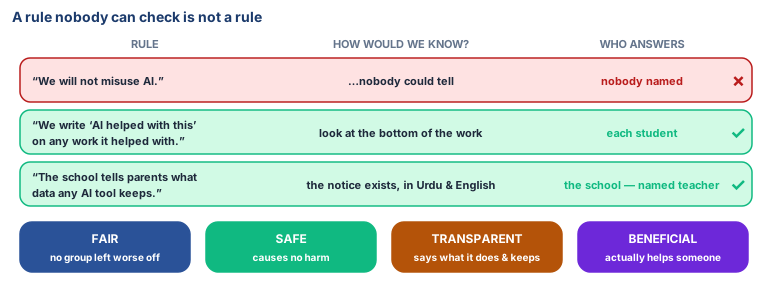
Bilal starts with "We will not misuse AI."
Hiba reads it back to him. "How would anyone know if we broke that?"
A rule nobody can check is not a rule. What would yours be?
Watch
From "can we?" to "should we?" — — scan code 8.5.5 in the printed book.
Warm up your fingers
Skill: clean typing of a final document (Term 3 focus, 5 min)
- On typing.com, one short Advanced accuracy drill.
- Then type your group's first rule in Writer, correctly spelled and punctuated, ready to paste into the charter. This document is going on a wall, so accuracy beats speed today.
- Term 3 goal: 32–38 WPM at 94% accuracy, against your own last score.
On the laptop
You need: LibreOffice Writer · charter-draft.odt (four columns: Rule · Why · How we'd know · Who is responsible) · charter-final.odt
Mission 1: Four groups, four marks (groups, 12 min)
- ☐1
Each group takes one mark of responsible AI: fair, safe, transparent or beneficial. Save
charter-draft.odtascharter-<your mark>.odt. - ☐2
Write three rules, each beginning "We will…". Draw on the year: the data questions (5.1), the four checks (5.2), honest use (Unit 3), bias checks (Unit 4), deliberate use (5.4).
- ☐3
Predict: which of your three rules will fail the class's test? Mark it with a star.
- ☐4
Column 3 is the test: how would anybody know whether we kept it? Column 4: students, the teacher, the school or a named role. If no one can be named, the rule isn't ready.
Mission 2: Merge, cut and sign (whole class, 10 min)
- ☐5
Each group reads its rules aloud. The class asks each one: how would we know? Rules that can't answer are rewritten or dropped. Was your starred rule the one?
- ☐6
The teacher merges the survivors into
charter-final.odt. Cut to eight to ten — a charter nobody remembers is one nobody follows. - ☐7
Check all four marks are there, and that at least one rule names the school. The duties don't all run one way.
- ☐8
Print it. Those who agree sign. One copy for the lab wall, one for the head teacher.
No laptop today?
Groups write their rules on chart-paper strips. The class sorts them under the four marks, applies how would we know? aloud, and copies the final charter onto chart paper for signing.
Now you know
- AI ethics are the values that guide how AI is designed, built and used. They answer should, not can.
- Responsible AI is fair · safe · transparent · beneficial.
- Accountability means a name is attached: who checks it, who fixes it, who answers.
- A rule is real only if someone could tell it had been broken.
- Rules bind the powerful too. A charter asking nothing of the school is just a notice.
🕌 From our heritage
The Qur'ān describes a community whose "affairs are decided by mutual consultation" (Ash-Shūrā 42:38). Shūrā is the reason this charter is written by the class rather than handed to it: rules that people have argued over and agreed to are the ones that are kept. The same verse is why your teacher will ask the head teacher to discuss it with you, not simply approve it.
Source: Qur'ān 42:38, translation by Dr. Mustafa Khattab, The Clear Quran.
Debate it
Your charter says: "We will always say when we have used AI in our work."
What should happen when someone breaks that rule — and who decides? Would your answer be the same if the person who broke it were a teacher rather than a student?
Check yourself — practice, not a test
1. The values and principles guiding how AI is designed, built and used are called AI ______.
2. Which are the four marks of responsible AI? (choose all that apply)
- ○ Fair
- ○ Safe
- ○ Fast
- ○ Transparent
- ○ Beneficial
3. Which is a checkable rule?
- ○ We will respect technology
- ○ We will have a positive attitude to AI
- ○ We will write "AI helped with this" at the bottom of any work an AI tool helped us with
- ○ We will not misuse AI
4. A rule that everyone in general is responsible for is stronger than one with a named person.
- ○ True
- ○ False
5. Put the charter steps in order:
- 1. Test each rule: how would we know?
- 2. Sign it and take it to the head teacher
- 3. Cut the list to eight or ten
- 4. Draft rules in groups
Remember
A rule nobody can check is not a rule. Name what we do, and name who answers for it.