Class 9 · Unit 1: The AI project cycle, and ethics · Lesson 1.2 · 40 min
Problem scoping: 4Ws, stakeholders, ethics
Eleven students out of thirty-four, on a day the road was clear. “The problem is snow,” says Bilal. Is it?
Today you will: Fill a 4Ws canvas with evidence · List stakeholders and what could go wrong for them · Tell ethics from morality
Story
The club has chosen its problem, and it is not the exhibition-friendly one.
In January, Class 9 sat with eleven students present out of thirty-four. Not a snow day — the school was open, the road was clear by nine. Eleven.
Bilal: “So the problem is snow.”
Hiba: “Is it? Sameer lives twenty minutes away and he came. Two students who live closer than him did not. If it were only snow, that would make no sense.”
Their teacher writes one line on the board and leaves it there for the rest of the period:
Teacher: “Our school has a winter attendance problem” (is not a problem statement. It is a shrug.)
Watch
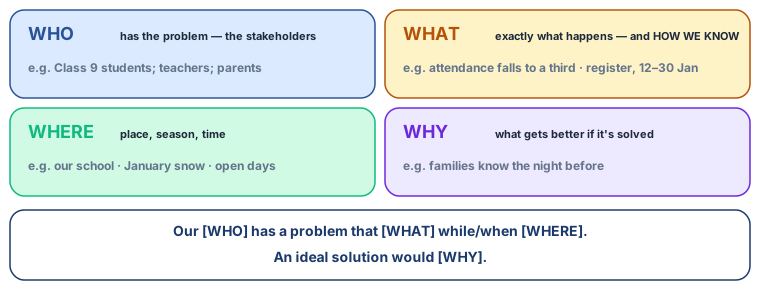
Scoping a problem with the 4Ws — — scan code 9.1.2 in the printed book.
Warm up your fingers
Skill: brackets and quotes inside a sentence (5 min)
-
On typing.com, continue the symbols lessons.
-
Type this three times, looking only at the screen:
statement = "Our school has a problem that attendance falls in winter" -
Notice what your hands must do: shift for the quote, no space before the closing quote, underscore instead of a space in a name. This is how code will look in Unit 5.
-
Term 1 goal: 32–38 WPM at 94% accuracy.
On the laptop
You need: LibreOffice Calc · 4ws-canvas.ods (sheets Canvas, Stakeholders, Statement)
Mission 1: The 4Ws canvas (10 min, in pairs)
- ☐1
Sheet Canvas: fill Who · What · Where · Why for the winter attendance problem.
- ☐2
The What block has two cells: what happens and how we know. Fill the second with real evidence — "the register, 12–30 January" — not "everyone knows".
- ☐3
Replace every "everyone", "the students" and "always" with something countable.
Mission 2: Stakeholders (8 min)
- ☐4
Sheet Stakeholders: list at least six. Columns: Who · What they lose now · What they gain · What could go wrong for them if we build it · Were they asked?
- ☐5
Push past the obvious: the student who came to a half-empty class, the parent deciding at 7 a.m., the bus driver.
- ☐6
Predict: how many will have yes in the last column? Then mark it honestly.
Mission 3: The statement (5 min, alone)
- ☐7
Sheet Statement: fill the template. Read it to your partner. They ask only: could someone check this is true? and could someone tell when it's solved? Fix it and save — Lesson 1.3 builds on it.
Finished early?
Write the weakest possible problem statement for the same problem, then say exactly what makes it weak.
No laptop today?
Chalk the four blocks on the board and fill them from the class, one student holding the pen. Nothing goes in What without a source. Do the stakeholder list aloud and keep a written copy for Lesson 1.3.
Now you know
- Problem scoping is stage one: exactly what is wrong, for whom, and how you'd know it was fixed.
- The 4Ws canvas: Who (the stakeholders) · What, with evidence · Where · Why.
- A scoped problem is checkable someone else can test it, and tell when it's solved. "We have a winter attendance problem" is not scoped; "attendance falls to a third in January snow, even on open days" is.
- The people most affected are often the ones nobody asked.
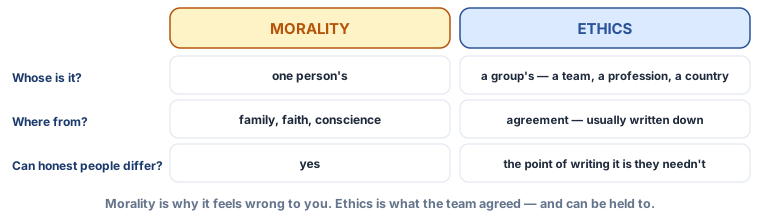
- Scoping asks should, not only can. A problem you could solve only with data you shouldn't collect is not a project.
Debate it
The scoped statement promises families a message the night before.
- How would you find out whether families would act on it — before building anything?
- Who could be harmed if the message wrongly says the school is closed?
- A member suggests recording which students are absent, by name. Your answer, and why? (Class 6: children's personal data.)
Check yourself — practice, not a test
1. Put the blocks of the 4Ws canvas in the order the template uses:
- 1. What
- 2. Where
- 3. Why
- 4. Who
2. Which belongs in the What block?
- ○ The season when it happens
- ○ What goes wrong, and the evidence that it does
- ○ Who benefits if it is solved
- ○ The tool you plan to use
3. Which of these are stakeholders in the winter attendance problem? (choose all that apply)
- ○ A student who misses the lesson
- ○ The teacher who must repeat it
- ○ A parent deciding at 7 a.m.
- ○ The company that sells the laptop
4. "Everyone says attendance is bad in winter" is acceptable evidence for the What block.
- ○ True
- ○ False
5. The people who have the problem or are touched by it are called the ______.
6. Morality or ethics?
What I personally believe is right, from my upbringing · A written code a profession agrees to follow · A team's rule that data is deleted after the project ends · A feeling that something is wrong even where no rule forbids it
Match with: Ethics · Morality
Remember
A problem is scoped when someone else could check it, and tell when it is solved.