Class 9 · Unit 1: The AI project cycle, and ethics · Lesson 1.3 · 40 min
Data acquisition and system maps
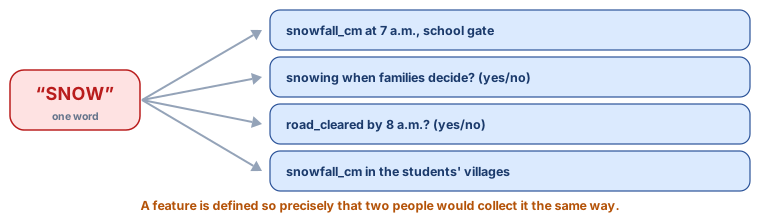
Bilal types one word at the top of a spreadsheet: SNOW. Then he realises it's four different things.
Today you will: Turn vague words into precise features · Write a data plan with sources and permission · Draw a system map and question it
Story
Bilal: “We need data.” (and opens a new sheet. At the top he types SNOW.)
Then he stops.
Snow what? Centimetres on the ground at 7 a.m.? Whether it was falling at the moment families decided? Whether the road was cleared, which is not the same as whether it snowed? And snow where — at the school, or in the villages the students walk from?
Hiba: “One word is not a feature. It's four different features wearing the same coat.”
Watch
Features, sources and system maps — — scan code 9.1.3 in the printed book.
Warm up your fingers
Skill: the underscore and the equals sign (5 min)
-
typing.com symbols lessons, focusing on
_and=. -
Type this five times without looking at the keys — these are the names you will use for features in Unit 5:
snowfall_cm = 12road_cleared = True -
Term 1 goal: 32–38 WPM at 94% accuracy.
On the laptop
You need: LibreOffice Calc and Draw · data-plan.ods · system-map.odg
Mission 1: The data plan (10 min, in pairs)
- ☐1
Open
data-plan.ods. From your Lesson 1.2 problem statement, list at least eight features. - ☐2
Split every vague word. Weather becomes the two or three measurable things you meant.
- ☐3
Fill every column: Feature · Why it matters · Source · How often · Whose permission?
- ☐4
If a row needs a parent's consent, delete it — and write in the notes what you would have learned from it.
Mission 2: The system map (10 min)
- ☐5
In
system-map.odg, put one feature per box. Start with snowfall_cm, road_cleared, distance_to_school, attendance. - ☐6
Draw arrows from cause to effect, marked + (they rise together) or − (one rises, the other falls).
- ☐7
Predict: add exam_week. Will its arrow to attendance be + or −? Draw it — then circle it and write how would we check this?
Finished early?
Add two more boxes — temperature, bus_running, parent_at_home — and mark their arrows.
No laptop today?
Do the data plan in your notebook. Then build the map on the board: one student per feature, holding a card, the class joining them with chalk arrows and calling out plus or minus. An arrow nobody can justify gets rubbed out.
Now you know
- Data acquisition is stage two: what to collect, from where, how often, with whose permission.
- A feature is one measurable thing, defined so precisely that two people would collect it the same way.
- Four questions for every feature: what exactly · what source · how often · whose permission.
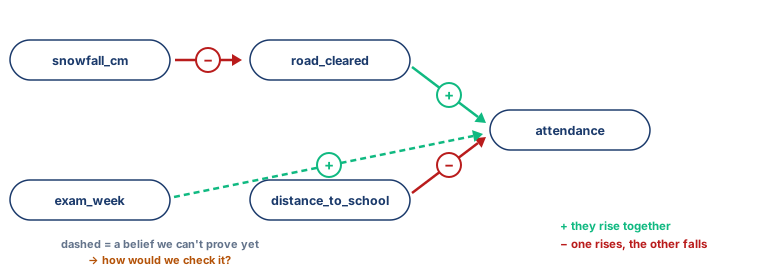
- A system map turns your beliefs into boxes and arrows — and a belief you can see is one you can test.
- Consent is a design decision. If a feature needs a child's personal data, drop it and record what you lost.
🕌 From our heritage
Ibn Khaldūn (1332–1406) complained that historians repeated impossible reports because they only checked who had passed the story down. His remedy, in the Muqaddimah, was to test every report against how society actually works — its geography, its economy, what people can really do — so that a claim which could not have happened is caught even when the chain of narrators looks respectable. A system map is that idea drawn on a page: you sketch how the world works, and then ask whether your data's story fits it.
Source: Ibn Khaldūn, al-Muqaddimah (1377), on the criticism of historical reports and the science of ʿumrān.
Debate it
The club marks exam_week → attendance as +.
- Where did that belief come from? How could you check it in one afternoon?
- If it's right for Class 6 but wrong for Class 9, what does that say about treating "the school" as one thing?
- A member wants family_income as a feature. Give two reasons to refuse — one about consent, one about what it would do to the people it describes.
Check yourself — practice, not a test
1. Which of these is properly defined as a feature?
- ○ Weather
- ○ Winter difficulty
- ○ Snowfall in centimetres, measured at 7 a.m. at the school gate
- ○ Student mood
2. Mark each arrow + or −:
snowfall_cm → road_cleared · road_cleared → attendance · distance_to_school → attendance · temperature → snowfall_cm
Match with: + · −3. For every feature, a data plan must say: (choose all that apply)
- ○ What exactly is measured
- ○ Where it comes from
- ○ How often it is collected
- ○ Which brand of laptop will store it
4. A system map is only worth drawing after the data has been collected.
- ○ True
- ○ False
5. One measurable thing, defined precisely enough that two people would collect it the same way, is called a ______.
Remember
Name the feature exactly, or you will collect four things and call them one.