Class 9 · Unit 1: The AI project cycle, and ethics · Lesson 1.5 · 40 min
Bias, access and deployment
“It works,” says Bilal. “It works for whoever can receive it,” says Hiba. That's not the same sentence.
Today you will: Tell AI bias from AI access · Write a deployment note · Name who your project leaves out
Story
The winter predictor works. On the club laptop, on twenty past days, it is right more often than not. Bilal wants to send it out as a message to families the night before.
Their teacher asks three questions, and the room goes quiet.
Teacher: “Sent how — to whose phone? Written in which language? And what happens in Hajin, where Sameer's family share one phone between five people and the signal goes at dusk?”
Bilal: “It still works.”
Hiba: “It works for whoever can receive it. That's not the same sentence.”
Watch
Two different failures — bias and access — — scan code 9.1.5 in the printed book.
Warm up your fingers
Skill: everything from this term, mixed (5 min)
-
typing.com symbols review. No new keys — just all of them together.
-
Type this twice, slowly and without looking:
message = "School will run as normal"if snowfall_cm > 10: send(message) -
Term 1 goal: 32–38 WPM at 94% accuracy. Check where you started in March.
On the laptop
You need: LibreOffice Calc and Writer · cases.ods · deployment-note.odt
Mission 1: Bias or access? (10 min, in pairs)
- ☐1
Open
cases.ods: six short cases. For each, fill Bias, access or both? · Who is left out? · One fix. - ☐2
Predict: two of the six are both. Guess which before you start.
Mission 2: The deployment note (10 min)
- ☐3
Open
deployment-note.odtand fill it for the club's winter predictor, one line per heading: Who receives it, and how · In which language · Who cannot receive it · What it does when unsure · Who is told when it's wrong · Who can switch it off. - ☐4
Be strict with Who cannot receive it. "Nobody" is almost never true.
- ☐5
End with one sentence: what would you change so fewer people are in that row?
Finished early?
Count them. Roughly how many families in your own class would be in row three?
No laptop today?
Read the six cases aloud; pairs hold up one hand for bias and two for access, then defend the two that are both. Do the deployment note on paper. Students from villages with different signal or power can fill row three themselves — they are the evidence.
Now you know
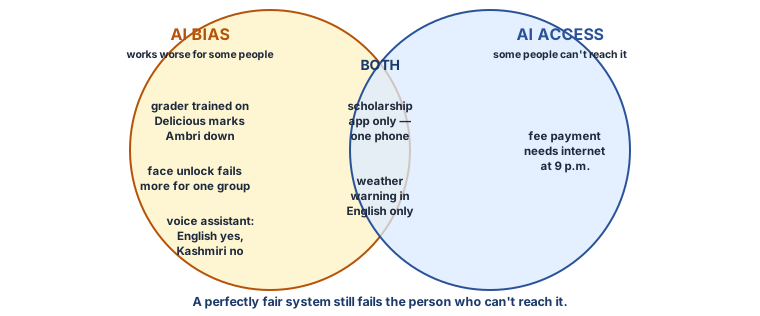
- AI bias is unfairness that comes from the data — who collected it, who is missing from it, who labelled it. A model learns the world it was shown, gaps included.
- AI access is different: a fair system still fails a person with no device, no signal, no electricity, or no literacy in its language.
- In Jammu and Kashmir, access is not a small footnote:
- Mobile connectivity reaches roughly 94% of villages, and about 20,441 km of optical fibre had been laid by March 2025 — real progress, and not the same thing as use.
- About 11.9% of rural households shop online, against 32.4% of urban ones — a gap in what people can actually do, not in what is technically available.
- Roughly 66% of students have internet at home. A tool that assumes the other third can reach it has quietly excluded them.
- Language is both. Kashmiri has far less written text for a model to learn from, so tools work worse in it — bias and access in one problem.
- Deployment is the last stage, and it decides who the project was really for. A model nobody can reach has not been deployed.
Debate it
The club decides to send the winter message by SMS, because SMS needs no internet.
- Who does that include who a mobile app would have excluded?
- Whose phone does the message actually arrive on, in a family with one phone — and does the student ever see it?
- A member says: "We can't solve everyone's problem. Let's build it for the students who can receive it." Give the strongest argument for that position, and then the strongest argument against it.
Check yourself — practice, not a test
1. A model grades Ambri apples poorly because it was trained on Delicious apples. This is mainly:
- ○ AI bias
- ○ AI access
- ○ A deployment failure
- ○ A rule-based model
2. A well-built, fair warning system is useless to a family with no phone signal. This is mainly:
- ○ AI bias
- ○ AI access
- ○ A labelling error
- ○ A false negative
3. Where does bias enter a system? (choose all that apply)
- ○ Who collected the data
- ○ Who is missing from the data
- ○ Who labelled the data
- ○ The brand of the laptop it runs on
4. A language with little written text available is called a low-resource language, and AI tools usually work less well in it.
- ○ True
- ○ False
5. The stage where a model goes into real use, and where access decides who it serves, is called ______.
Remember
"It works" is not a finished sentence. It works — for whom?