Class 9 · Unit 2: Data literacy · Lesson 2.2 · 40 min
Privacy and security: two different things
`survey-final-FINAL.ods` is still on the lab laptop. Column A is names. Column D says who missed nine days.
Today you will: Tell privacy from security · Cut the columns nobody needed · Write three data rules you'll really keep
Story
Last term Hiba's class ran a survey for their project: how each student travels to school, how long it takes, and whether they missed any days in January.
It went well. The chart was good. The file is still on the shared laptop in the lab, called survey-final-FINAL.ods, and anyone who uses that laptop can open it.
Bilal: “It's only travel times. Nobody cares.”
Hiba opens it. Column A is names. Column D says who missed nine days in January.
Hiba: “If I can open it, so can anyone who sits here. We asked people for this. We didn't ask them if the whole school could read it.”
Two things went wrong here, and they are not the same thing. What are they?
Watch
Privacy is a promise, security is a lock — — scan code 9.2.2 in the printed book.
Warm up your fingers
Skill: the shifted symbols (Term 1 focus, 5 min)
-
On typing.com, continue the symbols lessons.
-
Then type this line five times — a passphrase pattern, not a real password:
chinar_kettle_seven_bicycle -
The underscore is Shift and the key right of zero. Aim for zero mistakes rather than speed; in a password, one wrong character fails the whole thing.
On the laptop
You need: LibreOffice Calc · class-survey-practice.ods (invented names) · audit.ods
Mission 1: Audit it (8 min, in threes)
- ☐1
Open
class-survey-practice.ods— the kind of file a project leaves behind. - ☐2
In
audit.ods, for every column answer two privacy questions — did we need it? who may see it? — and one security question — what protects it? - ☐3
Predict: how many of the six columns will survive? Then delete every column you didn't need, and save as
class-survey-minimal.ods.
Mission 2: Secure what's left (6 min)
- ☐4
Answer yes or no: Is it on a shared laptop? Is a copy on a phone or in a chat? Does anyone outside the group have it? Is there a backup? Does it need to exist after marking?
Mission 3: Three rules (4 min)
- ☐5
Write your group's three rules for project data this year — rules you can really keep on the school's laptops.
Finished early?
Rewrite the survey so it answers the project's question with no names at all.
No laptop today?
Groups get a printed copy and strike out the columns nobody needed, then answer the five security questions in their notebooks. Each group reads out its three rules; the best six go on the wall.
Now you know
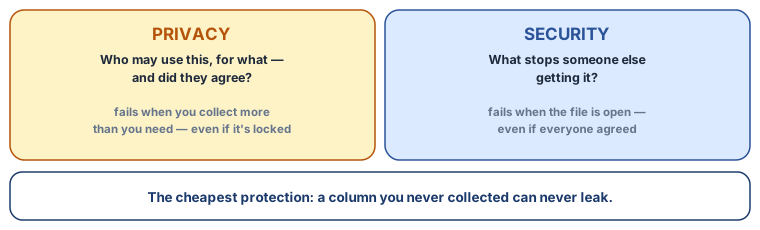
- Privacy: who may use this, for what, and did they agree? Security: what stops someone else getting it?
- They fail separately. Too many columns is a privacy failure even if locked; an open file is a security failure even if everyone agreed.
- Collect the least you need. It's the cheapest protection there is.
- A breach is unauthorised access — and its cost is paid by the people in the data.
- Basic security: a passphrase, a locked screen, updates, backups, one known place for files, and deleting what's finished with.
- Under India's DPDP Act, when your class runs a survey, you are the holder, with duties.
Debate it
The survey's most useful column — days missed in January — is also the one that could embarrass a classmate.
Can the class keep that column and still protect the person? What would have to change about how it was collected, stored, and reported?
Check yourself — practice, not a test
1. A school keeps exam marks in a locked cupboard, but shares them with a company that sells tuition classes. This is:
- ○ Good privacy, bad security
- ○ Good security, bad privacy
- ○ Bad security, bad privacy
- ○ Neither — marks are not personal data
2. The cheapest way to protect a piece of data is to:
- ○ Encrypt it twice
- ○ Never collect it in the first place
- ○ Keep three backups
- ○ Rename the file
3. A data breach means the data was destroyed.
- ○ True
- ○ False
4. Which are security measures? (choose all that apply)
- ○ A strong passphrase
- ○ Locking the screen when you leave the laptop
- ○ Asking people's permission before collecting their data
- ○ Keeping a backup
- ○ Deleting the file when the project is finished
5. Privacy is the ______; security is how you keep it.
Remember
Privacy is the promise. Security is how you keep it. A column you never collected cannot leak.