Class 9 · Unit 3: Maths for AI · Lesson 3.2 · 40 min
Statistics: the middle and the spread
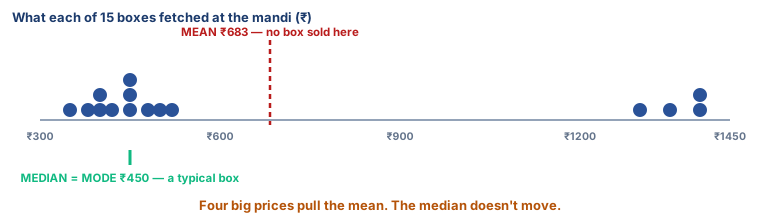
“The average box fetched ₹683.” Bilal's uncle sold fifteen boxes. Not one fetched ₹683.
Today you will: Find the mean, median and mode · Catch an average that describes nobody · Use the range to see the spread
Story
A trader at the Sopore mandi tells a reporter: "Growers did well today. The average box fetched ₹683."
Bilal's uncle sold fifteen boxes that morning. Not one fetched ₹683. Most went for about ₹450.
Neither man is lying.
How can an average describe a day that nobody had?
Watch
Three averages and a spread — — scan code 9.3.2 in the printed book.
Warm up your fingers
4 minutes on typing.com: accuracy first.
- Term 2 accuracy lessons. Target 94%, speed second.
- Then type these five function names five times each without looking down:
AVERAGEMEDIANMODEMINMAX
On the laptop
Tool: LibreOffice Calc. File needed: unit-3/statistics.ods — two sheets,
Mandi and Orchards.
Part A: The average that describes nobody (9 min)
Mission 1: Your mission
- ☐1
Open the Mandi sheet. Column B holds what each of fifteen boxes fetched.
- ☐2
In D2
=AVERAGE(B2:B16), D3=MEDIAN(B2:B16), D4=MODE(B2:B16). - ☐3
Before reading on, answer in F2: which of the three describes a typical box?
- ☐4
In F3, count how many boxes beat the mean:
=COUNTIF(B2:B16;">683"). (If your Calc separates arguments with commas, use,.) - ☐5
The test. Delete the four highest prices and watch D2 and D3. In F4 write which number moved a lot and which barely moved. Then Ctrl+Z four times to restore them.
Part B: Same mean, different orchard (9 min)
- ☐6
Open the Orchards sheet: ten box weights from Orchard A, ten from Orchard B.
- ☐7
In row 13,
=AVERAGE(B2:B11)and the same for column C. The means are identical. - ☐8
In row 14,
=MAX(B2:B11)-MIN(B2:B11)and the same for C. These are the ranges. - ☐9
In E2: you will resell these as "10 kg boxes". Which orchard, and why?
- ☐10
The typo. Change B6 from
10.2to100.2— a decimal point in the wrong place, the commonest data error there is. Watch the mean. Then add=MEDIAN(B2:B11)below it. In E3 finish: "One typo moved the mean from 10.0 to ____, and the median from 10.0 to ____." - ☐11
Ctrl+Z until B6 reads 10.2 again, and save.
Finished early?
On the Mandi sheet, use =COUNTIF to find how many boxes fetched the
modal price. Then tally the vehicle colours you counted for homework and find the mode of
those.
No laptop today?
Write the fifteen prices on the board. Half the class computes the mean; the other half lines them up and takes the middle. Announce both, then ask which one the reporter should have quoted. For Part B, read out both orchards' weights, then change one to 100.2 in front of the class and recompute the mean aloud.
Now you know
- Statistics is collecting, exploring and analysing data to draw conclusions — forecasts, disease tracking, disaster planning.
- Mean = total ÷ count · median = the middle value · mode = the commonest.
- The mean is pulled by extremes; the median isn't. Use the median for prices, incomes and waiting times.
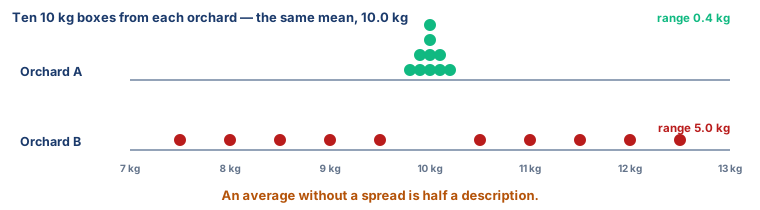
- Range = maximum − minimum. Two datasets can share a mean and be nothing alike.
- An outlier is far from the rest. Check it before deleting: a 100 kg crate exists; a 100 kg apple box doesn't.
Debate it
An app predicts tomorrow's mandi price from last year's records — which include one day when a box was typed as ₹14,000 instead of ₹1,400.
What will the app have learned, and who pays for it? Name one check that would have caught the typo before training.
Check yourself — practice, not a test
1. Fifteen boxes fetch mostly ₹450; four fetch ₹1,300 or more. Which is true?
- ○ The median will be higher than the mean
- ○ The mean will be higher than the median
- ○ The mean and median must be equal
- ○ The mode must equal the mean
2. The largest value minus the smallest is the ______.
3. One extreme outlier usually moves the median more than the mean.
- ○ True
- ○ False
4. A shopkeeper wants to know which crate size to order most of. He should use:
- ○ The mean
- ○ The median
- ○ The mode
- ○ The range
5. Two datasets both average 10 kg. Set A ranges 9.8–10.2, set B ranges 7.5–12.5. Which statements are correct? (choose all)
- ○ They describe very different situations
- ○ A buyer reselling fixed-weight boxes should prefer set A
- ○ Set B must contain a mistake
- ○ The mean alone did not tell you this
Remember
The average says where the middle is. The spread says what you will actually meet.