Class 9 · Unit 3: Maths for AI · Lesson 3.3 · 40 min
Probability, and types of events
The forecast said 30% rain. The day stayed dry. “Wrong again,” says Bilal. Is it?
Today you will: Write a chance three ways · Name five kinds of event · Watch small samples swing
Story
The forecast says 30% chance of rain. Hiba leaves her umbrella at home, and the day stays dry.
Bilal: “Wrong again.”
Hiba: “No. It said thirty, not zero. A dry day is what thirty percent mostly looks like.”
Can a single dry day prove a 30% forecast wrong?
Watch
What a probability promises — — scan code 9.3.3 in the printed book.
Warm up your fingers
4 minutes on typing.com: numbers and comparison symbols.
- Term 2 lessons, then by hand:
< > / % .— ten of each. - In Class 6 you typed
RAND()<0.5for a coin. Today the number after<is not 0.5 — and changing it changes the weather.
On the laptop
Tool: LibreOffice Calc. New file, saved as rain-model.ods in my-data-9.
Part A: Name the event, then price it (6 min)
Mission 1: Your mission
- ☐1
In A1 type
Statement, B1Type of event. Copy these five, one per row:- The sun rises tomorrow in Srinagar.
- It rains in Srinagar on a day in November.
- A tossed coin lands heads.
- An apple box picked at random from the mandi is top grade.
- It snows in Srinagar in July.
- ☐2
In column B type one of:
Certain,Likely,Unlikely,Impossible,Equally likely. - ☐3
In D1 type
Month, E1Rainy days, F1Fraction, G1Decimal, H1Percent. - ☐4
Enter April 10, June 5, September 4, November 2 from the teacher's table. Treat every month as 30 days.
- ☐5
In F2
=E2/30, G2=F2, H2=F2*100. Fill down. Read the November row aloud: 2/30 = 0.07 = 7%. Part B: Two hundred Aprils (10 min)
- ☐6
In J1
Day, K1Weather. Number J2:J201 from 1 to 200 (type 1 and 2, select both, drag). - ☐7
In K2 type exactly
=IF(RAND()<0.33;"Rain";"Dry")and fill down to K201. (Comma instead of semicolon if that is what your Calc uses.) - ☐8
In M1
Rainy days, M2=COUNTIF(K2:K201;"Rain"). In M3Expected, M4=0.33*200. - ☐9
Press F9 ten times. Each press is a fresh set of 200 days. Write down all ten counts. Is any of them exactly 66? Is any of them nowhere near it?
- ☐10
In M6 record the smallest and largest counts you saw, and the gap between them.
- ☐11
The small-sample trap. In M8 type
=COUNTIF(K2:K21;"Rain")— only the first twenty days. Press F9 ten more times. This one swings from about 2 to about 12: from 10% to 60%, out of the same weather.
No laptop today?
Give each pair thirty paper slips: ten marked Rain, twenty Dry. Draw one, record it, put it back, repeat twenty times. Pool the class's draws on the board — thirty students give 600 draws — and compare the class fraction with 0.33. The pooled figure sits far closer than any pair's.
Now you know
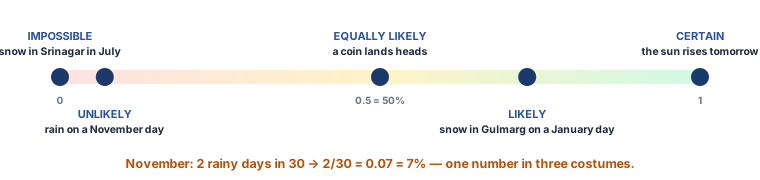
- Probability = favourable outcomes ÷ possible outcomes a fraction, a decimal or a percentage.
- The scale runs from 0 (impossible) to 1 (certain). Five kinds of event: certain · likely · equally likely · unlikely · impossible.
- A probability describes many repetitions, not one day. One dry day can't prove a 30% forecast wrong.
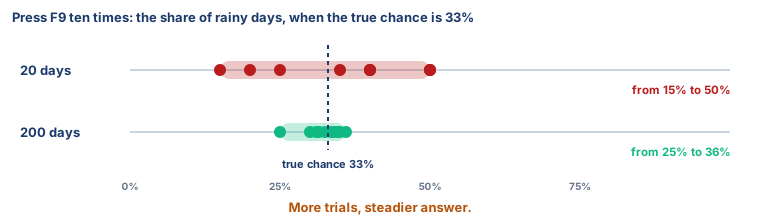
- More trials, steadier answer. Twenty days swing wildly; two hundred stay near the truth. Lesson 3.5 comes back to this.
Debate it
A weather service says 70% chance of heavy snow on Friday, and the head teacher must decide on Thursday whether to close the school.
What else does she need to know before deciding? Explain why "70%" alone cannot make the decision for her.
Check yourself — practice, not a test
1. If it rains on 10 days out of 30, the probability of rain on a random day is 0.33, or ______%.
2. Match each statement to its type of event:
Snow in Srinagar in July · A tossed coin lands tails · Rain in Srinagar in November · The sun rises tomorrow
Match with: equally likely · unlikely · impossible · certain3. A forecast says 30% chance of rain and the day stays dry. This shows:
- ○ The forecast was wrong
- ○ It should have said 0%
- ○ Nothing — one day cannot test a probability
- ○ Probability does not apply to weather
4. Counting rainy days across 200 simulated days gives a steadier estimate than counting across 20.
- ○ True
- ○ False
5. In =IF(RAND()<0.33;"Rain";"Dry"), changing 0.33 to 0.07 models:
- ○ A faster calculation
- ○ A much drier month, like November
- ○ Certain rain
- ○ Nothing at all
Remember
A probability is a promise about many days, never about tomorrow alone.