Class 9 · Unit 4: Generative AI · Lesson 4.1 · 40 min
Generative AI, and how it differs
Ask the same question three times and get three different answers. Broken — or working exactly as designed?
Today you will: See the spread behind every generated word · Tell generative from conventional AI · Find why our words cost more tokens
Story
Hiba's teacher asks the same question three times, on the projector, from the school's account: "Write one sentence about the chinar tree."
Three answers come back. All three are good. None of them is the same.
The class is divided. Nusrat says the computer is thinking harder each time. Bilal says it must be broken — a calculator that gave three answers to 7 × 8 would be broken.
Then the teacher runs the leaf classifier from Class 8 on the same photograph, three times. Three identical answers: chinar, 94%.
Two machines, both called AI. One says the same thing every time and the other never does. Today you find out why — with a spreadsheet, not a chatbot.
Watch
Sorting machines and producing machines — — scan code 9.4.1 in the printed book.
Warm up your fingers
Skill: accuracy while thinking, Term 2 (5 min)
- On typing.com, open the timed paragraph your teacher has set for this term .
- Target this term: 35–40 WPM at 94% accuracy or better.
- Type without looking down. When you make a mistake, finish the line first, then fix it.
- Words for this unit:
tokenprobabilitysamplepromptverifysource
On the laptop
You need: LibreOffice Calc · next-word-counts.ods · kinds/ with kinds.ods · tokens.ods
Mission 1: Counts into a spread (8 min, in pairs)
- ☐1
Open
next-word-counts.ods. Row 1 isthe, with the count of every word that followed it. - ☐2
Turn counts into percentages:
=B2/$H$2, filled across. That's a probability distribution. - ☐3
Chart the row. This picture is what the model makes at each step — a shape, not a word.
- ☐4
Predict: which will sound more natural, always taking the tallest bar or sampling with
=RAND()? Generate five words each way and read both aloud.
Mission 2: Five kinds, two machines (6 min)
- ☐5
In
kinds.ods, for each sample: which kind (text, image, audio, video, code) and conventional or generative? - ☐6
One of the two photographs was generated. Say which, and why — then check
kinds/answers.txt.
Mission 3: Tokens (3 min)
- ☐7
In
tokens.ods, splitunhappiness,Srinagar,photosynthesisandtumbaknariinto pieces a machine would have seen thousands of times. Which cost the most?
Stuck?
A #DIV/0! means the formula isn't pointing at the row total. For Part 3, split walking together first: walk + ing.
Finished early?
Pick another row and predict, before charting it: will one word dominate, or will many share?
No laptop today?
Convert one printed row to percentages on the board, then generate twice — always the biggest, and by rolling a die against the bands. Do Parts 2 and 3 from the handout.
Now you know
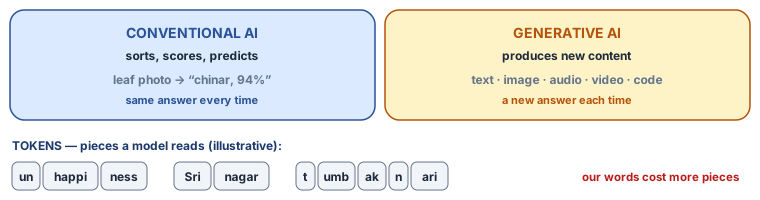
- Conventional AI sorts, scores or predicts. Generative AI produces new content text, image, audio, video or code.
- It learned differently: from huge amounts of unlabelled text or images, by predicting a hidden piece again and again.
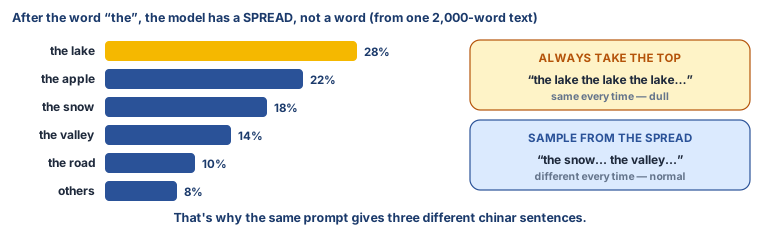
- At each step it makes a spread over every possible next token, then samples from it. Temperature sets how far down it samples.
- So the same prompt gives different answers, and none is "the real one".
- A token is a piece of text. Our place names cost more tokens than English words the same length.
- Training happened once, before your lesson. Nothing you type in class is teaching it.
Debate it
Your spread for the was built from one 2,000-word text, so the king and the water were
likely and the polymerase was impossible.
A real model's spread is built from enormous amounts of text — but far more of it is in English than in Kashmiri, and far more about Delhi than about Baramulla. What does that do to the spread when someone asks it about our valley?
Check yourself — practice, not a test
1. Generative AI differs from conventional AI because it:
- ○ Runs faster
- ○ Produces new content rather than sorting or scoring existing content
- ○ Is always correct
- ○ Needs no data
2. Which are kinds of generative AI? (choose all that apply)
- ○ Text
- ○ Image
- ○ Audio
- ○ Code
3. At each step, a generative model produces:
- ○ One word, chosen in advance
- ○ A probability for every possible next token
- ○ A search result from the internet
- ○ A fact from a stored database
4. Asking the same question twice and getting two different answers means the model is faulty.
- ○ True
- ○ False
5. The setting that decides how far down the spread a model samples is called ______.
6. A word the model has rarely seen is usually split into:
- ○ Fewer tokens than a common word
- ○ More tokens than a common word
- ○ Exactly one token, always
- ○ No tokens at all
Remember
Conventional AI sorts. Generative AI produces — by sampling likely next tokens.