Class 9 · Unit 4: Generative AI · Lesson 4.2 · 40 min
Prompting: role, task, context, format
Same tool, same minute. Bilal gets four paragraphs of beautiful nothing. Hiba gets six lines a parent will read.
Today you will: Build a prompt: role, task, context, format · Judge the first answer, then fix the prompt · Keep every prompt free of personal data
Story
Two students, one job: a short notice for parents about the science exhibition.
Bilal types: "write a notice about the science exhibition."
What comes back is four paragraphs of beautiful nothing — "We are delighted to invite our esteemed parents to an enriching showcase of scientific temper" — no date, no place, no time, and a sentence about refreshments nobody promised.
Hiba types a longer thing. She names who is writing, what is needed, what the reader already knows, and how long it must be.
What comes back is six lines, with blanks where the date and the hall should go, in language a parent will actually read.
Same tool. Same minute. The difference is entirely in what was asked.
Watch
Asking properly — — scan code 9.4.2 in the printed book.
Warm up your fingers
Skill: quotation marks and colons, Term 2 (5 min)
- On typing.com, open the punctuation practice your teacher has set .
- Today's keys are the ones a written prompt needs:
":,and the apostrophe. - Prompts are typed once and reused. A prompt with a missing quotation mark is still a prompt; a Python line with one is not — that is Unit 5's problem, so practise now.
On the laptop
You need: LibreOffice Calc · prompt-sheet.ods · prompt-log.ods · the school's AI account (teacher only) · prompt-pairs/ if there is no account
Mission 1: Paper first (7 min, in pairs)
- ☐1
In
prompt-sheet.ods, fill Role · Task · Context · Format for the job your teacher sets — e.g. a six-line notice inviting parents to the science exhibition. - ☐2
Write it out as one paragraph in the last column.
- ☐3
Check it before it goes anywhere: any name, photo, number, address or anything about a classmate? Replace it with a placeholder like
[STUDENT NAME].
Mission 2: Run it, once (10 min, whole class)
- ☐4
Predict: what will be wrong with the first answer? Write one guess.
- ☐5
Your teacher runs the prompts on the projector, two or three at a time.
- ☐6
In
prompt-log.ods: my prompt · what came back · what was wrong · my next prompt. Fix the prompt, not the answer.
Stuck?
Your prompt is probably missing Context. Add one sentence on what the reader knows and what must not be invented.
Finished early?
Ask for the same thing twice more — as three options, then as a table. Which shape would you use?
No laptop today?
Do Part 1 on paper. For Part 2, read the printed weak and strong pairs in prompt-pairs/ and mark which of the four parts fixed each problem.
Now you know
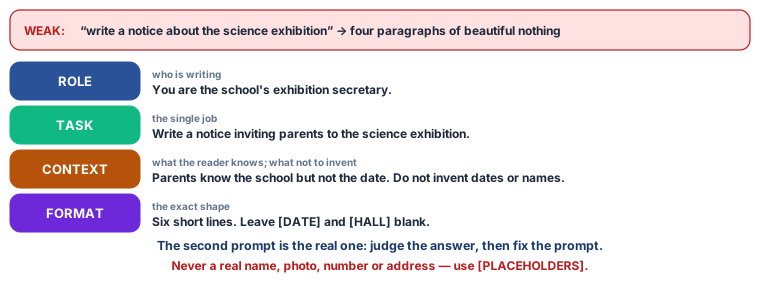
- A prompt sets the context. What you leave out gets filled with whatever is generally likely.
- Four parts, any order: Role · Task · Context · Format.
- Say what you don't want: "Do not invent any dates or names."
- The second prompt is the real one. Judge the first answer, then fix the prompt.
- Never personal data in a prompt. Use a placeholder and fill it in yourself.
- Fluency is not accuracy Lesson 4.3.
🕌 From our heritage
Muslim scholars held that you cannot judge a matter you have not properly framed: al-ḥukm ʿalā al-shayʾ farʿ ʿan taṣawwurihi — "a judgement about a thing follows from conceiving it correctly." A jurist asked a half-stated question was expected to establish the facts before answering, because an answer to a badly put question is worthless however well it is phrased. Your four columns are that same discipline: frame the question, then ask it.
Source: a maxim standard in works of logic and uṣūl al-fiqh.
Debate it
Hiba's prompt worked because she knew what a good notice looks like — the date, the place, the time, the plain language.
Could someone who had never seen a good notice write a good prompt for one? What does that tell you about who gets the most out of these tools?
Check yourself — practice, not a test
1. Put the four parts of a prompt in the order taught in this lesson:
- 1. Context
- 2. Task
- 3. Role
- 4. Format
2. Which prompt is most likely to return something usable?
- ○ "Write about water."
- ○ "Write a good essay on water, very nice."
- ○ "You are a science teacher. Explain in six lines, for a Class 6 pupil, why water in a kangri-warmed room evaporates. Do not invent any numbers."
- ○ "Water essay, urgent, fast."
3. If the answer is wrong, the right move is usually to fix the answer by hand rather than to improve the prompt.
- ○ True
- ○ False
4. Which of these must never appear in a prompt for a school task? (choose all that apply)
- ○ A classmate's name
- ○ The topic of the lesson
- ○ A phone number
- ○ A photograph of a student
5. Saying "do not invent any dates" is an example of telling the model what you do not ______.
Remember
Role, task, context, format — on paper first, and nobody's personal data in it.