Class 9 · Unit 4: Generative AI · Lesson 4.4 · 40 min
Honest use, and citing AI
Bilal got the top mark. Then the teacher asked him one question about his own page two, and he couldn't answer.
Today you will: Write an honest AI-use line · Tell help from replacement · Pass the four-minute test
Story
Bilal's project write-up comes back with the highest mark in the class. His teacher is pleased, and asks him one question in front of everyone — the kind a viva examiner asks.
Teacher: “On page two you say the method would not work in winter. Why not?”
Bilal knows the sentence is there. He can picture it. He cannot say why it is true, because he never worked it out — it arrived in the paragraph, it sounded right, and he kept it.
Hiba's write-up got a lower mark. When her turn comes she answers for four minutes, and then says where she is unsure and why.
By the end of that week, one of them can explain their own project and one cannot. The marks were the smaller difference.
Watch
Your thinking, declared — — scan code 9.4.4 in the printed book.
Warm up your fingers
Skill: typing your own words at speed, Term 2 (5 min)
- On typing.com, open the free-writing or timed paragraph your teacher has set .
- Target: 35–40 WPM at 94%+, typing sentences you compose as you go rather than copying.
- This is the skill the rest of the lesson needs: getting your own thinking down fast enough that reaching for a tool is not the easier path.
On the laptop
You need: LibreOffice Writer and Calc · checked-paragraph.odt (from Lesson 4.3) · ai-use-line.odt · honest-cases.ods
Mission 1: The declaration (7 min, alone)
- ☐1
Open your checked paragraph from Lesson 4.3 and the three examples in
ai-use-line.odt. - ☐2
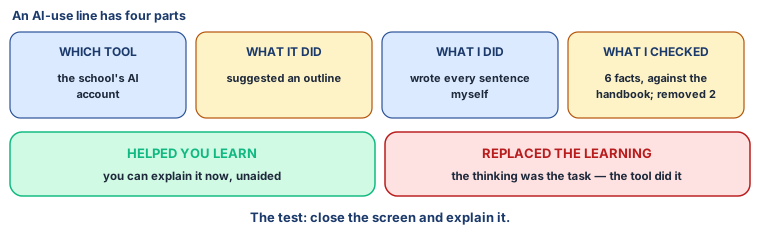
Under your paragraph, write your AI-use line: which tool · what it did · what you did · what you checked, against what.
- ☐3
If the honest line would be "the tool wrote it and I changed three words" — write that. Then fix the work, not the sentence.
Mission 2: The four-minute test (10 min, in pairs)
- ☐4
Close the laptop lid. Predict: which of your own sentences will be hardest to explain?
- ☐5
Your partner asks three questions: why is this true? where did this number come from? what did you leave out, and why? Answer without the screen.
- ☐6
They record in
honest-cases.odswhat you could and couldn't answer. Swap. - ☐7
Anything you couldn't answer, mark in your paragraph as still to find out.
Stuck?
Can't write the declaration? The work probably has more of the tool in it than you'd like. Write the true version — nobody loses marks here for honesty.
Finished early?
Sort the four cases at the bottom of honest-cases.ods: helped me learn or replaced the learning? One reason each.
No laptop today?
All of it works on paper: the declaration under the Lesson 4.3 handout, and the four-minute test with a closed notebook.
Now you know
- Work you can't explain is work you don't have in a viva, an interview, or your own head next year.
- Helped you learn: afterwards you can explain it unaided. Replaced the learning: the tool did the thinking that was the task.
- Declare it precisely. "I used AI" names nothing.
- Not the same as plagiarism: a model has no author to cite, so you describe the process.
- An honest declaration costs you nothing and protects you.
🕌 From our heritage
Ḥadīth scholars would not let a transmitter be vague about how he received something. Ḥaddathanā meant "he narrated it to us, and I heard it directly from him"; akhbaranā, that it was read back to the teacher in his presence; balaghanī, merely "it reached me" — and that last word warned every reader to treat the report differently. One word carried the whole difference between hearing and hearsay. Your AI-use line does the same job: it tells the reader exactly how what they are reading came to be.
Source: the modes of transmission (ṣiyagh al-adāʾ) set out in the ḥadīth sciences; see Ibn al-Ṣalāḥ, Muqaddimah fī ʿUlūm al-Ḥadīth (13th century).
Debate it
Two students hand in the same quality of work. One used AI and declared it. One used AI and did not.
The second student gets the same mark today. What does he lose, and when does he find out he has lost it?
Check yourself — practice, not a test
1. The best test of whether you learned something is:
- ○ The mark you were given
- ○ How long the work took
- ○ Whether you can explain it with the screen closed
- ○ How many sources you listed
2. A usable AI-use declaration names: (choose all that apply)
- ○ the tool
- ○ what the tool did
- ○ what you did
- ○ what you checked, and against what
3. Asking a tool to explain a concept you are stuck on, then explaining it back in your own words, is replacing the learning.
- ○ True
- ○ False
4. A book has an author you can name; a model does not, so your declaration describes the ______ instead.
5. Which is honest and complete?
- ○ "I used AI."
- ○ "AI helped a little."
- ○ "I used the school account to suggest an outline; I wrote the text; I checked all six facts against the district handbook."
- ○ "No AI was used." (written by a student who used it for the outline)
Remember
Your thinking, AI's help, your check, your name on it — and say which was which.