Class 10 · Unit 1: The project cycle, and ethical frameworks · Lesson 1.2 · 40 min
Frameworks, and what shapes a decision
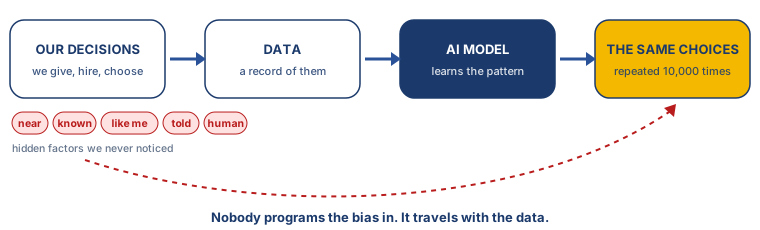
You give to the cause you can see from your desk. So does an AI trained on you.
Today you will: Make 10 decisions and find what moved you · Say what an ethical framework is for · Explain how an AI inherits our blind spots
Story
The class has ₹5,000 from the school fête, and it has to go to one cause. Three are written on the board: a family in Kupwara whose house was damaged in the spring floods, the animal shelter on the edge of town, and new books for the school library.
It takes four minutes to decide. The library wins, easily.
Afterwards their teacher asks a question nobody expected. "Hands up if you know anyone in Kupwara."
Nobody.
Teacher: “Hands up if you have used the library this term.”
Every hand.
Teacher: “So. Did you choose the best cause — or the one you could see from your desk?”
Watch
What shapes a decision — — scan code 10.1.2 in the printed book.
Warm up your fingers
Skill: numbers and symbols in a row (5 min)
-
On typing.com: the symbols lessons.
-
Type three times, eyes on the screen:
gift = {"family": 2000, "shelter": 1500, "library": 1500} # total 5000 -
Goal this term: 38–44 WPM at 95%.
On the laptop
You need: LibreOffice Calc · ten-donations.ods
Mission 1: Ten decisions (10 min, alone)
- ☐1
Sheet Decide: ten rounds, ₹1,000 each, two recipients. Type A's share in column D; B gets the rest.
- ☐2
Some uses are hidden. Type
Yin column F to reveal one — or don't. Decide first. - ☐3
Go with your first answer. Nobody else sees this sheet, and there is no right amount.
Mission 2: What moved you? (8 min, alone)
- ☐4
Predict: which of these five moved you most? Write it in H1. Location (near or far) · Relationship (known or stranger) · Identity (like me or not) · Information (told or hidden) · Human or not
- ☐5
Open sheet Tally. Each factor has a lean. Zero means it made no difference to you.
- ☐6
Finish the sentence at the bottom: "The factor that moved me most was … and I did / did not notice it while deciding."
Mission 3: The class, without names (5 min)
- ☐7
Your teacher collects one word from each of you — your biggest factor. Nothing else.
- ☐8
If a computer learned to give from these decisions, what would it learn?
Finished early?
Change round 7 as if you had revealed its use. Did knowing more make you give more, or less?
Online, with your teacher only: CBSE uses a game called My Goodness. Your teacher may play it on the projector. Don't fill in its survey yourself — no student's data goes to an outside website.
No laptop today?
Your teacher reads the ten rounds; write A or B for each. Then tick every round where you chose the near / known / like-me / told-me / human side, and count your ticks per factor.
Now you know
- A framework is a set of steps for solving a problem in an organised way — like the project cycle, or the 4Ws canvas.
- An ethical framework helps make sure our choices do not cause unintended harm.
- Hidden factors sway every decision: culture, religion, intuition and values, how we value humans and non-humans — and today's five.
- Having them is human. The danger is having them without knowing.
- AI inherits them. A hiring tool trained on a company's past hires learned to mark down the word women's. Nobody programmed that. It learned it.
- So the framework comes first. Used before the model is built, it catches the harm before anyone is hurt.
Debate it
- If the school trained an AI on your class's choices to share out next year's money, who would it keep leaving out?
- Choosing the library wasn't wrong. What would have made it a considered choice?
Check yourself — practice, not a test
1. What is an ethical framework for?
- ○ To make a model more accurate
- ○ To help make sure our choices do not cause unintended harm
- ○ To collect data faster
- ○ To replace the law
2. Which of these can influence a decision without the person noticing? (choose all that apply)
- ○ Where the recipient lives
- ○ Whether we know the person
- ○ How much we were told
- ○ Our culture
3. A model trained on past human decisions cannot be biased, because a computer has no opinions of its own.
- ○ True
- ○ False
4. A set of steps that helps solve a problem in an organised way is called a ______.
5. A company's hiring tool, trained on its own past hiring, marked down applications that mentioned women's. Where did the bias come from?
- ○ The programmer wrote a rule against women
- ○ The computer chose to be unfair
- ○ The past hiring decisions it learned from
- ○ The applicants typed their forms wrongly
Remember
An AI learns our decisions — including the reasons we never noticed we had.