Class 10 · Unit 1: The project cycle, and ethical frameworks · Lesson 1.4 · 40 min
Bioethics, and a hospital case
The computer picked the man two streets from the hospital. It skipped the grandfather beyond the pass.
Today you will: Use the 4 principles of bioethics · Catch a proxy in real numbers · Fix a hospital model, principle by principle
Story
Hiba's grandfather lives beyond a mountain pass that closes with snow every winter. He has a weak heart, bad knees and sugar. He goes to the district hospital perhaps twice a year — when the road is open, when someone can take him, when the bus fare can be found.
In the spring, the hospital starts a new programme. A computer picks the patients who most need a nurse to check on them each month. Hiba's grandfather is not picked.
A man from town, two streets from the hospital, is picked. He has one illness. He goes to the hospital every month, because it is two streets away.
Hiba: “The computer thinks he is sicker, because he spends more.”
Watch
The four principles of bioethics — — scan code 10.1.4 in the printed book.
Warm up your fingers
Skill: a formula with a condition (5 min)
-
On typing.com: the symbols lessons.
-
Type three times, eyes on the screen:
=AVERAGEIF(B2:B21; "Far"; C2:C21) -
In LibreOffice, semicolons separate the parts. Goal this term: 38–44 WPM at 95%.
On the laptop
You need: LibreOffice Calc · hospital-case.ods — 20 invented patients. Where: Near or Far from the hospital. Conditions: long-term illnesses a doctor has confirmed — how ill they really are. Spending: rupees spent on their care last year.
Mission 1: Pick like the computer (7 min, in pairs)
- ☐1
Predict: there are nurses for 5 patients, and the model picks the 5 top spenders. How many of them live Far? Write it in H1.
- ☐2
Sort by Spending, largest first. Colour the top 5 yellow. How many are Far? Write it in H2.
Mission 2: Pick by illness (7 min, in pairs)
- ☐3
Sort by Conditions. How many patients have 3 or more? How many of those live Far? Write both in H3 and H4.
- ☐4
In A24, finish the sentence: "The model picked by spending, so…"
Mission 3: Why? (6 min)
- ☐5
Under the data, use
AVERAGEIFto find average conditions and average spending for Near and for Far. Near conditions is=AVERAGEIF(B2:B21; "Near"; C2:C21). - ☐6
In A30, give two reasons from life in the valley why a Far patient might spend less, even when sicker.
Mission 4: Four fixes (5 min)
- ☐7
Write one line per principle of bioethics: what went wrong here, and one fix.
Finished early?
Suppose the model predicted Conditions instead. What new problem appears? (Who records a patient's conditions — and who rarely sees a doctor?)
No laptop today?
Your teacher writes the 20 patients on the board. Circle the top 5 spenders in one colour and everyone with 3+ conditions in another. Count the Far patients in each. Then do Part 4 aloud, one principle per row of desks.
Now you know
- Bioethics is the sector-based framework for healthcare and the life sciences. It has four principles.
- Respect for autonomy people can know how a decision about them was made, and take part in it.
- Non-maleficence do not harm; if some harm can't be avoided, take the path of least harm. (Maleficence is causing harm on purpose.)
- Beneficence do more than avoid harm: do the most good for everyone, to clinical standards.
- Justice share benefits and burdens fairly, whatever a person's background.
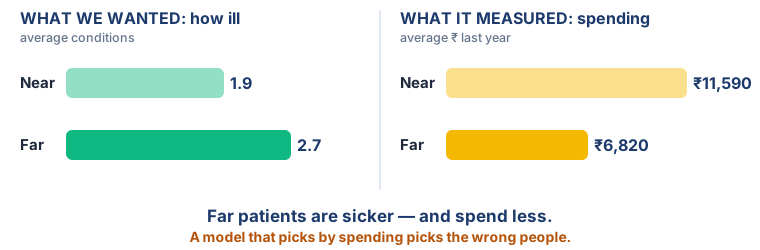
- The trap is a proxy. The model was meant to find illness but learned from spending, because spending was easy to count. Spending follows access — road, snow, bus fare — not just illness.
- Accurate about the wrong thing. It predicted spending very well, and no accuracy score will ever show you the mistake. Ask: what else makes this number go up or down?
Debate it
The hospital could keep the model and add a rule: "always include at least two Far patients." Or it could switch the model off and let a nurse choose.
- Which principle does the rule serve — and which might it still fail?
- A nurse has hidden factors too (Lesson 1.2). Is a person automatically fairer than a model?
Check yourself — practice, not a test
1. Match each principle to what it asks:
People can understand and take part in decisions about themselves · Avoid harm, and choose the path of least harm · Actively do the greatest good for all · Share benefits and burdens fairly, whatever a person's background
Match with: Justice · Beneficence · Non-maleficence · Respect for autonomy2. In the hospital case, what did the model learn from?
- ○ How ill each patient was
- ○ The patients' own answers to a survey
- ○ How much had been spent on each patient's care
- ○ The doctors' notes
3. A model that predicts spending very accurately is therefore a good way to find the sickest patients.
- ○ True
- ○ False
4. Intentionally causing harm is called ______.
5. Bioethics is used mainly in which field?
- ○ Agriculture
- ○ Healthcare and the life sciences
- ○ Banking
- ○ Transport
Remember
A model can be accurate about the wrong thing. Ask what the number really measures.