Class 10 · Unit 1: The project cycle, and ethical frameworks · Lesson 1.5 · 40 min
Applying a framework to our project
A kind idea, built to help children. Why did the team decide to stop?
Today you will: Run a real ethics review · Check data for consent and proxies · Decide: go ahead, change it, or stop
Story
Bilal's group has an idea they are proud of.
Bilal: “We use the school's own records — attendance, marks, how often homework comes in late. The model finds the students who are going to drop out, before they do. Then the teachers can help them.”
It is a kind idea. Their teacher says so. Then she hands them a single sheet of paper with six headings and says: "Before you collect anything, fill this in."
Twenty minutes later, Hiba puts her pen down. "We can't build it."
Hiba: “Why not? It's to help them.”
She points at heading four. "Because it watches children and gives each one a score. And because the thing we'd really be measuring is who has to stay home to help at harvest." She turns the sheet over. "But I think I know what we can build."
Watch
An ethics review, before the first byte — — scan code 10.1.5 in the printed book.
Warm up your fingers
Skill: sentences with punctuation (5 min)
-
On typing.com: the lesson your teacher sets.
-
Type three times, eyes on the screen:
Decision: change it. Reason: it scores children; we will use counts, not names. -
Goal this term: 38–44 WPM at 95%.
On the laptop
You need: LibreOffice Writer · ethics-review.odt · your Class 9 problems.ods
Mission 1: Choose a candidate (5 min, in your project group of 3–4)
- ☐1
The year project is a classifier you build and measure — a model that sorts photos, sounds or rows of data into classes. Pick one of the six ideas on the board, or your own.
- ☐2
Write it at the top of the review, with the Sustainable Development Goal it serves.
Mission 2: The review (20 min)
- ☐3
Fill all six headings, two or three lines each. Three rules keep it honest:
- Utility: write the exact thing your model will learn to get right — "sorts leaf photos into healthy and scab", not "helps farmers".
- The data: for every kind of data, write whose it is and whether it is about a person. Then the proxy check: what else makes this number go up or down?
- Where it could fail: name one season and one group of people.
- ☐4
Predict: alone, write go ahead, change it or stop on a scrap of paper. Then compare as a group.
- ☐5
Fill heading 6. Change it → write the new project in one line. Stop → write the problem you still care about, and another way to serve it.
Mission 3: Swap and challenge (5 min)
- ☐6
Swap with another group. Add one comment in a different colour: a question they missed, or a stakeholder they forgot. Swap back.
- ☐7
Save as
ethics-review-group-N.odtin the project folder. It is page one of your project.
Finished early?
Write one way your model could score well on its Utility line and still let down the people it is for. Unit 3 will teach you to measure that gap.
No laptop today?
Do the whole review on the printed sheet, swapping across desks. Type it up next lab period — it is page one of your project.
Now you know
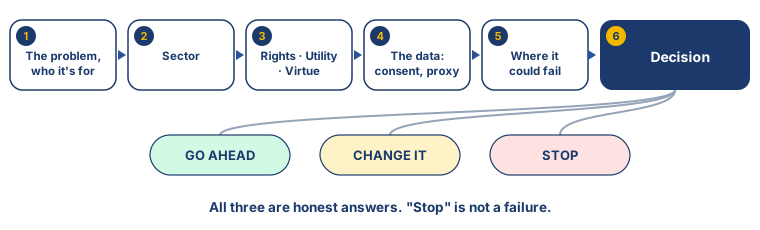
- Review before you build. At the review sheet, changing the project is free. After the data is collected, every change costs something — and harm may already be done.
- Use both kinds of framework: a sector-based one where it exists, and rights, utility and virtue everywhere.
- Write what the model optimises, in one line. If you can't write it, you don't yet know what you're building.
- Consent. Under India's DPDP Act, 2023, anyone under 18 is a child. A child's data needs a parent's verifiable consent, and children's behaviour must not be tracked or monitored.
- Proxy. For every number: what else makes it go up or down?
Debate it
The review stopped Bilal's model — but not the problem it was meant to solve.
- Name two ways the school could help children at risk of dropping out, with no model at all.
- When is not building an AI the most useful thing an AI team can do?
Check yourself — practice, not a test
1. Put the six headings of the ethics review in order:
- 1. The problem and who it is for
- 2. Where it could fail
- 3. Sector
- 4. Three value questions
- 5. Decision
- 6. The data
2. When is the best time to apply an ethical framework to an AI project?
- ○ After the model is deployed, when problems appear
- ○ After the model is trained, before it is tested
- ○ Before any data is collected
- ○ Only if something goes wrong
3. Which are honest decisions at the end of an ethics review? (choose all that apply)
- ○ Go ahead
- ○ Change it
- ○ Stop
- ○ Build it first and decide later
4. Under India's DPDP Act, a person aged 16 counts as a child.
- ○ True
- ○ False
5. A number used as a stand-in for what we really want to measure — like spending for illness — is called a ______.
Remember
Review before you build. "Change it" and "stop" are answers, not failures.