Class 10 · Unit 2: Modelling · Lesson 2.1 · 40 min
AI, ML and DL, and the words for data
The washing machine box says “AI”. Is it lying?
Today you will: Tell AI, ML and DL apart · Point to the features and the label · Say what training and testing data are for
Story
The new washing machine arrives at Bilal's house with a sticker across the front in gold letters: AI WASH.
Bilal: “It's intelligent. It knows how dirty the clothes are.”
Hiba: “How?”
Bilal: “A sensor. It measures how cloudy the water is, and if it's cloudy it washes longer.”
Hiba: “So somebody wrote a rule: cloudy means longer. Does it get better at washing after a year?”
Bilal reads the sticker again. "It doesn't say that."
Hiba: “Then it might be AI. But it isn't learning anything.”
Watch
Three circles, and the words for data — — scan code 10.2.1 in the printed book.
Warm up your fingers
Skill: column names, fast and exact (5 min)
-
On typing.com: the symbols lessons.
-
Type three times, eyes on the screen:
apple,weight_g,red_percent,sweetness_brix,shape_ratio,variety -
Underscores need Shift. Commas, no spaces. Goal this term: 38–44 WPM at 95%.
On the laptop
You need: LibreOffice Calc · ai-ml-dl.ods · datasets/apples.csv
Mission 1: Three circles (8 min, in pairs)
- ☐1
Open sheet Systems in
ai-ml-dl.ods. For each of the ten systems, write AI, ML or DL — the smallest circle it fits in. - ☐2
Use one question: does it get better from examples, or does it follow rules someone wrote? Rules only → AI. Learns from examples → ML. Learns from huge data, like photos or speech → DL.
Mission 2: The anatomy of a dataset (10 min, in pairs)
- ☐3
Open
apples.csvin Calc. - ☐4
Colour the feature columns blue and the label column yellow. Leave
applewhite — it is a name tag, not a feature. - ☐5
Predict: which one feature do you think best tells an Ambri from the other two? Write it in H1.
- ☐6
Sort by that feature and look down the
varietycolumn. Did the Ambris bunch together? Try one other feature and compare.
Mission 3: Training and testing (5 min)
- ☐7
Copy apples A01–A28 into a new sheet named Training, and A29–A36 into Testing.
- ☐8
Hide the
varietycolumn in Testing. You have just made unlabelled data. In H3, write why a model must never see the testing apples while it learns.
Finished early?
Invent a fifth feature a farmer could measure for every apple. Would it help tell the varieties apart — and would it be easy to collect for 36 apples?
No laptop today?
Your teacher reads the ten systems; the class shows one, two or three fingers for AI, ML or DL.
Then copy the first four rows of apples.csv from the board and label each column feature,
label or name tag.
Now you know
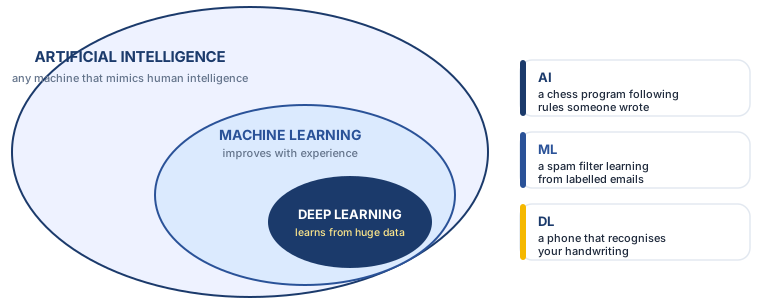
- AI is the umbrella. Any technique that lets a machine mimic human intelligence — even rules a person wrote.
- ML learns from experience. It improves at a task by learning from data, not from rules typed in.
- DL learns from huge data through many layers. It is how machines read handwriting and recognise faces.
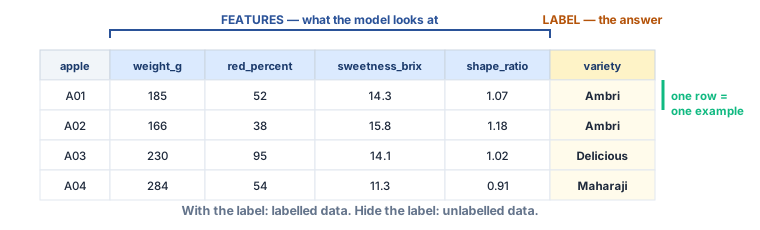
- Features and label. Features are the columns the model looks at. The label is the answer it must learn to predict.
- Labelled or unlabelled. Labelled data has the answer filled in; unlabelled data does not.
- Training and testing. Train on one set, like a teacher's worked examples. Test on another the model has never seen, like the class test.
Debate it
The washing machine's sticker says AI, and by CBSE's definition it is allowed to.
- Should a company be allowed to put "AI" on something that never learns? What would you want the sticker to say instead?
- Why might a company want the word on the box?
Check yourself — practice, not a test
1. Match each system to the smallest circle it fits in:
A chess program whose rules were typed in by its makers · A spam filter that learns from emails people marked as spam · A phone that learns to read handwriting from millions of samples
Match with: DL · AI · ML2. In apples.csv, what is variety?
- ○ A feature
- ○ The label
- ○ A name tag
- ○ The testing set
3. Deep learning is a kind of machine learning.
- ○ True
- ○ False
4. The examples a model learns from are called the ______ data set.
5. Why is the testing data kept away from the model while it learns?
- ○ It is too big to use
- ○ It has no features
- ○ So we can check the model on examples it has never seen
- ○ Testing data is always unlabelled
Remember
Features are what it looks at. The label is what it must learn to say.