Class 10 · Unit 2: Modelling · Lesson 2.4 · 40 min
Neural networks, and how AI makes a decision
Same sky, same forecast. Bilal goes to play cricket; Hiba stays home. Which of them is wrong?
Today you will: Build one neuron in a spreadsheet · Change its weights and change its mind · Be a node in a human neural network
Story
Saturday. The sun is out over the ground behind the school, but the forecast says rain by four.
Bilal: “I'm going. It's sunny now. I've got my jacket.”
Hiba: “I'm not. It says rain later, and I haven't got an umbrella.”
Bilal: “Same sky. Same forecast. One of us is wrong.”
Their teacher, passing, stops. "Neither of you is wrong. You're weighing the same things differently."
Watch
One neuron, then many — — scan code 10.2.4 in the printed book.
Warm up your fingers
Skill: a formula that multiplies two columns (5 min)
-
On typing.com: the symbols lessons.
-
Type three times, eyes on the screen:
=SUMPRODUCT(B2:B6;C2:C6) -
Goal this term: 38–44 WPM at 95%.
On the laptop
You need: LibreOffice Calc · neuron.ods
Mission 1: Build one neuron (8 min, in pairs)
- ☐1
Open
neuron.ods. Column A has the four questions and Bias. Column B is the input: 1 for yes, 0 for no. The bias input is always 1. Column C holds the weights: 3, −2, 1.5, 1, −2. - ☐2
Set Saturday's inputs: sunny 1, rain forecast 1, jacket 1, umbrella 0.
- ☐3
Predict: go or stay? Write it in E1.
- ☐4
In C8, add it all up:
=SUMPRODUCT(B2:B6;C2:C6). In C9, decide:=IF(C8>0;"GO";"STAY"). Were you right?
Mission 2: Same day, different weights (5 min)
- ☐5
You are now Hiba: more cautious. Change the bias weight from −2 to −4. Same inputs — what does the neuron decide now?
- ☐6
Find the smallest change to one weight that turns Hiba's STAY back into GO. Write it in E3.
Mission 3: The human neural network (15 min, whole class, away from the laptops)
- ☐7
Your teacher places 20 of you as a network: 7 in the input layer, 6 in hidden layer 1, 6 in hidden layer 2, and 1 in the output layer. Everyone else is an observer.
- ☐8
Only the input layer sees a picture. No talking, all game. Each node writes one word per chit and passes it forward, as your teacher explains.
- ☐9
The output node reads the chits and guesses the picture. Then the picture is revealed.
Finished early?
Online: open playground.tensorflow.org, press play, and watch a real network change its weights as it learns. What happens when you add a hidden layer?
No laptop today?
Do Parts 1 and 2 on the board: the class calls out 1s and 0s, and pairs do the multiplying on paper. Then play the human neural network with the whole period to spare.
Now you know
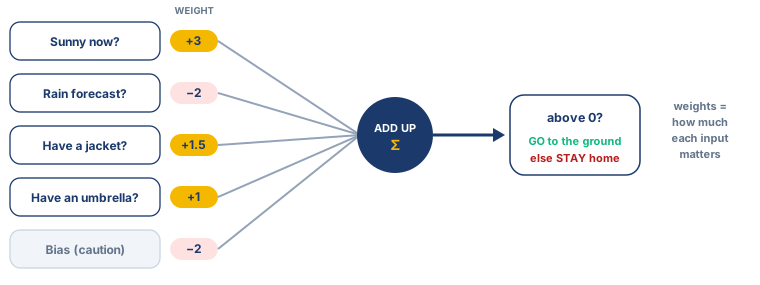
- A neuron weighs its inputs. Each input is multiplied by a weight — how much it matters — then everything is added with a bias and compared with a threshold.
- Different weights, different decisions. Bilal and Hiba saw the same sky. Their weights differed.
- A neural network is layers of neurons: an input layer, hidden layers that do the working, an output layer that answers.
- It learns by adjusting weights. It guesses, measures how wrong it was, and nudges every weight — thousands of times.
- Its big advantage: it finds useful features by itself, which is why it suits huge data like images. CBSE names ANN and CNN; CNNs are Unit 4.
Debate it
In the game, no single person knew the picture except the input layer, and nobody could explain how the output node reached its guess.
- A real network has millions of weights. Could anyone explain why it made one decision?
- If a network like that turned down your scholarship, what would you want to be told?
Check yourself — practice, not a test
1. Put the layers of a neural network in order, from data to answer:
- 1. Input layer
- 2. Output layer
- 3. Hidden layers
2. In a neuron, what does a weight say?
- ○ How heavy the input is
- ○ How much that input matters to the decision
- ○ How many inputs there are
- ○ Whether the answer is right
3. A neural network learns by adjusting its weights after its mistakes.
- ○ True
- ○ False
4. The kind of neural network built for images, which Unit 4 explores, is a ______ neural network.
5. Sunny 1, rain forecast 1, jacket 1, umbrella 0, with weights 3, −2, 1.5, 1 and a bias of −2. What is the total?
- ○ 2.5
- ○ 0.5
- ○ −1.5
- ○ 4.5
Remember
A neuron weighs. A network learns by changing its weights.