Class 10 · Unit 4: Computer vision · Lesson 4.1 · 40 min
What computer vision does
Your phone read a signboard in Urdu and spoke it in English. What did it have to *see* first?
Today you will: Name the four computer vision tasks · Match real systems to their task · Tell computer vision from image processing
Story
On Residency Road, Hiba's cousin from Delhi points her phone at a shop sign written in Urdu. The screen flickers, and English words appear on top of the Urdu, in the same place, the same size.
Hiba: “How does it do that?”
Bilal: “It's reading.”
Hiba: “Before it can read, it has to find the sign. Then find the letters on the sign. Then work out which pixels are letters and which are the wall.”
Her cousin looks at the phone again. "That's four jobs."
Hiba: “At least.”
Watch
Four things a machine can do with a picture — — scan code 10.4.1 in the printed book.
Warm up your fingers
Skill: a list of words, fast (5 min)
-
On typing.com: the lesson your teacher sets.
-
Type three times, eyes on the screen:
tasks = ["classification", "localisation", "detection", "segmentation"] -
Goal this term: 38–44 WPM at 95%.
On the laptop
You need: LibreOffice Calc · LibreOffice Draw · cv-tasks.ods · datasets/market.jpg
Mission 1: Twelve systems, four tasks (10 min, in pairs)
- ☐1
Open sheet Systems in
cv-tasks.ods. For each system, write which of the four tasks it mainly needs. - ☐2
Ask two questions: one object or many? and is a box enough, or does it need the exact outline?
- ☐3
Predict: which task will turn up most often? Write it in F1, then count.
Mission 2: Be the model (10 min)
- ☐4
Open
market.jpgin Draw — a photo of a fruit stall. - ☐5
Copy it four times on the page. On each copy, do one task by hand:
- Classification: type one label for the whole photo.
- Localisation: draw one box round the biggest apple.
- Detection: draw a box round every apple you can see. Count them.
- Segmentation: use the polygon tool to trace the exact outline of three apples.
- ☐6
Time yourself on the last one. How long did it take?
Mission 3: Vision or processing? (3 min)
- ☐7
In
cv-tasks.ods, sheet Which: six things a phone does to photos. Mark each CV or image processing.
Finished early?
Find one thing in your own home that uses computer vision. Which task does it use?
No laptop today?
Your teacher reads the twelve systems; show 1, 2, 3 or 4 fingers for the task. Then take the printed stall photo and do Part 2 with a pencil: one label, one box, every box, three outlines.
Now you know
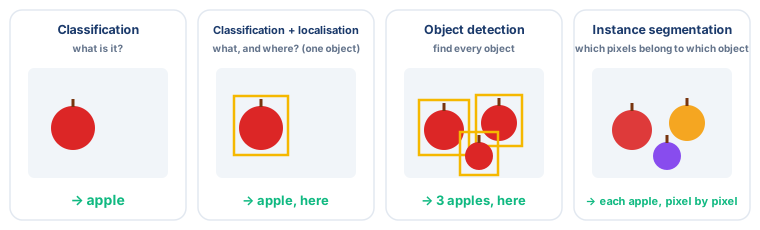
- Computer vision lets a machine take in images and video and make sense of the pixels.
- Classification: one label for the whole image.
- Classification + localisation: the label and a box — one object only.
- Object detection: a box round every object of each kind.
- Instance segmentation: every pixel labelled with its object — the exact outline.
- Image processing changes a picture; computer vision understands it.
Debate it
A camera at a traffic junction in Srinagar can detect every face that passes.
- Which task is that? What could it be used for that helps people — and what could it be used for that harms them?
- Who should decide whether such a camera is allowed? (Unit 1: which framework would you use?)
Check yourself — practice, not a test
1. Match each output to its task:
"This photo shows a leaf." · "The leaf is here" — one box · A box round every car in the street · Every pixel of each car coloured separately
Match with: Object detection · Classification + localisation · Instance segmentation · Classification2. Which task is used for only one object?
- ○ Object detection
- ○ Classification + localisation
- ○ Instance segmentation
- ○ All of them
3. Making a photo brighter is computer vision.
- ○ True
- ○ False
4. The smallest unit of a digital picture, which CV collects information from, is a ______.
5. A self-driving car must know where every person on the road is. It needs at least:
- ○ Classification
- ○ Object detection
- ○ Image processing
- ○ A bigger camera
Remember
Classify it, box it, find them all, outline each one.