Class 10 · Unit 5: Natural language processing · Lesson 5.1 · 40 min
Why language is hard, and the stages of NLP
“His face turned red.” Angry? Embarrassed? Sunburnt? You knew at once. A machine has five stages to get through first.
Today you will: Say why human language is hard for machines · Name NLP's everyday uses · Walk a sentence through the five stages of NLP
Story
Hiba's grandmother speaks Kashmiri, her mother answers in Urdu, and Hiba replies in English, all in one conversation at dinner. Nobody at the table notices.
Grandmother: “Pass the salt.” (in Kashmiri.)
Hiba: “Can you reach the salt?” (Bilal, in English.)
Bilal, visiting, says: "Yes." And doesn't move.
Everyone laughs. Bilal goes red.
Bilal: “He wasn't being rude. He answered the question I asked. Not the one I meant.” (Hiba explains later.)
Bilal: “That, is exactly what a computer would do.”
Watch
Five stages to understanding — — scan code 10.5.1 in the printed book.
Warm up your fingers
Skill: a sentence with quotation marks (5 min)
-
On typing.com: the lesson your teacher sets.
-
Type three times, eyes on the screen:
"Can you reach the salt?" she asked. He said, "Yes." -
Goal this term: 38–44 WPM at 95%.
On the laptop
You need: LibreOffice Calc · nlp-stages.ods
Mission 1: Where does it break? (10 min, in pairs)
- ☐1
Sheet Sentences: ten sentences. Each one is fine up to some stage of NLP — and then breaks.
- ☐2
For each, write the first stage it fails at: lexical, syntactic, semantic, discourse or pragmatic. If it passes all five, write all fine.
- ☐3
Predict first: which stage do you think will catch the most sentences?
Mission 2: One word, many meanings (7 min)
- ☐4
Sheet Words: bank, light, fair, bat, left, spring. For each, write two sentences that use it with different meanings.
- ☐5
Then one from your own languages: a Kashmiri or Urdu word with two meanings. Write both.
Mission 3: NLP around you (6 min)
- ☐6
Sheet Uses: the six applications CBSE names. For each, write one real example you have seen or used, and one thing it gets wrong for people in the valley.
Finished early?
Write one sentence that passes the first four stages and fails only the fifth — it means something different from what it says. Try it on a partner.
No laptop today?
Your teacher reads the ten sentences aloud. The class holds up 1 to 5 fingers for the stage each breaks at, and argues the close ones. Then pairs write the two-meaning sentences on paper.
Now you know
- Natural language is hard for machines: one word has many meanings, context changes everything, and people break grammar and still understand each other.
- NLP lets machines read, understand and produce human language — voice assistants, captions, translation, sentiment analysis, spam filters, keyword extraction.
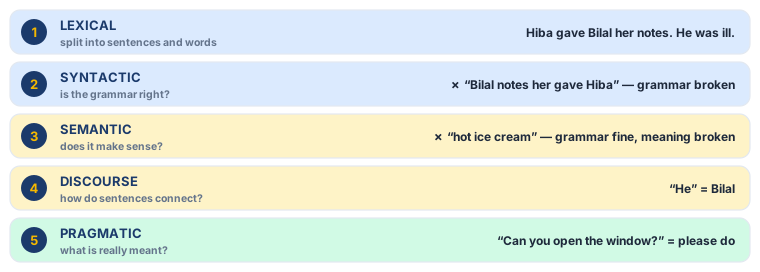
- Five stages: lexical (split it) → syntactic (grammar) → semantic (meaning) → discourse (connect the sentences) → pragmatic (what was really meant).
- Grammar isn't meaning. "Hot ice cream" passes syntax and fails semantics.
- Meaning isn't intention. "Can you reach the salt?" passes semantics — and still needs pragmatics.
Debate it
Most NLP systems are trained mainly on English. Kashmiri has far less written text for a model to learn from.
- What happens to a Kashmiri speaker who asks a voice assistant for help? (Class 9 called this a problem of access and bias together.)
- Who should build NLP for languages like Kashmiri — and who should decide how it is used?
Check yourself — practice, not a test
1. Put the five stages of NLP in order:
- 1. Discourse integration
- 2. Syntactic analysis
- 3. Pragmatic analysis
- 4. Semantic analysis
- 5. Lexical analysis
2. "Hot ice cream" has correct grammar but no sensible meaning. Which stage rejects it?
- ○ Lexical
- ○ Syntactic
- ○ Semantic
- ○ Pragmatic
3. Working out that "he" in the second sentence means Bilal is:
- ○ Lexical analysis
- ○ Discourse integration
- ○ Syntactic analysis
- ○ Tokenisation
4. Pragmatic analysis finds the intended meaning, not just the literal one.
- ○ True
- ○ False
5. Which are applications of NLP? (choose all that apply)
- ○ Automatic captions on a video
- ○ Translating a signboard's text
- ○ Sorting reviews into positive and negative
- ○ Brightening a photo
Remember
Split, check the grammar, check the meaning, connect it, then ask what was meant.